
Politics
‘Slap in the face’: Survivor of sexually explicit deepfakes lashes out over Republicans stalling on AOC’s AI crimes bill
Key Points
‘Slap in the face’: Survivor of sexually explicit deepfakes lashes out over Republicans stalling on AOC’s AI crimes bill The measure would hold perpetrators and Big Tech accountable for pornographic deepfake images and other online harms. Rhian Lubin and Eric Garcia report on survivors’ frustrations with Republicans stalling on a bipartisan bill brought by AOC, as Paris Hilton exclusively tells The Independent ‘there is no legitimate policy reason’ for the hold-up - Bookmark - CommentsGo to...
‘Slap in the face’: Survivor of sexually explicit deepfakes lashes out over Republicans stalling on AOC’s AI crimes bill
The measure would hold perpetrators and Big Tech accountable for pornographic deepfake images and other online harms. Rhian Lubin and Eric Garcia report on survivors’ frustrations with Republicans stalling on a bipartisan bill brought by AOC, as Paris Hilton exclusively tells The Independent ‘there is no legitimate policy reason’ for the hold-up
- Bookmark
- CommentsGo to comments
Sitting in her car one morning before work, Sabrina Javellana was frantically scrolling through photos of herself online that someone anonymously sent her a link to, with an ominous warning of their explicit content.
As she sifted through the dozens of images, posted on 4chan, she came across one that made her freeze.
“I recognized one from when I was 17 in high school, just taking a cute picture in a mirror of my outfit, about to go hang out with my friends…except my clothes were totally removed,” she recalled.
“It was the same exact photo, except they used this AI-generated technology to remove my clothes, and it looked hyper-realistic. But I knew this wasn't real. From that day on, my world turned upside down.”
Javellana was 23, working in local politics in Florida, when she fell victim to AI deepfake pornography in 2021, which she describes as an act of sexual violence.
With the unstoppable rise of AI technology, it has never been easier for perpetrators to create and share nonconsensual sexually explicit deepfakes. The estimated number of deepfakes rose from approximately 500,000 in 2023 to 8 million in 2025, according to analysis. And 99 percent of deepfakes target women.
Still, it remains unclear how serious tech bosses are about tackling the problem. OpenAI CEO Sam Altman appeared unaware of the latest deepfake bill being pushed by lawmakers on both sides of the aisle when The Independent quizzed him on it in Washington, D.C. recently, while Elon Musk’s xAI is suing Minnesota over its attempts to ban so-called “nudification” apps in the state.
Momentum to tackle nonconsensual sexually explicit deepfakes by the U.S. government had been picking up steam after Congress passed the TAKE IT DOWN Act last year. It prohibits the publication of authentic and AI-generated sexual images published without a person’s consent, and requires online platforms to remove them within 48 hours of a complaint.
The DEFIANCE Act would allow victims to file civil lawsuits against people who produce, distribute, and solicit nonconsensual deepfake AI pornography, as well as those who intend to distribute such images.
It was cleared the Senate by unanimous consent in January but is languishing in the House, with time running out. The bipartisan bill, introduced by New York Democratic Rep. Alexandria Ocasio-Cortez and co-sponsored by Republican Rep. Laurel Lee of Florida.
But some Republicans, it seems, do not want to hand Ocasio-Cortez a win so close to the midterms in November, when she is up for election.
When The Independent recently asked Ocasio-Cortez about the GOP lawmakers reportedly blocking the bill because her name is attached to it, her response was blunt. “I don't think that we should be emboldening child pornographers and helping abusers just because of some personal beef that they may have,” she said.
Ocasio-Cortez said that she would welcome the assistance of first lady Melania Trump, who supported the TAKE IT DOWN Act.
“I think that this is a really great opportunity, just as we have in the House, to be able to champion and for women to uplift one another across party lines,” she told The Independent.
Javellana, a Democrat, said the issue transcends party politics and described the blockage as “petty.”
“It feels like a slap in the face to the women and girls who have spoken so bravely to tell their stories,” Javellana, 28, told The Independent. “This is not about making AOC's star even brighter.”
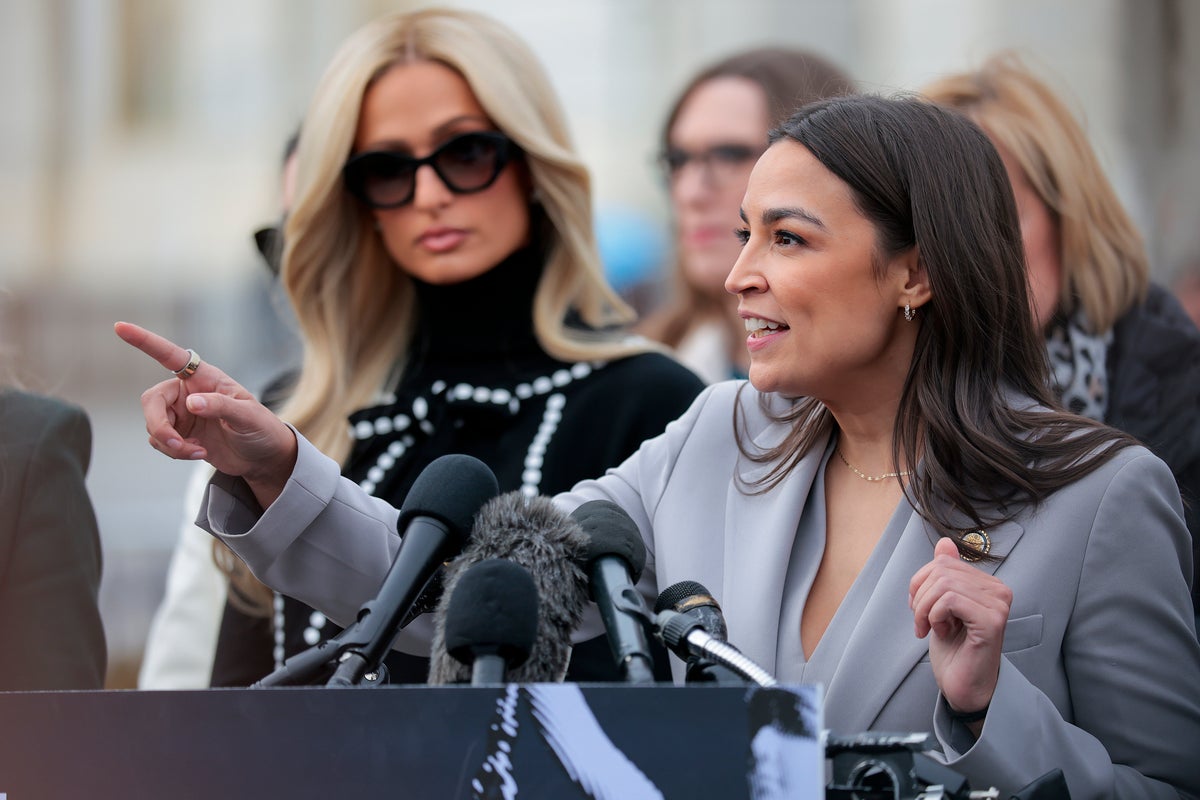
At a January press conference, Ocasio-Cortez teamed up with Paris Hilton, where the pair spoke of what it feels like to be a victim of deepfake AI pornography. Hilton said that more than 100,000 deepfake images of her exist online and has urged lawmakers to pass the DEFIANCE Act.
“Every day the DEFIANCE Act isn’t put on the calendar in the House, more women and girls become victims without a meaningful path to justice,” Hilton exclusively told The Independent in an emailed statement.
I felt fear for my family, my home; I purchased a firearm. It impacted my stress, my health, everything. It crushed me to step away, but I had to for my sanity, for my survival, for my health, for my safety
Hilton added that there is “no legitimate policy reason” for the bill to be stalled and hit out at Rep. Jim Jordan, Chairman of the House Judiciary Committee. “Representative Jim Jordan and House leadership have an opportunity to protect millions and send a clear message that people who knowingly create or distribute nonconsensual explicit deepfakes to cause harm will be held accountable,” Hilton said.
The Independent contacted Jordan’s office for comment.
As AI technology advances at pace, the law is yet to catch up on holding perpetrators and Big Tech accountable for sexually explicit deepfakes and other online harms. And while the DEFIANCE Act “isn’t perfect,” Javellana said, introducing civil penalties provides victims with “more tools in the toolbox.”
In 2018, then aged 21, Javellana became one of the youngest elected officials in Florida when she won a seat on the Hallandale Beach city commission in Broward County, located between Miami and Fort Lauderdale. The young politician threw herself into issues she cares about deeply, which her critics deemed progressive.
“I'm speaking about climate change, I'm speaking about police reform, I'm speaking about government corruption,” she said.
The online abuse soon followed. “Because I was outspoken, because I was a young woman and an easy target,” Javellana said.
Everything changed on the day she received the first AI deepfake, depicting her nude. More popped up, and still do to this day, she said. “It’s not just the photos, but the comments from all these anonymous users. I would do her, I would rape her... just disgusting, vulgar comments.”
She served her four years in office but decided not to run for re-election following the ordeal.
“I felt fear for my family, my home; I purchased a firearm,” she said. “It impacted my stress, my health, everything. It crushed me to step away, but I had to for my sanity, for my survival, for my health, for my safety.”
She had limited options for recourse but reached out to the Florida Department of Law Enforcement and consulted with a New York-based attorney. Due to a lack of state and federal legislation about AI deepfakes at the time, neither resulted in any morsel of justice. It was baffling to Javellana that what happened to her did not constitute a crime.
“It wasn't illegal to do this to people, to take their own likeness and make it into a new nude image and put their face on it and destroy their life, their career,” she said. “I totally lost my sense of self. I felt like I had no agency over my own body…I felt like this was a new form of sexual violence.”
Javellana suffered in silence for a year, not wanting to tell her family or friends about the images.
“It felt like a losing battle,” she said. “I decided maybe no one will ever see these. I'll never talk about it to anyone. I'll just, you know, compartmentalize it and try to move on with my life.”
Then, in January 2022, then-Florida Democratic state senator Lauren Book introduced a bill making it a felony to create sexually explicit deepfakes without consent. Book went public with her own experience where she was blackmailed with sexually explicit deepfake AI images.
Javellana reached out to Book to share her story and testified about her ordeal in the Florida Senate, marking the beginning of her public fight for women and girls. “I reached out to [Book’s] office and I told her, ‘Hey, this happened to me, and I want to help support your bill and make sure it gets passed.’”
With Javellana’s help, the Florida bill was swiftly signed into law by Governor Ron DeSantis. She hopes the DEFIANCE Act will follow suit, stressing that federal lawmakers can’t afford to delay.
Prince Harry and Meghan are the latest high-profile names to back the bill. The couple criticized House lawmakers given the bill has been passed by the Senate.
“This begs the question: why the delay?” a release last week from the Duke and Duchess of Sussex asked. “The answer may lie in the deepest offense to families and children: the tech industry’s commitment to pushback on these bills to protect their bottom line.”
It isn’t only high-profile women and girls who are being targeted, as instances of deepfakes are cropping up more and more in schools, an issue Hilton has also raised.
“Around 99 percent of nonconsensual explicit deepfakes target women. But anyone can become a victim,” she told The Independent. “These AI tools and nudification apps are becoming cheaper, faster, and easier to use. All it takes is a single photo, and within seconds a coworker, stranger, classmate, or ex-partner can create realistic explicit images that can devastate someone’s reputation, career, relationships, and mental health.”
Javellana added: “Big tech has started this revolution where it's growing so fast, our laws are not catching up to it. It's going to continue to grow, impacting women and girls in all different aspects of life, not just public figures, politicians, celebrities. It's impacting more and more every single day, [including] girls in school.”
The bill is flailing even though it enjoys the support of House Speaker Mike Johnson as well as right-wing firebrands like GOP Reps. Nancy Mace of South Carolina and Anna Paulina Luna of Florida, in addition to progressive Democrats like Reps. Jamie Raskin of Maryland and Ro Khanna of California.
It has not so much as come up for a vote in the Judiciary Committee - which handles legislation relating to legal affairs and votes on whether to put a bill on the House floor - which is galling to many survivors.
“AOC is a very powerful force, but it's so much bigger than her,” Javellana said. “And I know that these [Republican] leaders see that. It would be a win for them just as much as for her, as for President Trump.”
“This is common sense and to survivors, to victims...it's upsetting.”
But Javellana and other advocates remain confident that the DEFIANCE Act will become law. She is already looking ahead to the next fight.
“We're still not going to be done because this is still very reactive and not preventative,” she said of the bill. “And the preventative is once we start talking big tech, once we start talking about holding the platforms liable.”
“They are not good at all about responding to inquiries and reports of people asking to take this [content] down or regulating their users,” she added.
Indeed, when The Independent asked OpenAI CEO Sam Altman for his take on the DEFIANCE Act last week, he said he was “unfamiliar” with it. This was the same week the entrepreneur was in Washington, D.C., to talk with lawmakers about AI policy.
Javellana doesn’t believe she will ever discover the identities of the people who created the deepfake pornographic images of her, but whatever happens, she won’t be silent anymore.
“I wanted to hide for a while, but you know what? I can't do that,” she said. “That's letting them win.”
If you need support, call the Rainn National Sexual Assault Hotline at 800-656-HOPE (4673) or visit rainn.org
Join our commenting forum
Join thought-provoking conversations, follow other Independent readers and see their replies
Comments