
Politics
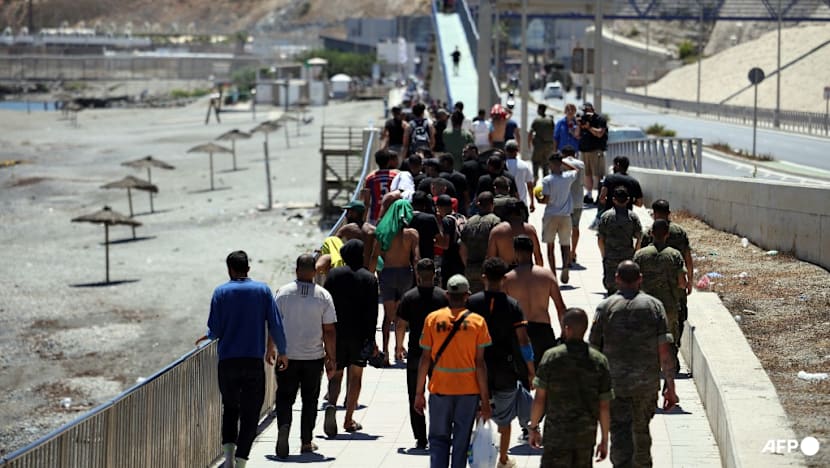
Migrant children risk abuse on streets of Ceuta, aid groups warn
Key Points
Migrant children risk abuse on streets of Ceuta, aid groups warn CEUTA: Hundreds of unaccompanied children are at risk of abuse and exploitation as they sleep rough on the streets of Ceuta after taking part in the mass migrant entry into the Spanish territory a week ago, aid groups warned on Thursday (Aug 6). Although most of the crowds of migrants have returned across the border to Morocco, authorities are struggling to find shelter for Moroccan children remaining in the Spanish enclave,...
Migrant children risk abuse on streets of Ceuta, aid groups warn
CEUTA: Hundreds of unaccompanied children are at risk of abuse and exploitation as they sleep rough on the streets of Ceuta after taking part in the mass migrant entry into the Spanish territory a week ago, aid groups warned on Thursday (Aug 6).
Although most of the crowds of migrants have returned across the border to Morocco, authorities are struggling to find shelter for Moroccan children remaining in the Spanish enclave, who cannot be summarily deported.
Jose Miguel Morales, head of Federacion Sur Acoge, a migrant rights and assistance group based in southern Spain, said some children living on the streets had been beaten and assaulted.
"Every day that passes without a solution and without safe accommodation means leaving these children - especially these girls - exposed to all kinds of abuse," he told Spanish public television.
"We are talking about real children - 10 years old or younger in some cases. Many are under 14."
The charity Save the Children has called for urgent efforts to register all minors, warning that girls in particular face "heightened risks of violence, trafficking and exploitation".
SLEEPING ROUGH
Spain's government said on Wednesday that around 70,000 of the 72,000 migrants who entered Ceuta from Morocco on Jul 30-31 had since returned, leaving about 2,000 behind.
The opposition-run city administration said the number was higher and that it included more than 1,000 unaccompanied minors.
AFP reporters in Ceuta in the days following the influx saw unaccompanied children suffering limited access to food, water, shelter and sanitation.
Groups of youths and men from sub-Saharan Africa could be seen on Thursday gathering in wooded areas and on a beach in the city.
One small group kicked a football near a police van as officers watched, while others prayed on the sand.
Some napped on a beach with their faces shielded from the sun by plastic bags or T-shirts.
Shoes, water bottles and small bundles of belongings lay beside them, highlighting the lack of permanent accommodation.
Other migrants took to sleeping on the streets of residential areas away from the centre of Ceuta as the territory's reception facilities struggled to cope.
Many lay waiting outside the migrant reception centre, which authorities closed because it was full.
"COMPLETELY OVERWHELMED"
Ceuta authorities said there were around 1,100 children needing attention in the city, which had a theoretical capacity of 90 places.
"Our capacity has been completely overwhelmed," Ceuta's vice-president Alejandro Ramirez told private television channel La Sexta on Thursday, describing the situation as "unsustainable".
Authorities were working "at full speed to set up emergency facilities" in schools and warehouses to provide shelter for the children, he added.
Children sleeping rough were relying on charities and local residents for food and other basic supplies.
Morocco has committed "to working on identifying unaccompanied minors with a view to their return to the homeland", a Moroccan diplomatic source told the official Moroccan news agency MAP on condition of anonymity.
But these partners must "transcend the obstacles that their legislation and their administrative and judicial authorities place in the way of this operation", the source said.
Luna Blanca, a Ceuta-based charity providing food and social assistance to vulnerable people, said it had been distributing between 3,500 and 4,000 meals a day since the influx began.
"The first three days were extremely difficult - no food, no water, nothing. Things started to get a little better yesterday," Reda Saed, a migrant from Egypt who entered Ceuta, told AFPTV.
"FULFIL OUR DREAMS"
Socialist Prime Minister Pedro Sanchez's government said on Tuesday it had approved 25 million euros (US$29 million) in funding for Ceuta to help support unaccompanied minors.
The redistribution of children to other parts of Spain under existing legal provisions faced resistance from regions governed by the opposition conservative Popular Party and the far-right, anti-immigration Vox party.
Vox officials in the regions of Andalusia and Extremadura warned on X that they would oppose the transfer of migrant minors from Ceuta to their territories.
Vox leader Santiago Abascal criticised the government's funding for the minors, writing on X that "not one euro from Spaniards" should go "for illegals, for invaders".
Migrants in Ceuta told AFP they had come to escape poverty. Researchers also told AFP they had detected false rumours on social networks that the border had been opened.
At least 80 people died on the Spanish side of the frontier during the main rush as migrants swam into Ceuta, according to Spanish authorities. Moroccan authorities said 11 people died on their side.
"We want to reach Europe and fulfil our dreams and those of our families," Ahmad, a migrant from Yemen, told AFPTV.