
Science
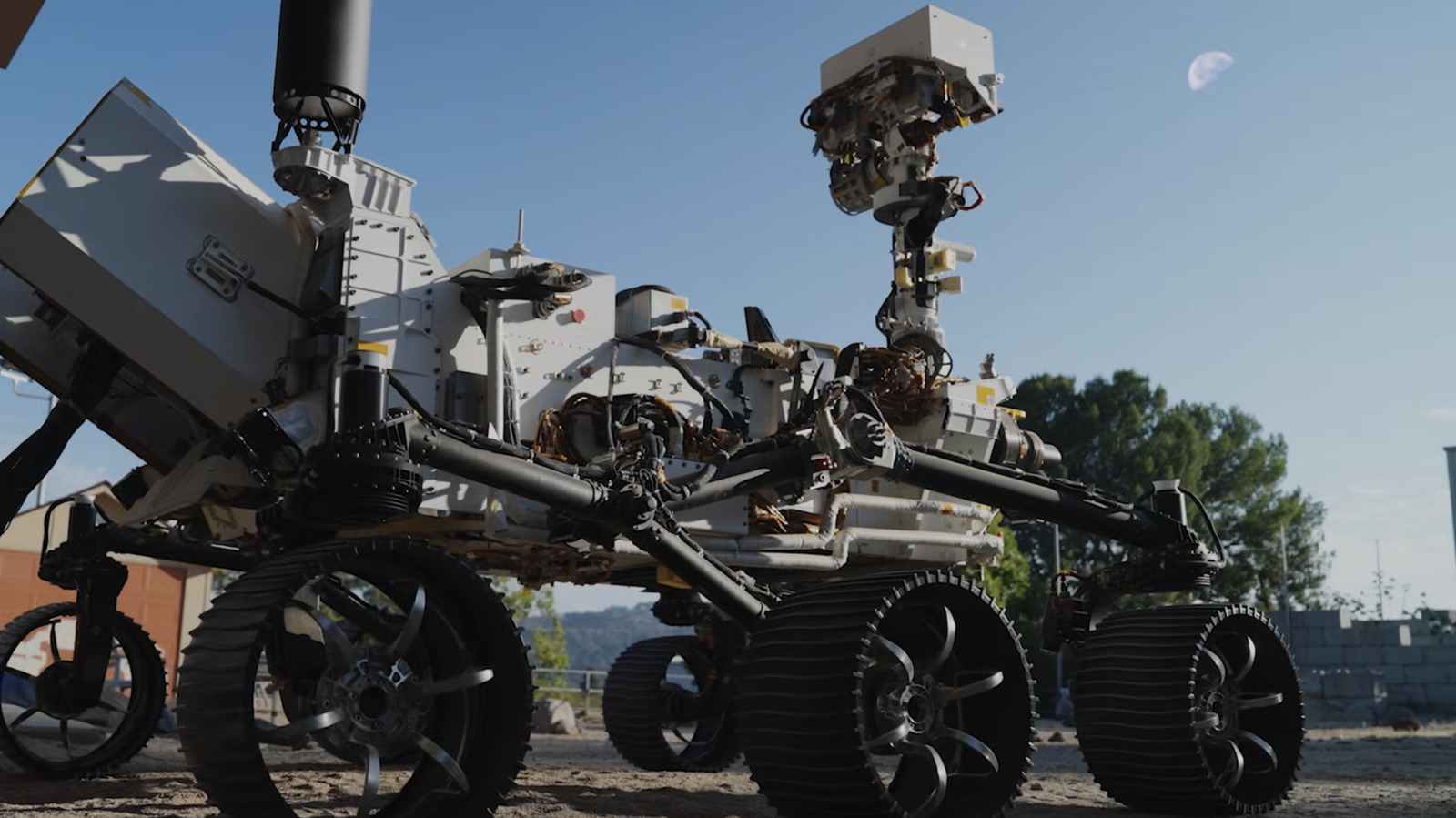
One of NASA's Mars rovers could find itself promised to the moon instead
Key Points
One of NASA's Mars rovers could find itself promised to the moon instead And it could explore all areas, regardless of illumination. Did you know that Curiosity and Perseverance have full-scale replicas here on Earth, which scientists use to test features and updates before beaming them up to the Mars rovers? They were built to stay here on Earth as testbeds for the Martian vehicles, but now NASA is planning to send one of them — or a hybrid of the two — to the moon.
One of NASA's Mars rovers could find itself promised to the moon instead
And it could explore all areas, regardless of illumination.
Did you know that Curiosity and Perseverance have full-scale replicas here on Earth, which scientists use to test features and updates before beaming them up to the Mars rovers? They were built to stay here on Earth as testbeds for the Martian vehicles, but now NASA is planning to send one of them — or a hybrid of the two — to the moon.
PROMISE the rover
In late June, NASA announced a new proposal to send a rover called PROMISE, which is short for Polar Rover for Observation, Mapping and In-Situ Exploration, to the lunar surface. According to Ars Technica, the BBC and the Carl Sagan-founded NGO, The Planetary Society, it will be the repurposed version of Perseverance's engineering test model. The video NASA released about the project also showed Perseverance's landing on Mars, before cutting to show its replica here on Earth. However, NASA's announcement calls the new vehicle a "hybrid" of the engineering versions of the Perseverance and Curiosity rovers, so it will possibly bear characteristics from both.
Before being renamed as PROMISE, Perseverance's test model used to be called Operational Perseverance Twin for Integration of Mechanisms and Instruments Sent to Mars, or OPTIMISM for short. "We've had years now of experience operating the two rovers on the surface of Mars, and we've got this hardware that the taxpayers have invested a lot in," NASA administrator Jared Isaacman said during an update about the agency's moon base plans. "So the question was posed: 'What if we send it to the moon?' ... It's going to bring an immense capability to the lunar south pole in short order."
NASA plans to use PROMISE to scout the lunar south pole, which is a potential location for future lunar bases due to the abundant water ice in the area, and to characterize the lunar surface and subsurface. It will come equipped with a multi-mission radioisotope thermoelectric generator (MMRTG), which uses plutonium as fuel. The generator converts heat from the natural decay of the plutonium into electricity. That means PROMISE wouldn't need the sun at all to explore the moon and achieve its goals.
"For moon-based objectives, having a nuclear RTG on it allows us to go anywhere we want, regardless of the illumination," said Carlos García-Galán, the program manager for the Moon Base project. "Surviving the lunar night is going to be one of the bigger challenges with this capability; we wouldn't have to worry about that."
So, when will we see PROMISE head to the moon?
Well, it depends on a lot of factors. Not to mention, PROMISE is still a concept at this point. OPTIMISM is not ready for flight and has to undergo numerous tweaks and upgrades before it can become a functional lunar rover.
NASA has yet to reveal what it has to do to make the rover ready for the mission. But according to The Planetary Society, the vehicle doesn't have sensors to control onboard temperature, flight-ready scientific instruments, a communications system or a generator yet. Further, its components aren't rated to be able to withstand abrasive, razor-sharp lunar dust. In other words, it has to undergo an extensive upgrade to be ready for the moon.
The NGO believes PROMISE would cost NASA between $700 million and $1.3 billion, and that it wouldn't launch until sometime in the early 2030s.
NASA (ORG)
Mars (LOCATION)
Earth (LOCATION)
Martian (ORG)
Ars Technica (ORG)
Carl Sagan (PERSON)
NGO (ORG)
The Planetary Society (ORG)
Perseverance (ORG)
Curiosity (ORG)
Operational Perseverance Twin for Integration of Mechanisms and Instruments Sent (ORG)
Jared Isaacman (PERSON)
MMRTG (ORG)
RTG (ORG)
Carlos García-Galán (PERSON)