
Weather
Drought and scorching heatwaves threaten Europe’s vision of a nuclear-powered future
Key Points
Drought and scorching heatwaves threaten Europe’s vision of a nuclear-powered future Nuclear power offers Europe a reliable way of powering itself without laying waste to the planet. But hotter summers and a changing climate are interfering with how it works, writes James C. Reynolds - Bookmark - CommentsGo to comments It is an image that somehow captures the crisis of Europe’s present and future: a smouldering wildfire burning on grassland just two miles from a nuclear plant. More than 100...
Drought and scorching heatwaves threaten Europe’s vision of a nuclear-powered future
Nuclear power offers Europe a reliable way of powering itself without laying waste to the planet. But hotter summers and a changing climate are interfering with how it works, writes James C. Reynolds
- Bookmark
- CommentsGo to comments
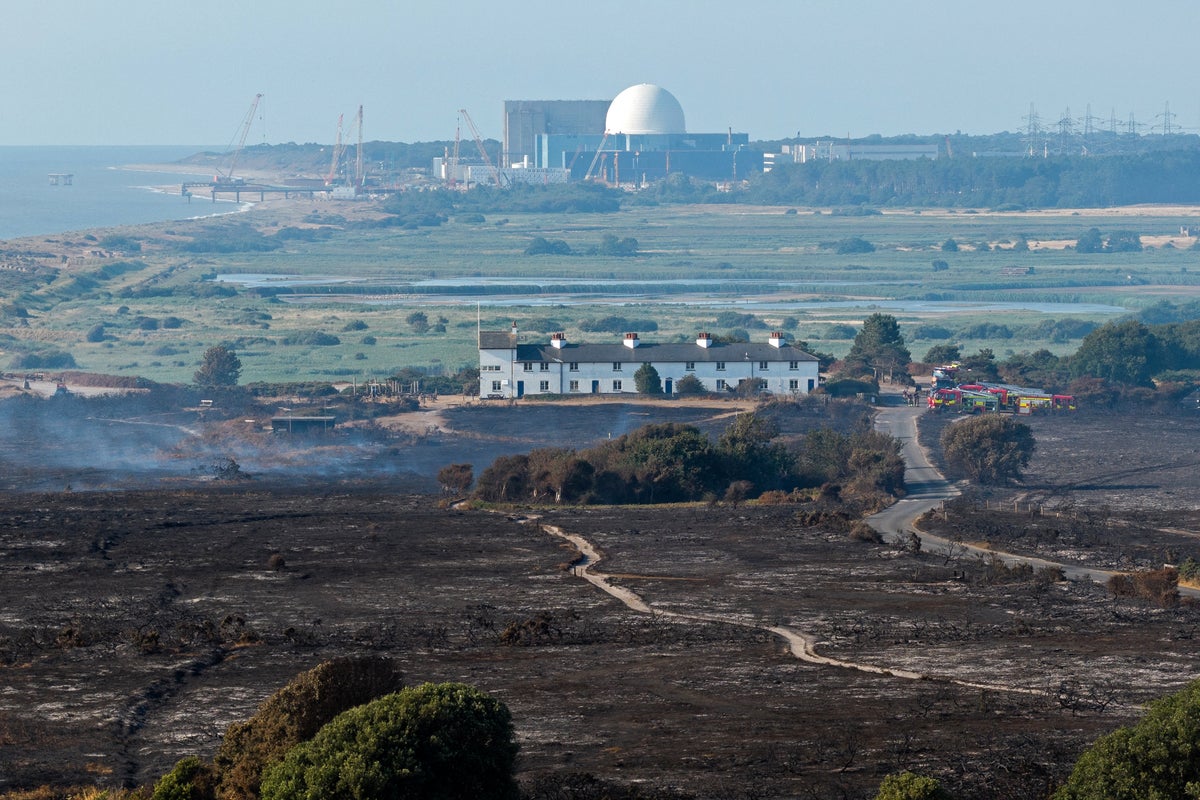
It is an image that somehow captures the crisis of Europe’s present and future: a smouldering wildfire burning on grassland just two miles from a nuclear plant.
More than 100 firefighters were called in to tackle the blaze sweeping through Dunwich Heath on the Suffolk coast at the end of July, which lies just north of the Sizewell B nuclear plant that powers up to 2.5 million British homes. The fire tore through the equivalent of 210 football pitches on the Suffolk coast before it was extinguished.
Across the continent, wildfires have been much more severe and widespread. Spain and France have seen tens of thousands of acres of land scorched over the last month, and nearly a quarter of a million people were forced from their homes. The Independent saw first-hand how communities have been torn apart as France recorded its hottest July on record.
It has left Europe in a bind. The continent urgently needs nuclear power to combat climate change; but extreme heat, drought and wildfires pose huge challenges for the transition.
As climate change brings hotter and more deadly summers, nuclear plants drawing water from drying rivers are struggling to keep their low-carbon nuclear fleets fully operational, resulting in outages and desperate moves to import electricity at a premium.
Heatwaves shut down nuclear plants
France had to close three reactors just last week after drought conditions cut flows in its rivers, while record-low waters levels on the Danube pushed Hungary to shut its sole nuclear plant, stretching power supply capacity to its limits.
Romania, meanwhile, blew up huge rocks and sank weighted barges in an effort to divert cooling water towards its nuclear plant on the Danube, after having to close one of two reactors last week. And Slovenia began reducing reactor output due to high temperatures and low flows on the Sava River. Serbia saw output at its largest hydropower plant fall to just 20 per cent of capacity, pressing the government to import electricity from abroad.
Experts say that while nuclear energy remains one of the most reliable and cost effective means of energy production, heat and drought linked to the climate crisis will create challenges for European nations to tackle in order to ensure a resilient grid ready for the future.
The European Union depends on nuclear power for about one quarter of its electricity needs and a third of its low-carbon electricity. That share has steadily risen since 2022, growing by nearly five per cent between 2023 and 2024 alone. And in March, the EU announced a further €330 million of investment to accelerate fusion energy and support nuclear technologies and skills.
It has taken decades for the continent to ease public concern about nuclear power. Incidents such as the Three Mile Island meltdown in 1979 and Chernobyl in 1986 encouraged caution and anti-nuclear movements in countries like Germany, which phased out its fleet in favourable of renewables, leaving a space for Russian energy imports until the invasion of Ukraine.
Steadily, opposition to nuclear power has grown quieter in Europe and stations today span from Torness, east of Edinburgh, to Odesa in Ukraine, and Almaraz in central Spain to Loviisa in Finland. That pivot has helped deliver a relatively cost-effective and continuous source of power with a low carbon footprint. But rising temperatures in Europe, driven by the climate crisis, still creates obstacles for swathes of the European fleet.
Why drought hits nuclear plants so hard
“We need abundant carbon-free electricity to limit climate change, even as climate change makes some of that electricity harder to produce,” explained Dr Katy Huff, professor of nuclear engineering at the University of Wisconsin-Madison.
Dr Huff, who served as assistant secretary for the Office of Nuclear Energy under the Biden administration, told The Independent that the problem brought by climate change is twofold.
First, low river levels brought by drought mean that nuclear plants struggle to take as much water as they need to cool down. Second, when temperatures are already high, there are restrictions on how much warm water the plants can discharge back into the river to avoid making it hotter.
“The latter limits can sometimes be relaxed temporarily with ecological monitoring, but regulatory waivers can’t fix a lack of water volume,” she said.
Rest assured, nuclear power stations will not go into meltdown if gets too hot, and a reactor cannot detonate like a bomb. But turning them off in countries such as Hungary, which depends on its station for 40-50 per cent of its power, can result in drastic consequences like limits on consumption and importing expensive electricity from outside.
Dr Huff said that these conditions are not unique to nuclear power: heat impacts fossil fuel plants in much the same way as it does nuclear reactors. In Serbia, water shortages have created problems at cooling systems in coal plants. Drought also affects hydropower and heatwaves affect the efficiency of solar panels and wind turbines.
What can Europe do?
In the future, reactor cooling will have to account for heatwaves driven by climate change, says Henry Preston, spokesperson for the World Nuclear Association. He pointed to the UAE’s adoption of a special deep sea water intake to ensure year-round cool temperatures. Others already use liquid sodium instead of water as a coolant.
Volodymyr Kholosha, president of the Ukrainian Nuclear Society and former minister of emergencies, told The Independent that Ukraine - also situated on thousands of rivers - has developed resilience by investing in cooling ponds and reservoirs, such as in Khmelnytskyi and Zaporizhzhia, and evaporative cooling towers.
He said these changes “significantly mitigate” the impact of seasonal heatwaves compared to the standard river-cooled facilities seen in Europe.
Mr Kholosha said that while high summer temperatures do not pose safety risks to plant operations, sustained heatwaves can affect performance, adding that “climate adaptation remains an important priority for the long-term development and modernisation of Ukraine’s nuclear sector”.
“In my view, climate adaptation is becoming one of the fundamental prerequisites for long-term energy independence in Europe,” he said.
“If generation assets cannot operate at capacity during extreme weather events, energy independence becomes fragile, exposing countries to volatile spot markets or unwanted dependency on external suppliers during critical supply pinches.
“Ultimately, climate adaptation for both nuclear power and renewables is an essential component of overarching energy security. By insulating generation capacity from weather extremes and hydrological deficits, European nations can maintain generation reliability and avoid weather-driven reliance on energy imports.”
Europe is getting warmer as a result of a changing climate. Nuclear has a role to play in ensuring power generation does not contribute to that shift. But it too now faces a direct challenge from hotter summers - leaving the continent in a bind.
To avoid a doom-spiral of wildfires and heatwaves leading to an energy crisis every summer, politicians will have to act.
Join our commenting forum
Join thought-provoking conversations, follow other Independent readers and see their replies
Comments
Europe (LOCATION)
James C. Reynolds - Bookmark - CommentsGo (PERSON)
Dunwich Heath (LOCATION)
Suffolk (LOCATION)
Sizewell (ORG)
British (ORG)
Spain (LOCATION)
France (LOCATION)
Independent (ORG)
Heatwaves (ORG)
Danube (LOCATION)
Hungary (LOCATION)
Romania (LOCATION)
Slovenia (LOCATION)
the Sava River (LOCATION)