
Education
As a mum of 3, I think doing schoolwork on devices should count under screen time guidelines
Key Points
As a mum of 3, I think doing schoolwork on devices should count under screen time guidelines As schools increasingly rely on digital learning, mother-of-three Wang Yingyu argues that the level of screen time devoted to schoolwork deserves just as much scrutiny as recreational use, especially for younger children. It is 9.30am on a home-based learning (HBL) day, and there is one iPad between my two boys. My nine-year-old is on it, working through his lessons on the Student Learning Space...
As a mum of 3, I think doing schoolwork on devices should count under screen time guidelines
As schools increasingly rely on digital learning, mother-of-three Wang Yingyu argues that the level of screen time devoted to schoolwork deserves just as much scrutiny as recreational use, especially for younger children.
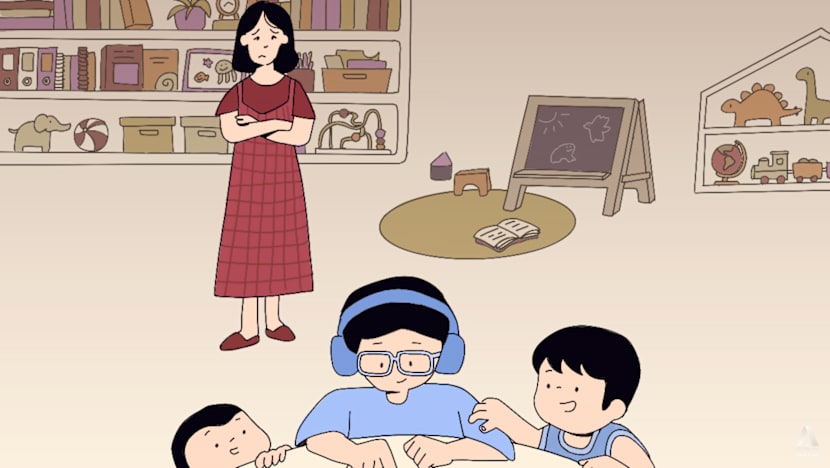
It is 9.30am on a home-based learning (HBL) day, and there is one iPad between my two boys.
My nine-year-old is on it, working through his lessons on the Student Learning Space (SLS), an online portal used in Singapore schools. My eight-year-old is waiting his turn – which in practice means hovering at his brother's elbow, offering unsolicited answers.
The two-year-old has climbed onto a chair for a better view. One child is supposed to be learning, but three are watching a screen. It takes at least another 10 to 15 minutes before I successfully peel the other two children away from the screen and learning can finally start in peace.
Singapore's guidance on screen use, issued under the Grow Well SG strategy, recommends less than two hours of screen time a day for children aged seven to 12, "unless related to schoolwork".
Recreational screen time is counted, rationed, used as a bribe and fretted over. School-related screen time is treated as a foregone conclusion.
I am not against e-learning. But as I watch their shoulders hunch and their faces inch closer to the screen, I find myself asking whether primary school children really need quite so much of it.
After all, even "good" screen time is still screen time.
WHAT THE GUIDELINES LEAVE OUT
Most of my boys' online homework is Chinese, and SLS is great for that in some ways. There's native-speaker audio on demand – with better fa yin (Chinese for pronunciation) than mine – and comprehension quizzes that are marked instantly.
But at the same time, these come with additional features that can distract from the main task.
My son discovered the playback speed button: Chinese at 2x speed is a chipmunk, at 0.5x a dying robot, and both remain the funniest thing ever, even on the 40th replay.
On paper, the only thing to fiddle with is the pencil. Yes, there may be more yawns, more rubbing of eyes, more complaints, but ultimately, less distraction.
Earlier this year, the government introduced guidelines on screen use, encouraging parents to focus not just on quantity but also quality – the content, context and whether screens are used together.
This has led to our own "policies" at home. We ban YouTube Shorts. If our children watch YouTube, it's only on the television together. They share one iPad instead of having one each.
However, on an HBL day, my sons can spend hours looking at a screen without it counting towards their two-hour daily limit.
A screen is a magnet, whatever is on it. Interactive e-learning draws in every child in the room, not just the one assigned to learn.
In a household with more than one child, HBL forces a choice: either the sibling or siblings crowd the learner, or every child gets a device.
The first undermines the learning while increasing screen time for everyone. The second assumes that every family can afford enough devices to go around. The default position that digital learning is "good" screen time also deserves scrutiny.
Sure, heavy at-home screen use was a necessity during the pandemic. But extending it as the default for primary school learning is a policy choice.
BUILD A CHILD'S FOUNDATIONS FIRST
A child's eyes, sleep and attention do not distinguish good pixels from bad ones.
Singapore already has one of the highest rates of childhood myopia in the world – around six in 10 children are myopic by Primary 6. Every hour spent on a screen, even for learning, also competes with the outdoor play and sleep that children need.
Then there is also the concern of what digital learning changes about learning itself. A beautifully produced, replayable explanation means a child never has to sit in confusion and work his way out.
Yet research pioneered at the National Institute of Education – and since adopted by the Ministry of Education for its own curriculum design – shows that students learn concepts more deeply when they wrestle with problems before being handed the solution.
Chinese, of all subjects, is learned worst on a screen in my view. Character knowledge is built by producing characters – stroke by stroke, by hand – not merely recognising them.
Adults who type more and write less know the phenomenon of 提笔忘字, which means that the character is known to the eye but lost to the hand. If children spend more time reading than writing, we shouldn't be surprised when they find the same happening to them too.
The EdTech Masterplan 2030 rightly aims to build digitally literate, self-directed learners. But at age eight or nine, children may not yet have the executive function that this vision assumes.
Digital literacy is not the same as screen familiarity. A child who reads, focuses and reasons well at 12 will pick up new platforms quickly. The foundations come first.
BETTER GUARDRAILS ARE NECESSARY
I am not saying no to EdTech. I am saying: not this much, not this young and definitely not untracked.
First, count screen time. Every digital assignment could come with an estimated completion time, and schools should keep track of the total screen time they require across all subjects.
This total should then be considered alongside existing guidance that recommends limiting children's recreational screen time to no more than two hours a day.
Second, keep digital HBL an exception and not the norm. Use technology only where it does what paper cannot – such as native-speaker audio – and rely on paper for tasks where writing itself is a crucial part of the learning process, such as practising Chinese characters.
Third, let the balance shift with the child's age. Those in lower primary should spend most of their learning time on paper, with use of digital devices increasing only as their attention and self-control mature.
Personal devices should still be largely kept to secondary school, as is already the case today.
Fourth, make SLS quieter. Scale back on "gamification" and, where possible, remove features such as speed buttons that reward the child for rushing through activities rather than engaging in thoughtful, uninterrupted learning.
Back at my dining table, I would rather have the same passage read aloud and copied out on paper – no chipmunk voice, and no queue for the iPad.
My nine-year-old son does not need his own device for schoolwork. He needs the adults around him to be honest about how many hours we are asking him to spend on one.
Wang Yingyu is a technology and intellectual property lawyer, and a mother of three.