
World News
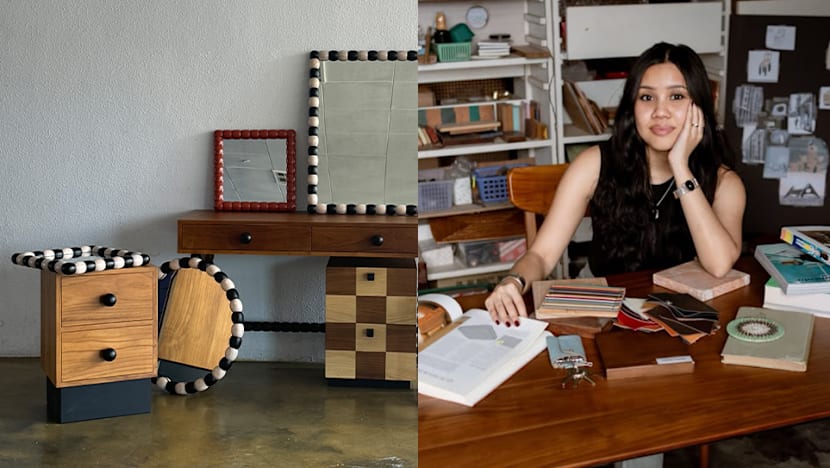
Singapore designer Faezah Shaharuddin is taking Malay cultural references to the world through furniture
Key Points
Singapore designer Faezah Shaharuddin is taking Malay cultural references to the world through furniture From Onde and Agar to Biskut, the Studio Kallang founder draws on childhood memories and Southeast Asian craft traditions to create furniture rooted in her own cultural experience. Mention the words Onde, Agar and Biskut and most Singaporeans would think of familiar Malay desserts and biscuits, not contemporary furniture. Yet these are the names of furniture collections by Singaporean...
Singapore designer Faezah Shaharuddin is taking Malay cultural references to the world through furniture
From Onde and Agar to Biskut, the Studio Kallang founder draws on childhood memories and Southeast Asian craft traditions to create furniture rooted in her own cultural experience.
Mention the words Onde, Agar and Biskut and most Singaporeans would think of familiar Malay desserts and biscuits, not contemporary furniture. Yet these are the names of furniture collections by Singaporean designer Faezah Shaharuddin, who is based in New York. As founder of Studio Kallang and part of the creative leadership behind her family’s furniture business, Gamar, her work has taken her from Milan Design Week to design-forward spaces across Europe, North America and Asia.
The names are deliberate. For decades, the language of collectible furniture has been shaped largely by European design traditions and, more recently, Japanese minimalism. Italian craftsmanship, French decorative traditions and Scandinavian modernism have helped define what many collectors recognise as sophisticated contemporary design. Faezah has chosen a different vocabulary, drawing instead on the colours, memories and everyday references of her own heritage.
“I wanted to use things that are authentic to my experience and my culture and have them be valued exactly the same,” she said.
It is an idea that has propelled Faezah onto the international stage within five years of founding Studio Kallang in Singapore. Yet furniture, she insists, is only the medium.
“Studio Kallang is basically my attempt to use furniture and objects to express cultural memory.”
LEARNING TO “SEE”
To hear Faezah describe Studio Kallang is to realise that she thinks less like a conventional furniture designer and more like an artist. Rather than treating chairs, tables and mirrors as ends in themselves, she sees them as vehicles for exploring identity and culture. Her works, however, are not destined for gallery walls, but for homes people inhabit every day.
That perspective can be traced to her formative years, spent in timber yards and furniture workshops across Southeast Asia. Faezah spent much of her childhood travelling through the region with her mother, Sharifah Maznah, who founded vintage furniture business Second Charm in 2001.
“She was a force of a woman,” Faezah said with a laugh.
Dressed in a baju kurung, her mother would negotiate vigorously with suppliers, factory owners and craftspeople in an industry largely dominated by men.
“It was very chaotic,” she recalled. “But I remember it being a very visually rich experience.”
While the warehouses and workshops immersed her in a fertile universe of colours and materials, it was at home that her worldview was formed. Her mother had pursued a PhD in Southeast Asian Studies in London before establishing Second Charm, while her father headed the Department of Malay Studies at the National University of Singapore. Together, they fostered a household where conversations about history, literature and culture were as common as discussions about craftsmanship and the importance of teak in Southeast Asian architecture.
As the family’s vintage furniture business pivoted to begin manufacturing its own collections with Indonesian craftspeople, Faezah found herself immersed in the material culture of Southeast Asia. Teak, rattan and solid wood were not simply materials to work with, but part of craft traditions and ways of life that had evolved across the region over centuries.
Looking back, she realises those years shaped more than her appreciation of furniture.
“They formed my visual world,” she explained.
FURNITURE AS LANGUAGE
Although she grew up in the furniture trade, Faezah did not set out to become a furniture designer. Instead, she studied visual communication at the University of Washington in Seattle. “A lot of people think I studied product design,” she said. “But I actually studied graphic design.” It was only after returning to Singapore during the pandemic that she began to see the workshops and materials she had grown up around with fresh eyes.
The workshops she had wandered through as a child, the craftspeople she had watched at work and the objects she had once taken for granted suddenly revealed themselves as a rich visual language she felt contemporary design had rarely acknowledged.
“Furniture, as a product, just happens to be my medium.”
Founded in Singapore in 2020, Studio Kallang became her way of exploring those ideas through what she calls her “artistic practice”, with furniture and objects serving as vehicles of expression. Her first design was a bedside table called Mamun, named after the Arabic word for “trusted friend”. Conceived as a companion by the bedside, it revealed her early instinct to imbue everyday objects with narrative and personality.
Second Charm later became Gamar, the family’s commercial furniture business. At its showroom on Kallang Avenue, homeowners can customise pieces with the team, while about 40 craftspeople in Indonesia make the furniture by hand.
“Gamar is the pragmatic side,” she said.
The two businesses nevertheless remain closely connected. Many of Studio Kallang’s collections continue to be made by Indonesian craftspeople with whom Gamar has worked for decades, allowing Faezah to experiment with new forms and materials while drawing on long-established woodworking expertise.
That philosophy is perhaps most visible in the collections themselves. Rather than adopting the Italian or French names often associated with contemporary luxury, Faezah chose Onde, Agar and Biskut, drawing on flavours and memories from her own childhood.
Each collection translates those familiar references into a distinct visual language. The Onde series, for instance, features oversized timber spheres inspired by the coconut-coated kuih, seen most recognisably in the Onde mirror. The translucent Agar collection combines coloured resin, wood and stainless steel to evoke the dessert’s luminous layers, while Biskut reinterprets the humble biscuit through softly rounded, sculptural forms.
“I think I have a decolonial streak,” she said with a laugh.
For Faezah, the point is not to reject European design traditions, but to question why they are so often treated as the default language of contemporary luxury when Southeast Asia has its own rich visual culture.
Living in New York has reinforced that conviction. In a city where cultures constantly intersect, Faezah says it has become easier to see Malay visual culture not as something niche, but as one among many design traditions. Rather than diluting her references for an international audience, the city has encouraged her to lean into them.
The real question, however, was whether the international design world would embrace that vocabulary too.
BEYOND FURNITURE
Embrace it has. Since debuting at Milan Design Week, Faezah’s collections have entered the international collectible design circuit through Galerie Philia, Adorno, The Oblist and 1stDibs, connecting her with galleries and collectors around the world. On The Oblist, her pieces are priced from US$1,800 (S$2,322) for the round Onde mirror to more than US$6,800 for an Onde shelf.
Yet she has resisted the temptation to grow simply because the opportunity exists. Instead, she prefers to let each collection develop at its own pace, trusting that meaningful work finds its audience over time.
“We just work very hard and take whatever comes,” she said.
That measured approach also reflects the relationship between the two businesses. Gamar draws on decades of manufacturing knowledge, material expertise and long-standing relationships with Indonesian craftspeople. Studio Kallang builds on those same foundations but asks different questions, transforming inherited knowledge into objects that explore memory, identity and belonging.
Despite their different purposes, both businesses continue to work with the tropical hardwoods Faezah grew up around. Teak remains central, valued for generations across Southeast Asia for its strength, longevity and natural character. It is deeply embedded in the region’s furniture traditions and in the craft knowledge of those who work with it.
Asked what she ultimately hopes both businesses will achieve, Faezah paused before answering.
“At the end of the day, they’re businesses and they’re supposed to sell things,” she said. “But I hope they also create meaning for people.”