
Education
Commentary: Banning Roblox may not be the solution to teen radicalisation
Key Points
Commentary: Banning Roblox may not be the solution to teen radicalisation Several governments have blocked Roblox but that does not mean children in those countries became safer, says online safety researcher Chew Han Ei. SINGAPORE: When serious harm is linked to a technology, calls to ban it usually follow. After being featured in recent cases involving self-radicalised youths in Singapore, some have asked if Roblox should be banned.
Commentary: Banning Roblox may not be the solution to teen radicalisation
Several governments have blocked Roblox but that does not mean children in those countries became safer, says online safety researcher Chew Han Ei.
SINGAPORE: When serious harm is linked to a technology, calls to ban it usually follow. After being featured in recent cases involving self-radicalised youths in Singapore, some have asked if Roblox should be banned.
In the latest case of a 14-year-old who was arrested by the Internal Security Department (ISD) in May for plotting a school attack, the student’s radicalisation journey began at 12 when he encountered first-person shooter games recreating real-life school shootings on Roblox.
While playing and watching gore and mass-shooting footage, the boy imagined his school bullies as the victims and himself as the perpetrator. He later prepared a 21-page manifesto detailing his attack plan.
Yet, Roblox was only one part of a longer journey.
The boy had searched for more information of mass shootings online, consumed material recommended through social media and joined channels linked to the True Crime Community before absorbing Islamic State, neo-Nazi and far-right material.
In this case, banning Roblox would not have thwarted all these pathways of radicalisation, meaning that a blunt ban of a platform should not be Singapore’s first or only response. Still, stronger safeguards should be required from such platforms.
MORE THAN JUST A GAMING PLATFORM
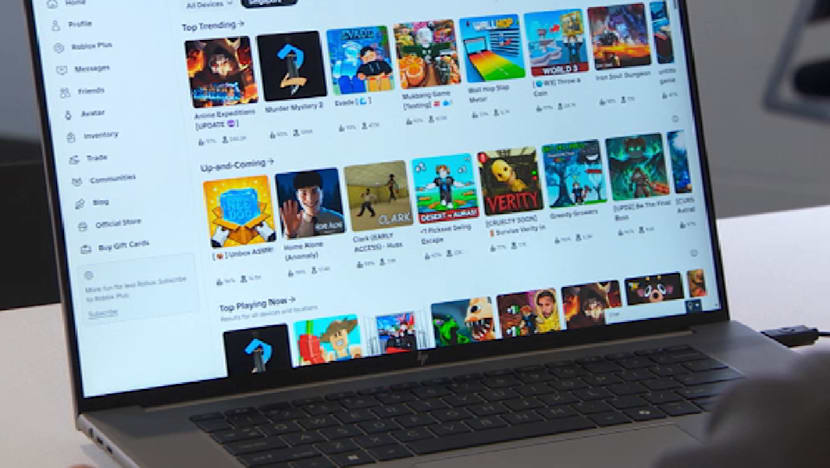
Roblox is usually described as a gaming platform, though it is more than that. Users can create experiences, find them through recommendations, communicate with others, form groups and spend money, all inside one product.
ISD has noted other cases where self-radicalised youths simulated attacks and role-played as terrorists on such platforms.
Last November, a 14-year-old was given a restriction order for making pro-Islamic State videos using footage from Roblox and Gorebox. In 2023, a then-16-year-old was issued a restriction order after he joined ISIS-themed Roblox servers and used gameplay footage to make propaganda videos.
In all these cases, the concern is not violent imagery alone. It is what users can practise, repeat, share and begin to regard as normal.
Over the past year, Roblox has introduced safeguards of its own: an age check for chat features intended to limit contact between younger users and adults, and separate Kids and Select accounts with different content and parental-control settings.
However, in the case of the 14-year-old boy, his radicalisation pathway did not appear to begin with an adult stranger. Instead, it began with user-created experiences recreating actual massacres, then moved through search, recommendations and other channels.
This means that age-segregated chat may reduce one risk but it does not answer whether a child is able to enter a violent simulation, assume the attacker’s role and find similar material afterwards.
Roblox’s community standards also prohibit content that recreates or imitates real-world sensitive events, including acts of mass violence, and material glorifying terrorist or extremist individuals and organisations. Yet, such experiences have evidently been available on the platform.
The platform should explain how they passed moderation, how they could be found, whether they were recommended and what happened when users reported them. If copies reappear, the company should show how quickly it detects them.
NEW REMEDIES DO NOT ALWAYS NEED A NEW LAW
Several governments, such as Russia and Turkey, have at various points blocked Roblox but that does not mean children in those countries became safer.
A fall in Roblox use would be easy to count and would tell us little about whether young people had moved to other games, secondary accounts or smaller services with weaker safeguards. The risk is presenting a ban as though the underlying problem had been removed.
So, what can Singapore do?
At the moment, Singapore’s Code of Practice for Online Safety – introduced by the IMDA in July 2023 – applies to six designated social media services: Facebook, HardwareZone, Instagram, TikTok, X and YouTube. It requires these designated social media services to curb the spread of harmful content, especially among younger users.
Roblox, however, is not among them. The government has separately said it is studying whether additional safeguards are needed for online gaming.
This classification matters as Singapore mulls restricting social media access for younger people. If scope is defined mainly by whether a company calls itself social media, Roblox may again sit outside it despite hosting user-created material, social interaction and algorithmic discovery.
A more workable approach would look at what a service allows users to do. Where children can create and discover content, communicate with others and receive recommendations, safety obligations should follow those functions.
Singapore also has the Code of Practice for Online Safety for App Distribution Services, which requires designated app stores to use age assurance and stop children downloading apps rated for older users. But age assurance at the app-store level is mainly a gatekeeping measure. It does not decide what is recommended inside the app, whether a new experience recreates an actual massacre, or whether a report leads to action.
This may be another gap in legislative coverage but it does not follow that Singapore needs another standalone online safety law.
Some remedies could come from amending the existing Online Safety Code of Practice or extending it to services such as Roblox. Others may need a targeted amendment to the Broadcasting Act, particularly if clearer powers are required over recommendation systems, product features or age-specific access restrictions.
The task is to identify what the present framework cannot do, then amend it. Starting with a new law may add another regulatory category without solving the problem created by platforms that cross several at once.
At the same time, Roblox should face closer scrutiny and stronger requirements. Regulators should first be clear about what the platform must change, and what a ban would leave untouched.
Roblox should enforce its own prohibition on simulations of real massacres, keep such experiences out of recommendations to children, retain age-based contact controls, and give regulators enough information to assess whether moderation works.
Where it falls short, enforcement can begin with directions to correct and firm deadlines, followed by financial penalties. A platform-wide or under-18 access restriction should remain available for persistent failure.
While schools, parents and community organisations have a role in identifying signs of risks, their role has limits. Parents cannot inspect a recommender system, determine why an experience was promoted to their child, or test moderation across millions of user-created experiences. The company that controls those systems must carry the larger responsibility.
Dr Chew Han Ei is an online safety researcher and Associate Director (Impact) at Singapore Management University. The views expressed are his own.
[Image text:] 2
p-snd-coming
EMC
CACAD
ERIT
KRKNYON
LO