
Science
Explosive 'Mountain of God' spits out the fastest-flowing lava on Earth — Earth from space
Key Points
Explosive 'Mountain of God' spits out the fastest-flowing lava on Earth — Earth from space A 2020 astronaut photo shows the unique structure of Ol Doinyo Lengai, an active stratovolcano in Tanzania that was recently adorned with a bright white "ash cone." The explosive peak produces a rare type of lava that is unusually cool but travels remarkably quickly. QUICK FACTS Where is it?
Explosive 'Mountain of God' spits out the fastest-flowing lava on Earth — Earth from space
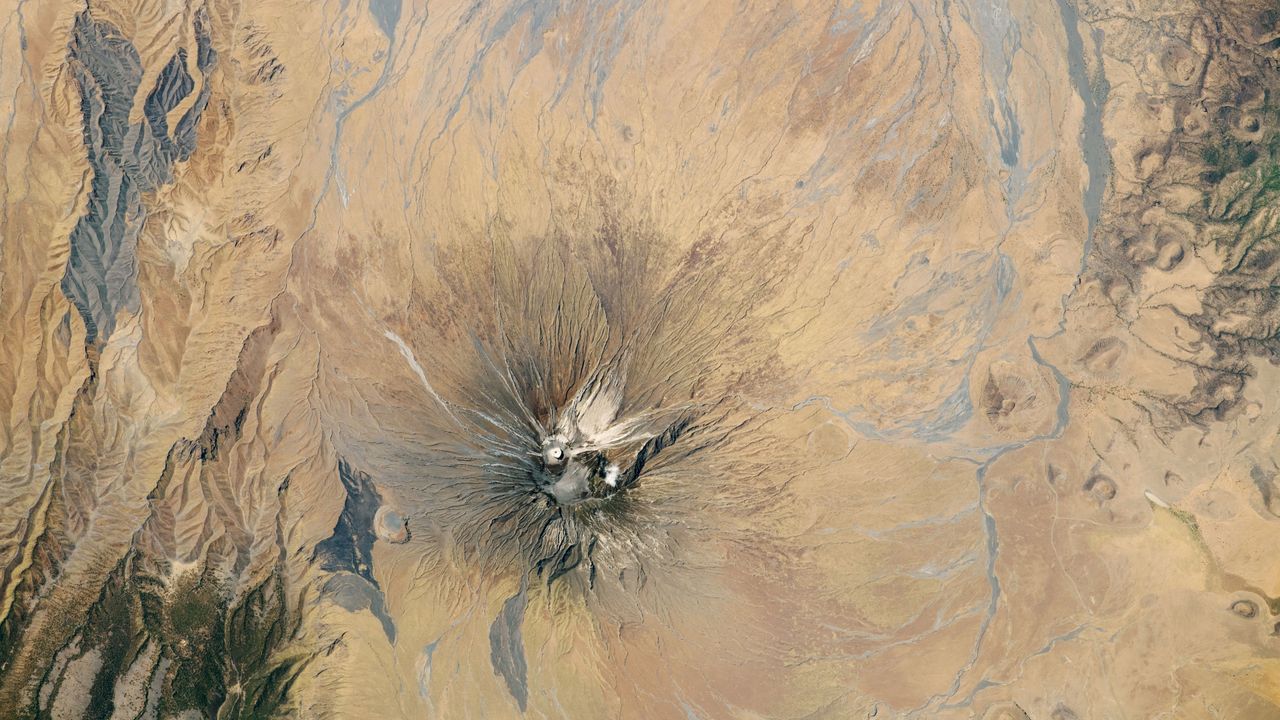
A 2020 astronaut photo shows the unique structure of Ol Doinyo Lengai, an active stratovolcano in Tanzania that was recently adorned with a bright white "ash cone." The explosive peak produces a rare type of lava that is unusually cool but travels remarkably quickly.
QUICK FACTS
Where is it? Ol Doinyo Lengai, Tanzania [-2.7734503796, 35.91519798]
What's in the photo? The lava-stained slopes and ash cone of a highly active volcano
Who took the photo? An unnamed astronaut on board the International Space Station
When was it taken? Oct. 6, 2020
This dramatic astronaut photo shows a highly active stratovolcano in Tanzania that was recently adorned with a striking white "crown" of ash. The explosive volcano produces a rare type of lava that is unusually cool, uniquely colored and the fastest-flowing on Earth.
The volcano is officially named Ol Doinyo Lengai and stands up to 9,718 feet (2,692 meters) above the grassy plains of the Arusha region of northern Tanzania. The local Maasai people call the towering peak the "Mountain of God," because they believe it is the residence of the supreme creator god Ngai (also known as Engai or Enkai), according to the book "Sacred Mountains of the World" (Cambridge University Press, 2022).
Ol Doinyo Lengai is one of Africa's most active volcanoes; it has been erupting on and off for the past 15,000 years. It alternates between effusive eruptions, where lava seeps out of its vents, and sporadic explosive outbursts, which can drastically alter its appearance. Its most recent eruption, which is effusive, has been going on since April 2017, according to the Smithsonian Institution's Global Volcanism Program.
The sacred mountain produces a rare type of lava that consists of natrocarbonatite rock, which is rich in sodium, potassium and calcium carbonate but low in silica. As a result, it is much cooler than most other lava, dipping to temperatures below 1,100 degrees Fahrenheit (600 degrees Celsius). It also has an unusually low viscosity, which makes it "some of the fastest-flowing lava in the world," according to NASA's Earth Observatory.
When it solidifies, this unusually runny lava turns surprisingly pale, due to chemical reactions with rainwater and moisture in the air. In this image, you can see several lightly colored rivers of rock snaking down the volcano's flank. The youngest of these lava flows was created during an eruption in 1998.
For most of the past century, Ol Doinyo Lengai's summit consisted of a bowl-like depression that gradually filled with lava. But between 2007 and 2008, a series of major explosive eruptions birthed a 330-foot-tall (100 m) ash cone that now looms over the summit's center.
This explosive event has transformed the volcano's appearance when viewed from space, additional photos from the Earth Observatory show. In the featured image, a dark spot of fresh lava can be seen in the center of the cone, making it look like a crown.
Get the world’s most fascinating discoveries delivered straight to your inbox.
Ol Doinyo Lengai is located in the East African Rift System, a roughly 2,000-mile long (3,500 kilometers) area surrounding a divergent fault line where the African Plate is splitting into the Somali and Nubian plates.
This region has been tectonically active for more than 25 million years and has created some of the continent's most interesting topographic features, including Mount Kilimanjaro and Mount Kenya, which are located on each side of Ol Doinyo Lengai, according to the Earth Observatory.
The godly mountain is around 10 miles (16 km) south of Lake Natron, a red salt lake that's famed for its large flamingo populations. The geographical features are often photographed alongside one another.
See more Earth from space
Green vortex in 'cryptodepression' lake
A 2020 astronaut photo shows a massive, milky-green vortex in Lake Skadar, which lies on the border between Montenegro and Albania.
Gold glitters around 'lake of souls'
A 2015 satellite photo shows a series of golden tendrils surrounding Ghana's Lake Bosumtwi, which is considered sacred to the local Asante people.
Trio of colorful lakes straddles states
A 2020 astronaut photo shows three uniquely colored lakes — Tahoe, Walker and Mono — straddling contrasting biomes on either side of the California-Nevada border.
Harry is a U.K.-based senior staff writer at Live Science. He studied marine biology at the University of Exeter before training to become a journalist. He covers a wide range of topics including space exploration, planetary science, space weather, climate change, animal behavior and paleontology. His recent work on the solar maximum won "best space submission" at the 2024 Aerospace Media Awards and was shortlisted in the "top scoop" category at the NCTJ Awards for Excellence in 2023. He also writes Live Science's weekly Earth from space series.
You must confirm your public display name before commenting
Please logout and then login again, you will then be prompted to enter your display name.
Earth (LOCATION)
Explosive 'Mountain of God' (LOCATION)
Ol Doinyo Lengai (PERSON)
Tanzania (LOCATION)
the International Space Station (ORG)
Arusha (LOCATION)
Maasai (ORG)
the "Mountain of God (LOCATION)
Ngai (PERSON)
Enkai (ORG)
Cambridge University Press (ORG)
Africa (LOCATION)
the Smithsonian Institution's (ORG)
Global Volcanism Program (ORG)
NASA (ORG)