
Education
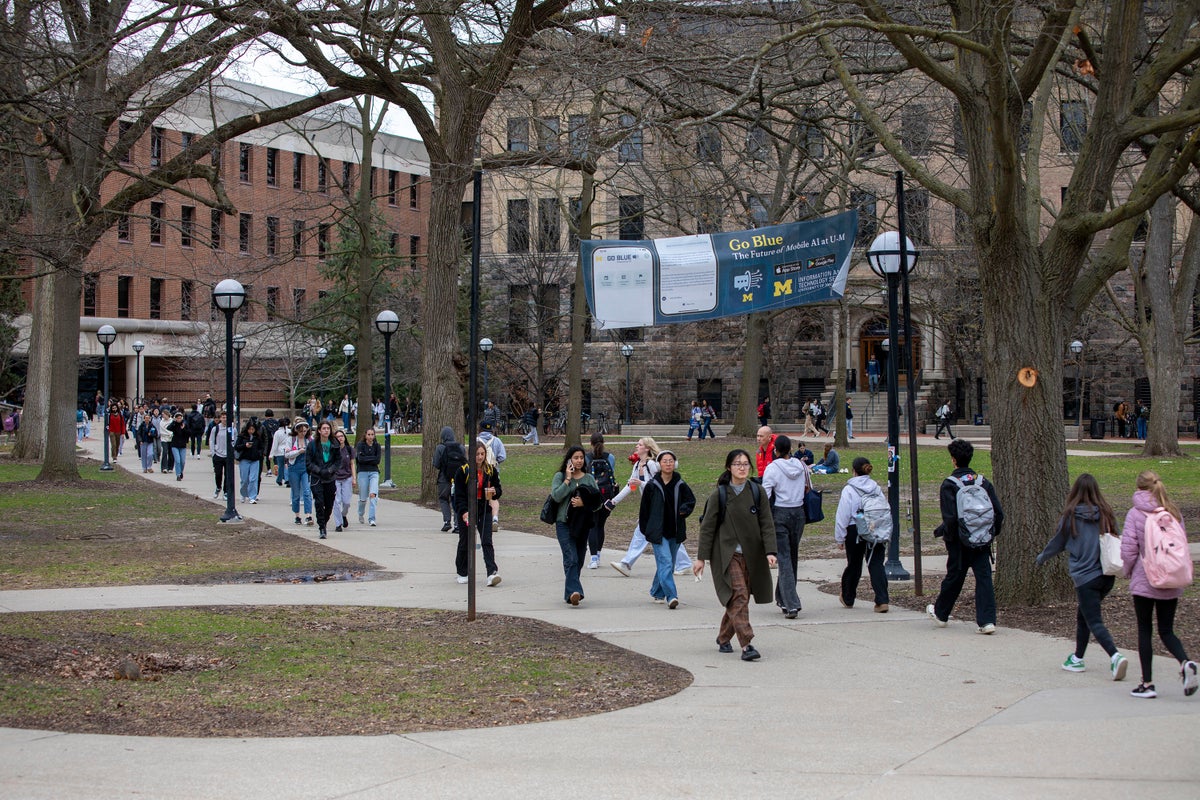
University of Michigan drops grades for freshmen in the first semester to ‘curb mental health crisis’
Key Points
University of Michigan drops grades for freshmen in the first semester to ‘curb mental health crisis’ Come fall 2027, official transcripts for first-semester freshmen will record only whether credit was earned - Bookmark - CommentsGo to comments The University of Michigan plans to transition first-semester freshmen into a pass or no-credit grading system beginning next fall to help address mental health challenges among young adults. Under the pilot program, incoming students enrolled in the...
University of Michigan drops grades for freshmen in the first semester to ‘curb mental health crisis’
Come fall 2027, official transcripts for first-semester freshmen will record only whether credit was earned
- Bookmark
- CommentsGo to comments
The University of Michigan plans to transition first-semester freshmen into a pass or no-credit grading system beginning next fall to help address mental health challenges among young adults.
Under the pilot program, incoming students enrolled in the College of Literature, Science, and the Arts — which educates roughly half of the university’s 8,000 first-year undergraduates — will not receive letter grades on their official transcripts during their first term, the school said in a statement.
“Our goal is to help first-year students acclimate to the demands of college and allow intrinsic motivations to guide personally meaningful academic journeys — core elements of a liberal arts and sciences education,” school officials said. “For example, they can explore a subject that may not come easily to them or take a course in a new field without the fear that a low grade may have long-term consequences.”
Official transcripts will record only whether credit was earned, leaving grade-point averages unaffected, and faculty will continue to track grades internally to evaluate eligibility for honors and scholarships.
“We will have more details to share this fall, as faculty, staff and students in the College of Literature, Science, and the Arts continue to inform the design, development and implementation of a pilot program,” a university spokesperson told The Independent.
The change comes amid broader national debates surrounding grade inflation and freshman preparedness. Similar models for first-year students have previously been introduced at institutions such as the Massachusetts Institute of Technology and the California Institute of Technology.
A faculty report from the University of California San Diego showed that the proportion of students requiring remedial math prior to precalculus rose to 8.5 percent in 2025, up from 0.5 percent in 2020, according to The Wall Street Journal. At Harvard University, faculty voted in May to cap the proportion of A grades at 20 percent per undergraduate course.
Data reviewed by the news outlet MLive showed that 74.1 percent of undergraduate grades at Michigan in 2022 were in the A range, compared to 57.6 percent a decade earlier.
Reaction to the announcement has drawn varied responses from academic staff, students and observers online.
Kenneth Lowande, a former Michigan political science professor now at Rice University, told The Wall Street Journal that the policy change may have minimal impact due to existing grade inflation, noting that grades had largely lost their utility as a measure of academic distinction. Michigan no longer requires standardized test scores for undergraduate admission.
Student leaders at the university expressed approval of the decision.
Summit Louth, the 20-year-old student body president, told the publication that peers he spoke with were generally pleased with the change, citing the link between academic anxiety and mental health. Louth added that though he earned top marks in his own first term and might have exerted less effort under a pass/fail system, he believed the absence of grade pressure fostered a better learning environment.
Discussion on social media platforms mirrored the divide. On the Reddit forum r/CollegeRant, several users defended the move as a practical adjustment to higher education.
“It’s actually a thing at many colleges including elite schools like MIT and CalTech,” one user wrote. “It's honestly a good idea because plenty of freshman mess up their first semester which can destroy their GPA and cause them to drop out.”
Another user added, “If you omitted my first semester, I would have been Summa Cum Laude instead of just Cum Laude. Transitioning to college isn’t easy!”
Critique was more pronounced on X, where several commentators raised concerns regarding academic standards.
“Why are colleges looking more and more like daycare?” user @Thomastnt33 posted. “This looks like a $30,000 a year daycare. They are not doing these kids a great disservice sticking them with debt and trying to perpetuate the problem.”
Commentator Ludovic Hood questioned the policy relative to students handling heavy workloads.
“Hundreds of thousands of student-athletes, ROTC candidates and kids working jobs to offset tuition manage intense schedules,” Hood posted on X. “What is this??”
Join our commenting forum
Join thought-provoking conversations, follow other Independent readers and see their replies
Comments
University of Michigan (ORG)
’ University of Michigan (ORG)
The University of Michigan (ORG)
the College of Literature, Science (ORG)
Arts (ORG)
The Independent (ORG)
the Massachusetts Institute of Technology (ORG)
the California Institute of Technology (ORG)
the University of California San Diego (ORG)
The Wall Street Journal (ORG)
Harvard University (ORG)
MLive (ORG)
Michigan (LOCATION)
Kenneth Lowande (PERSON)
Rice University (ORG)