
Weather
Europe wildfire tracker: France and Spain at extreme risk of new fires as temperatures soar to 42C
Key Points
Europe wildfire tracker: France and Spain at extreme risk of new fires as temperatures soar to 42C The continent is facing its fifth major heatwave of the summer - Bookmark - CommentsGo to comments Europe is in the grip of its fifth heatwave this summer, raising fears that extreme temperatures could trigger another set of wildfires across the continent. Wildfires have scorched more than 505,000 hectares (ha) of land across Europe during an unusually active wildfire season.
Europe wildfire tracker: France and Spain at extreme risk of new fires as temperatures soar to 42C
The continent is facing its fifth major heatwave of the summer
- Bookmark
- CommentsGo to comments
Europe is in the grip of its fifth heatwave this summer, raising fears that extreme temperatures could trigger another set of wildfires across the continent.
Wildfires have scorched more than 505,000 hectares (ha) of land across Europe during an unusually active wildfire season. A relatively wet winter that fuelled growth in vegetation was followed by rolling heatwaves which dried it all out, making the land more prone to catching fire.
During the same period, the extreme heat has been linked to 25,000 deaths this year, according to Bloomberg research covering Spain, France, the UK, the Netherlands and Switzerland.
Western Europe is suffering its hottest ever summer, with temperatures well above average.
On Thursday, temperatures are set to reach highs of 42C in Spain, including in the popular tourist hotspot of Cordoba, and 39C in Bordeaux, where a huge blaze forced the evacuation of more than 200,000 people last month.
Here, The Independent looks at where the risk of wildfires will be in the coming days.
Fire danger forecast
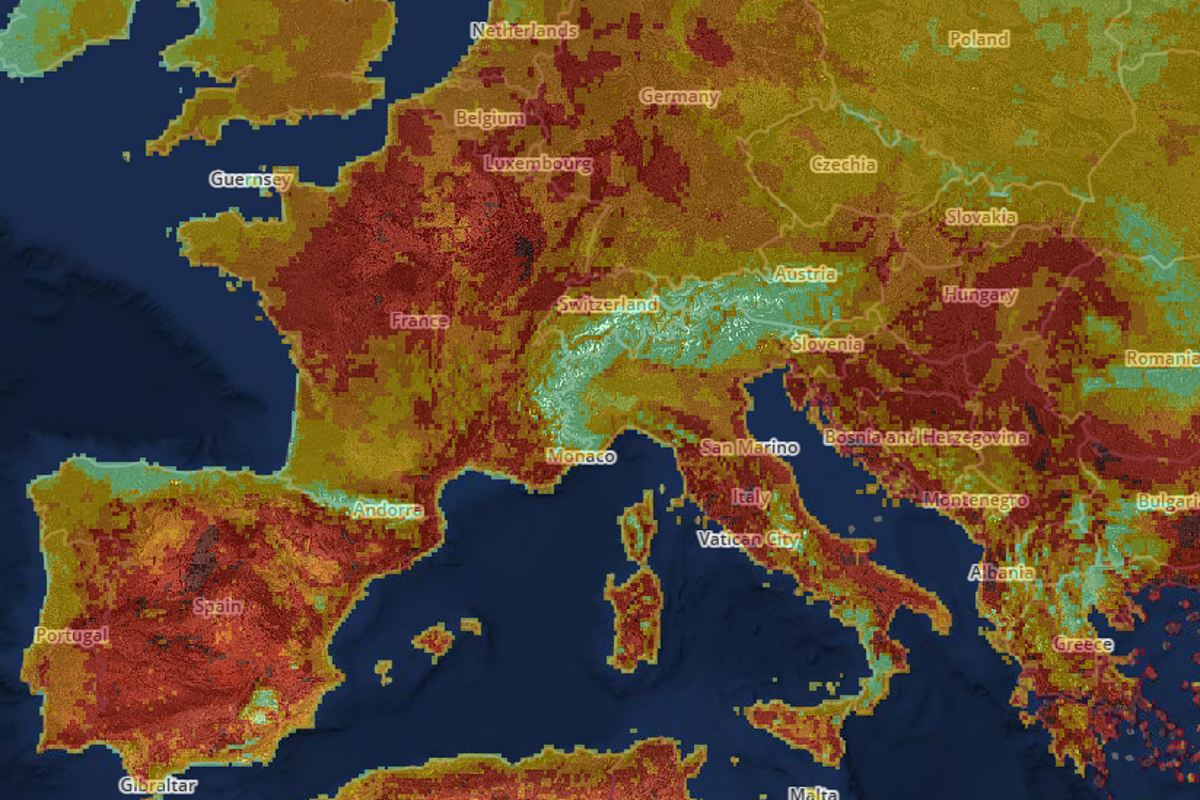
The EFFIS current situation viewer shows vast swathes of western, central, eastern and southeastern Europe are at “very high” risk of a wildfire on Thursday. Some areas, shown in dark red on the map, are at “extreme” risk.
The main wildfire threat will continue moving eastwards before abating in much of western Europe early next week, when southern Spain and and central European countries are at the highest risk.
Fires were ongoing in western Europe as of Thursday with around 1,200 people evacuated from a campsite on Wednesday after two wildfires spread near a beach in the country’s north.
The prefecture for the administrative department of Pas-de-Calais, in the country's north and bordering the Strait of Dover, said one of the wildfires was under control, but conditions were "unfavourable" for the other one. Access was difficult and the fire was spreading unimpeded toward the south.
Entire regions burnt
A record amount of land has burnt this summer, surpassing the total for 2025 at this time of the year and more than double the 20-year average between 2006 and 2025.
As of 5 August, some 505,583 hectares (ha) of land had burnt, compared to 379,392 at this point in 2025, and well above the 2006 to 2025 average of 197,347 ha.
The fires have already cost the continent up to £16.4 billion in economic costs, estimates published by forecaster AccuWeather showed last Thursday. This includes the cost of emergency response, damage to property, and health impacts.
In one of the largest fires around Bordeaux, a record-setting fire burned around 420 square kilometres of land.
Record-breaking temperatures
Western Europe reported a record-breaking 24-hour average temperature of 21.62C for June and July, according to a report by the EU’s Copernicus climate change service released on Monday.
This is 2.79C above the average temperature during the 1991 to 2020 period, smashing the previous heat record set in 2022.
Spanish forecaster Aemet says that tourist hotspots in Spain including Cordoba (42C), Sevilla (40C), Granada (39C), and Madrid (39C) will all see temperatures in the region of 40C on Thursday, while other touristy areas including Barcelona, Malaga and Alicante are all forecast to be in the low-to-mid 30s in the coming days.
Large parts of Spain, barring the eastern, southern and northwestern coasts, will be placed under yellow and amber warnings for the next three days.
In France, temperatures will near 40C in the popular tourist spots of Bordeaux, Nantes, and Toulouse.
Average rainfall plummets
Prolonged drought conditions have played a critical role in driving up the wildfire risk, with droughts that began in May deteriorating in July and August.
Data from the European Drought Observatory updated on 10 August shows that 50 per cent of the UK and EU is suffering some level of drought intensity, whether at ‘watch, ‘warning’ or ‘alert’ level. Nine per cent was at the alert level in July.
Almost the entire continent, barring parts of Scandinavia, is set to experience less rainfall than usual in the week between 10 and 16 August, according to estimations by Copernicus based on the ECMWY Monthly Forecast System.
Europe’s four major rivers, the Loire, Po, Rhune and Danube, have been pushed to record low levels this month, according to Copernicus.
“The drought has built up since early spring due to lower rainfall and higher than average temperatures, turning into fuel for the devastating wildfires in France and Spain in July,” the EU’s Joint Research Centre said.
Join our commenting forum
Join thought-provoking conversations, follow other Independent readers and see their replies
Comments