
Weather
Invasion of the Influencers: ‘Widow’s Bay’ has its demons; Amity its ‘Jaws’ — Nantucket says it’s battling far worse
Key Points
Invasion of the Influencers: ‘Widow’s Bay’ has its demons; Amity its ‘Jaws’ — Nantucket says it’s battling far worse Islanders say neither sharks nor ghosts worry them — it’s the content creators on shore who are ruining their summer. As Dairy Boy founder Paige Paul plants herself in the center of the conflict, correspondent Alex Hannaford drops anchor on the simmering culture war just off Cape Cod - Bookmark - CommentsGo to comments NANTUCKETT, Mass. — Inside The Landing Cafe, just a few...
Invasion of the Influencers: ‘Widow’s Bay’ has its demons; Amity its ‘Jaws’ — Nantucket says it’s battling far worse
Islanders say neither sharks nor ghosts worry them — it’s the content creators on shore who are ruining their summer. As Dairy Boy founder Paige Paul plants herself in the center of the conflict, correspondent Alex Hannaford drops anchor on the simmering culture war just off Cape Cod
- Bookmark
- CommentsGo to comments
NANTUCKETT, Mass. — It’s 7:45 am. Inside The Landing Cafe, just a few steps from Hyannis Harbor, blonde 20-somethings in Parke sweatshirts carrying identical canvas bags are milling about, eyes glued to their phones, waiting to board the Nantucket ferry.
There’s a rough hour-long ride ahead — the storm clouds portend choppy seas and 47 mph wind gusts. Ironically, I’m heading to the island to find out about a storm of a different kind — one that’s been brewing between social media influencers who use the island as an idyllic backdrop for their content, and locals and second-home owners who have been regulars for years.
In Apple TV’s summer hit Widow's Bay, Tom Loftis, the mayor of the fictional New England island, played by Matthew Rhys, desperately wants to turn the cursed, isolated town into a thriving tourist hotspot like Nantucket. But arguably, Nantucket, where old money and new money have long collided over dock space and dinner reservations, has something more insidious going on: the creeping sense that the very thing that sustains it might also be destroying it.
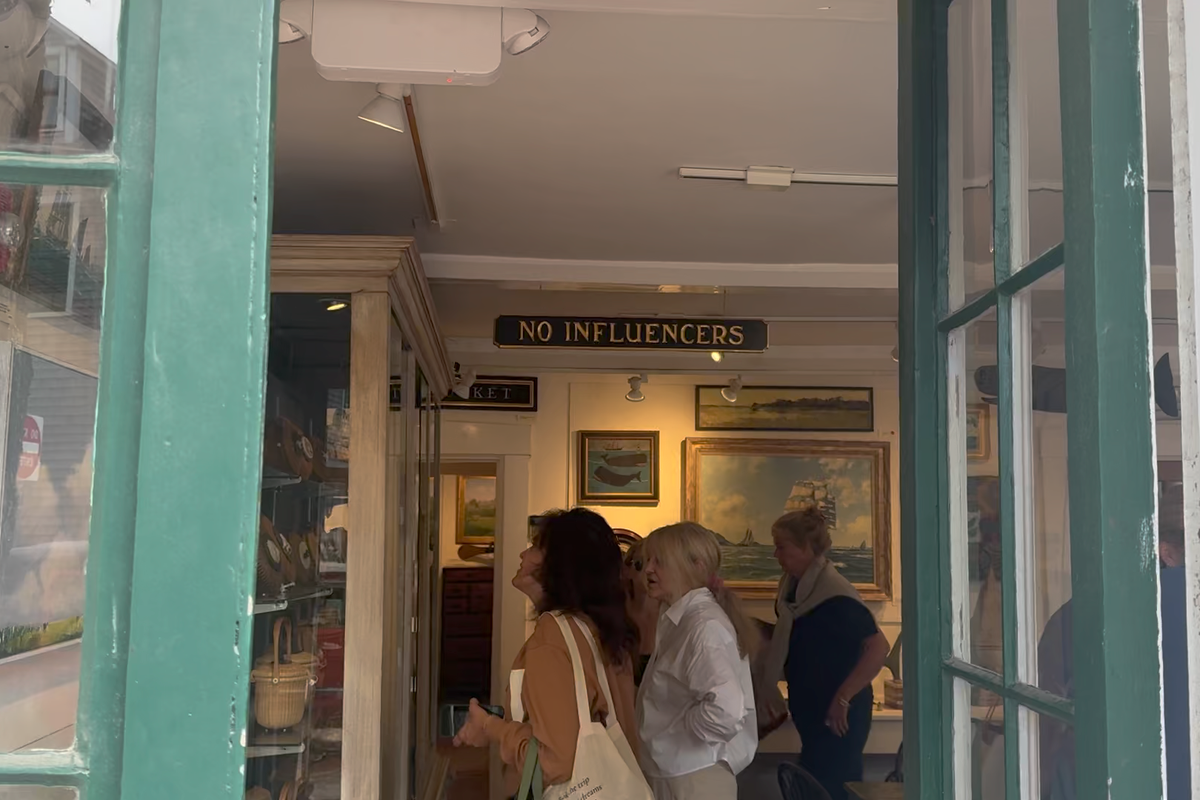
This all erupted in the past few weeks when John Sylvia, a 59-year-old antiques dealer whose family has sold nautical curios on the island for nearly a century, hung a hand-painted quarterboard from the ceiling of his shop, Four Winds Craft Guild. In gold leaf, it reads: "No Influencers." But when Sylvia’s partner, Jessica Jenkins, 50, who manages the store’s social media, posted a picture of the sign on Instagram, the message quickly blew up.
“Influencers have ruined every place from Kyoto to Paris,” wrote one commenter. “You cannot see anything at an art museum because of the line of people taking multiple selfies and blocking paintings.”
Then, Paige Paul, an influencer who commands over a million followers and recently opened a clothing store, Dairy Boy, on the island, said that given that the influencer orbit is dominated by women, Sylvia’s sign was effectively "barring women.”
“Mocking women when they become powerful in a new industry isn't new,” she posted.
The battle lines were drawn. In her shop, Paul hung up her own sign in response: "Everyone Welcome.”
Nantucket has indeed become ground zero for this very 21st-century collision, the kind playing out in any place where tourism has tipped from economic engine to existential threat. And social media content creators, or influencers, make themselves easy targets — visible, stereotypical in presentation, and invariably young and female.
The “No influencers” sign earned Sylvia a New York Times visit and he told the paper it was meant to be tongue-in-cheek — a joke about visitors who treated his store as a stage, filming without buying anything or even making conversation.
But the comments under the story were more blatant in their condemnation.
“So-called influencers are the scourge of the modern world today,” wrote one.
What happened on Nantucket exposed the fault line between those who see influencers — and by extension modern social media — as a societal irritant, and those who see the hostility toward them as the real elitism.
There’s an old saying on Nantucket: tourists come to the island with a dirty shirt and a $5 bill — and don’t change either. Greg Creedon says that’s been the case since the 1960s.
Creedon, 74, moved to Nantucket with his parents when he was four weeks old. His grandfather was superintendent of schools here. A retired tech worker who now works part time handing out tourist pamphlets, he meets me off the ferry and agrees to show me around.
We hop in his pickup truck and immediately hit traffic.
“There are places on the island where it's almost impossible to drive,” he says, and then goes on to describe Nantucket’s “commercial pattern” much as anyone who has seen the Spielberg classic Jaws once or twice might expect.
“You open Memorial Day, you have a slow month in June, then the Fourth of July hits and it’s off to the races until the middle of August,” Creedon tells me. “By then, a lot of people are really cranky. By the time kids start going back to school, the tourists start drifting away and we begin that long trip down into winter.”
Creedon sums up the influencer issue in his own inimitable Nantucket islander way: “Pointless tourism.”
The problem that those who sympathize with Sylvia’s “No Influencers” sign have is that they feel the island has become a destination to be photographed rather than lived; consumed rather than experienced.
They feel that these new, younger visitors, arrive with itineraries built for engagement metrics rather than engagement with the island itself: they clog the ancient cobblestone streets for the perfect selfie, treat century-old shops as backdrops, and leave behind a trail of photographic breadcrumbs for the next wave of the young and Instagram-obsessed to follow
Creedon describes it as a version of the bucket list — but on steroids. As we approach Dairy Boy, a line of young, mostly women devotees, snakes down the wooden staircase from the front door and along the street. It’s one-in-one-out, and I count 17 people waiting for their chance to peruse the beachwear, pajamas, workout shorts, colorful zip-up fleeces, and Wellington boots inside.
One of them, Hannah Moser, 26, has come with four friends. They’re vacationing on Cape Cod, but have ferried over to Nantucket for a night. “I heard about Dairy Boy on TikTok,” Moser tells me.
Her friend follows Paige Paul’s account, but Moser says the shop also appeared in her feed. Most people, she says, order the clothing online, but as she and her friends were on the island for the day anyway, they decided to check it out in person.
Another woman, a 23-year-old who only gives her first name, Jayne, says she, too, heard about Dairy Boy via TikTok and wanted to see it as she was on the island for a vacation with her family. “I liked the look of the clothes and wanted to see the store. I wouldn’t have come here just for this, but it’s a small town and I pass by every day.”
Inside the shop, it’s not crowded — there are about 12 people looking round — and I wonder whether the one-in-one-out policy is by design, to keep a line always visible, right out of the velvet-rope nightclub playbook.
Paul, who married American tennis player Tommy Paul in July but is better known by her maiden name Lorenze, did not respond to The Independent’s request for an interview.
Back outside, Creedon leads me through a door next to the Dairy Boy entrance.
“I'm going to show you one of the funniest incongruous things I've seen in a long time that I'm surprised nobody has pointed out,” he says. “In the office space above Dairy Boy is an organization called Sustainable Nantucket. You can’t make this up.”
The mission of Sustainable Nantucket is to help the island community by supporting local agriculture, food producers and craftspeople. Posie Constable is its managing director, and we sit down at a cluttered table in her office.
According to the 2020 census, Nantucket island has a year-round population of a little over 14,000. In July and August that number swells to around 80,000 or more.
“It’s a huge swing,” Constable says. “And for that reason, locals, while they love the revenue, can’t wait for tourist season to be over so they can reclaim their beaches and restaurants.”
She says it’s one event after another — dance festival, film festival, comedy festival, book festival. Not to mention the weddings. “The chamber of commerce has created all these events and helped create events that bring people here. So we've kind of done it to ourselves a little bit.”
Constable says 52 percent of Nantucket is in conservation — protected from development in perpetuity. But what that means is that for every new house that’s built, or old one torn down and rebuilt, there’s less available land for workforce housing to accommodate the people who keep its economy going.
“Our teachers, our healthcare workers, our town officials,” she rattles off.
Constable jokes that she’s too old to understand why young people are drawn to a culture of capturing everything on their phone — she says her daughters, who are in their 30s, call her a “Karen” when she goes off about having to walk through the scrum on Nantucket’s streets each day.
As for Dairy Boy, her downstairs neighbor, she says she wants to maintain a good relationship with all businesses on the island. Problems start to arise, she says, because of Nantucket’s size.
“[Growth] is more immediately impactful here because of our congested cobblestone streets. This is a very quaint place. And [it’s hard to] maintain the quaintness of our downtown when a merch drop is announced on Instagram, and then two or three truckloads of Cape Cod Express trucks roll up, offload boxes and boxes on pallets, and it all gets dragged back there,” she says.
“I’m not here to judge, but I am exhausted by the sense that this is not Nantucket. It's supporting the tax base, but it's at the expense of others who would like to also claim this as their island with less fanfare.”
Michael Harrison is chief curator at the Nantucket Historical Association, which has conducted extensive research into the island’s tourist economy.
Harrison reflects on Nantucket’s history as a whaling port. When the whaling industry collapsed, the islanders, looking for a new economic engine, decided it could become a summer resort destination. This happened just after the Civil War in latter 1800s. “And what the island provides for people who summer here versus what the island provides for the people who live here year-round has been a consistent source of tension since then,” he says.
But what has changed is the scale of that tourist economy. What was once hotel visits is now mostly second or even third homes. “There are day trippers on Nantucket today, but a lot of it is people who stay for a week or a month or have a seasonal home,” Harrison says.
The other thing to understand, he maintains, is that the tourist economy that’s on the island is not one founded on hot dog sales and T-shirts. “The engine of our economy is construction, real estate sales, and all the maintenance and infrastructure that keeps these summer homes going. Food sales and souvenirs and all of that are just a drop in the bucket compared with everything else,” he says.
There are only so many homes available, and so, Harrison says, you see older homes torn down to make way for bigger, more modern abodes. “I want a pool, I want a guest house, I want six more bedrooms,” he says of the newer buyers.
“The construction of all of that — the real estate transactions — that's a big deal, and because there's such competition to acquire those summer homes, the locals can't compete anymore with buying real estate or finding places to rent. That's been a problem for a long time, but it's getting worse and worse.”
I ask Harrison whether young influencers and young people with smartphones may be just the most visible sign of this tourism explosion right now; that perhaps they’re just an easy target, but that there's much more going on behind the scenes.
“There are those whose families have summered on Nantucket for a hundred years. Then there are the people who think, ‘Oh, Nantucket's the hot place to be. I'm going to go there now and record it for Instagram.” But, he says, there's even a tension there that doesn't involve the year-round community; a tension that gets at who gets to call Nantucket their own.
“Many people I know who have summer homes and come here for three months a year talk like they belong here; that they are Nantucketers in their imagination and they’ve earned it because for 70 summers they've been here,” he says.
“Meanwhile, the locals say, ‘Well you don't winter here.’ So there's always a lot of back and forth. But the locals hate the traffic, and the people who've been here for 70 summers hate the traffic, too. And we all bemoan how expensive everything is getting, and we all think it's a problem that there's there's not enough housing. So I think there are other, deeper systemic issues than whatever this [influencer issue] happens to be right now.”
Still, product lines and film companies and the like love to lure influencers to Nantucket to promote their wares.
My friend Angela Pham, a commercial photographer and content creator based in Upstate New York, recently returned from a press trip to Nantucket, organized by the luxury Italian brand LaDoubleJ. She told me the company had invited 10 fellow influencers but that due to a storm (not just me then) only two made it out there — Pham and another woman.
She said the brand hired local vendors such as caterers, photographers, yoga instructors, and a tour guide, for the two-day trip. “We had a local woman who lives on the island driving us around, telling us about life there,” Pham said.
“There were events with local people, a luncheon with islanders, and it was nice to talk about what they did there, what they liked about the island, their experience in the summer, and what it’s like in the winter. They also chartered a boat for us and we spoke to a local photographer who grew up on Nantucket.”
Pham says she doesn’t doubt that influencers are taking photos and clogging up the small island streets. “I was totally guilty of that, too. On my trip I had to create content — there's one street that has all these hydrangeas, and people live there, and there were throngs of people taking photos. I woke up at sunrise and was taking shots in the morning on a tripod and I felt so obnoxious. I didn't get in anyone's way, but I could imagine the kind of annoyance that would cause in people's day to day for sure.”
But she said it’s all in the approach. “If you approach it respectfully and encourage people to have a real connection with the place rather than just coming in and using it as a photo set, I think there's definitely ways to make content around a destination in a respectful way.”
Pham said they could highlight local businesses in the area; suggest to their followers they visit a particular coffee shop or restaurant, or offer local recommendations. “At the end of the day the algorithm is only going to push content that is valuable to people - content that is getting those saves, that is getting those shares, because they're offering value to the person consuming it.”
More broadly she believes the term “influencer” reflects people's negative feelings about their relationship with social media and the anxiety that it causes. “I think that people conflate social media with influencers,” she says. “But influencers and content creators are mini media properties; they offer free content, whether that be education, entertainment, recipes, tutorials, tips, reviews, and they need to subsidize that with ads. But I think the ad part angers people.”
Pham said what is almost certainly the real issue in a place like Nantucket is over-tourism. “But the vitriol in the comment sections online make it seem like it's more anger towards social media and the ‘fakeness’ of it and the anxiety that it brings. But they are two different things.
“The same thing is going in [in the small town where I live] — there’s a debate around a moratorium on new development. It's about change. There's always going to be resistance to change, and I think influencers represent change because they're just bringing in new faces and promoting places and bringing in outsiders. These places are usually primarily white and wealthy and so I think that aspect can't be ignored - that the newcomers are maybe more diverse.”
She also points out that young women standing in line to visit Dairy Boy are the same people who in the past would have read an article about a new shop opening up in Vogue magazine. “Maybe they're mistaken for influencers because they have a camera phone — but doesn't everyone have an iPhone these days and take photos? It doesn't mean that you're an influencer.
“I think that's where the kind of the misogynistic angle comes into this,” Pham said. “The word ‘influencer’ is just so gendered and it usually refers to women who are working in the beauty, lifestyle, fashion, motherhood space, and so they see these young women and they conflate them with influencers and social media.”
Perhaps, then, the ‘No Influencers’ sign was not the beginning of a conflict at all, but just its latest, most photogenic iteration. Nantucket has been choking on its own success long before the first tripod appeared on a hydrangea-lined street.
As he drops me off again in the middle of town in time for my ferry back to the mainland, Creedon is sure that, while the over-tourism problem won’t be resolved anytime soon, this brouhaha over influencers — and the influenced — on Nantucket will be a flash in the pan.
“The tide comes in and the tide goes out, and it never stops,” he says. “This will be a thing for a year or two, and then we'll move on to something else.”
Join our commenting forum
Join thought-provoking conversations, follow other Independent readers and see their replies
Comments
Amity (ORG)
Nantucket (PERSON)
Islanders (ORG)
Paige Paul (PERSON)
Alex Hannaford (PERSON)
Cape Cod - Bookmark - CommentsGo (LOCATION)
NANTUCKETT (ORG)
Mass. (LOCATION)
Hyannis Harbor (LOCATION)
Parke (ORG)
Apple TV’s (ORG)
Tom Loftis (PERSON)
New England (LOCATION)
Matthew Rhys (PERSON)
John Sylvia (PERSON)