
Science
Pigs wearing heated diving suits and diapers reveal a better way to beat 'the bends'
Key Points
Pigs wearing heated diving suits and diapers reveal a better way to beat 'the bends' A new study submerged pigs in a high-pressure tank and uncovered a potential new way to beat "the bends." Deep-sea divers take careful measures to avoid "the bends," a painful condition where gas bubbles form in divers' blood and tissues when they ascend from the depths too quickly. Now, a new study using unlikely test subjects — pigs in diving suits — has shown that switching up the gas they breathe...
Pigs wearing heated diving suits and diapers reveal a better way to beat 'the bends'
A new study submerged pigs in a high-pressure tank and uncovered a potential new way to beat "the bends."
Deep-sea divers take careful measures to avoid "the bends," a painful condition where gas bubbles form in divers' blood and tissues when they ascend from the depths too quickly. Now, a new study using unlikely test subjects — pigs in diving suits — has shown that switching up the gas they breathe underwater may help divers avoid this dreaded decompression sickness.
One day, the lessons from the research may help humans dive deeper for longer and get back to the surface more quickly, the study authors say. The work was published Aug. 10 in the journal PNAS.
Study co-author Dr. Richard Moon, an anesthesiologist and professor of medicine at Duke University, has treated many cases of decompression sickness over his career. He's even suffered from mild cases of the bends himself. While Moon only experienced slight joint pain in these instances, serious cases of decompression sickness can be fatal, blocking blood flow around the body and damaging the heart and other organs.
The trouble begins with the gases divers breathe to stay alive underwater.
Diving pioneers like Jacques Cousteau, who went underwater while breathing compressed air, noted the confusion and elation they felt during extended dives, calling it the "rapture of the deep." What they were truly feeling was the effects of nitrogen narcosis; this side effect of breathing nitrogen at high pressures makes divers feel drunk.
Divers who ascended rapidly would be beset with severe cramps that doubled them over in agony. These cramps came from bubbles of nitrogen that had dissolved in their blood and tissues in the deep ocean. When the divers ascended too quickly, the dissolved gas started bubbling out, and their bodies essentially became shaken-up cans of soda.
Many divers now minimize the risk of both nitrogen narcosis and the bends by using nitrox, a gaseous mixture of nitrogen and oxygen that has a higher oxygen content than regular air. And commercial deep divers often breathe heliox, a mix of helium and oxygen that reduces the risk of nitrogen narcosis.
Get the world’s most fascinating discoveries delivered straight to your inbox.
However, high levels of oxygen can be toxic in the abyss, and heliox is pricey and can still produce bends-like effects. Safe diving practices, such as tight limits on how long someone spends deep underwater, further cut the risk, but they can't erase it.
"The risk for diving injury almost exponentially increases with depth," said Dr. Kay Tetzlaff, a clinician researcher at the University of Tübingen who was not involved in the research.
For decades, Moon and his colleagues have studied ways to make deep-sea dives safer. The scientists knew that one way to stop gas from entering the body's tissues so quickly was to use a gas with larger molecules. But this replacement gas also had to be less soluble than helium or nitrogen.
"Our first idea was neon," Moon said. But this plan was undermined by Russia's invasion of Ukraine, which sent neon prices spiraling. Instead, they settled on carbon tetrafluoride (CF4), which, like helium, is inert, meaning it wouldn't chemically react with the body's tissues.
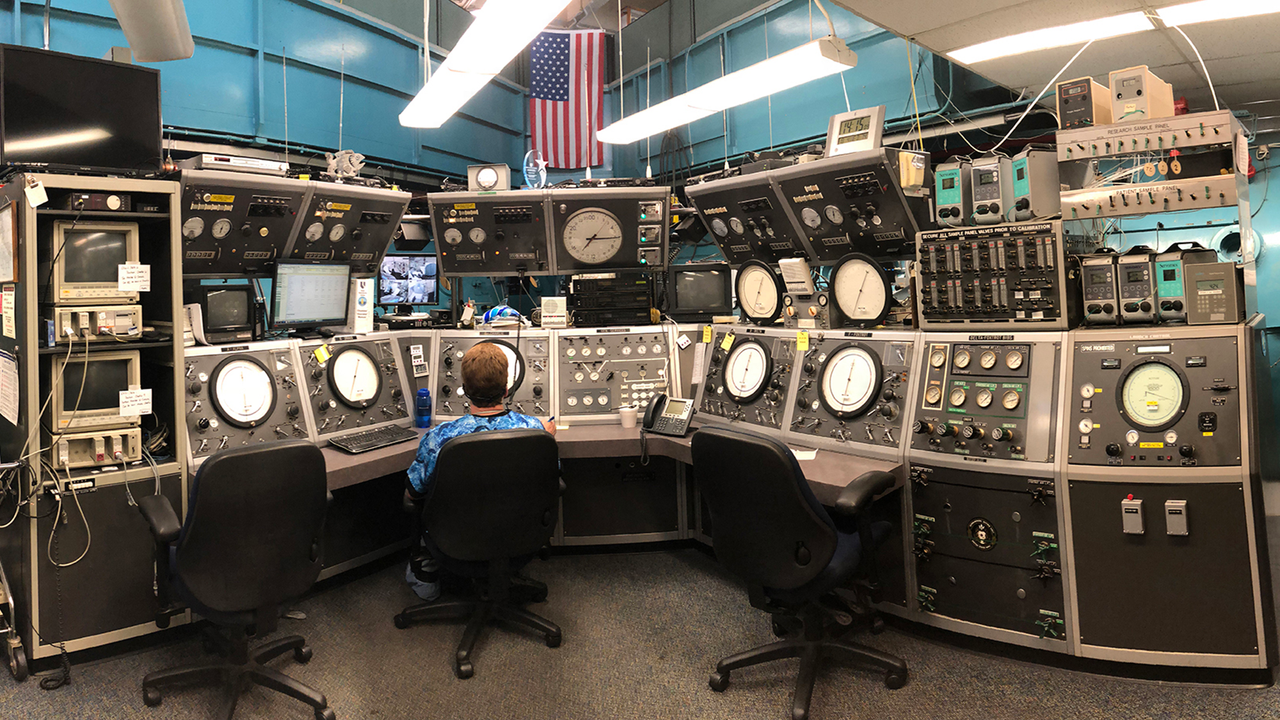
The team tested the gas inside a big, blue tank in Duke's hyperbaric facility. The pressure inside the vast tank can be altered to simulate the crushing conditions 200 feet (61 meters) below sea level.
The team ran their experiments with 40 pigs, whose biology makes them an appropriate model for studying the effects of diving. These pigs were fitted with custom-built suits featuring a hood, a built-in heater and a diaper, for emergencies.
All of the animals were sedated for hour-long simulated dives. Half breathed heliox for the entire dive, while the other half were switched to a mix of oxygen and CF4 for the last 10 minutes of their submersion. During this period, the helium in the pigs' bodies left their tissues and was replaced by the CF4. Because the latter gas is less soluble, it entered tissues more slowly than the helium left them. By the time these pigs resurfaced, there was less inert gas in their tissues, which reduced the risk of the bends.
Both groups of pigs were removed from their simulated dives at the same rate, and afterward, they were carefully monitored for three hours. The pigs that had breathed only heliox had much more pronounced signs of decompression sickness, such as impairment in their ability to walk and more bubbles of gas, or embolisms, in their hearts.
In many instances, these cases of depression sickness proved fatal; the dive and subsequent decompression killed over 80% of the heliox-breathing pigs in the three hours after the dive. By contrast, none of those that switched to CF4 died.
Related stories
Both Tetzlaff and Moon acknowledged that the findings won't immediately translate to a new standard of practice for human divers. For starters, the risk of decompression sickness for recreational divers is low enough — and the cost of CF4 is high enough — that few would likely switch their gases.
"I think the expense would limit it to commercial or military diving," Moon said.
Even if the population of people who would use CF4 is small, the new data could still have an important impact, Tetzlaff noted.
"Every dive that you can make safer is worth the effort, right?" he said. "Even if it only applies to a few people."
This article is for informational purposes only and is not meant to offer medical or diving advice.
Lance, R. M., Makowski, M. S., Mahon, R. T., Everitt, J. I., Natoli, M. J., Wright, M. C., Howle, L. E., Bartlett, N. C., Patel, A., Morales, G., & Moon, R. E. (2026). Isobaric counterdiffusion of carbon tetrafluoride breathing gas to prevent severe decompression sickness. Proceedings of the National Academy of Sciences, 123(33), e2600125123. https://doi.org/10.1073/pnas.2600125123
RJ Mackenzie is an award-nominated science and health journalist. He has degrees in neuroscience from the University of Edinburgh and the University of Cambridge. He became a writer after deciding that the best way of contributing to science would be from behind a keyboard rather than a lab bench. He has reported on everything from brain-interface technology to shape-shifting materials science, and from the rise of predatory conferencing to the importance of newborn-screening programs. He is a former staff writer of Technology Networks.
You must confirm your public display name before commenting
Please logout and then login again, you will then be prompted to enter your display name.