
Entertainment
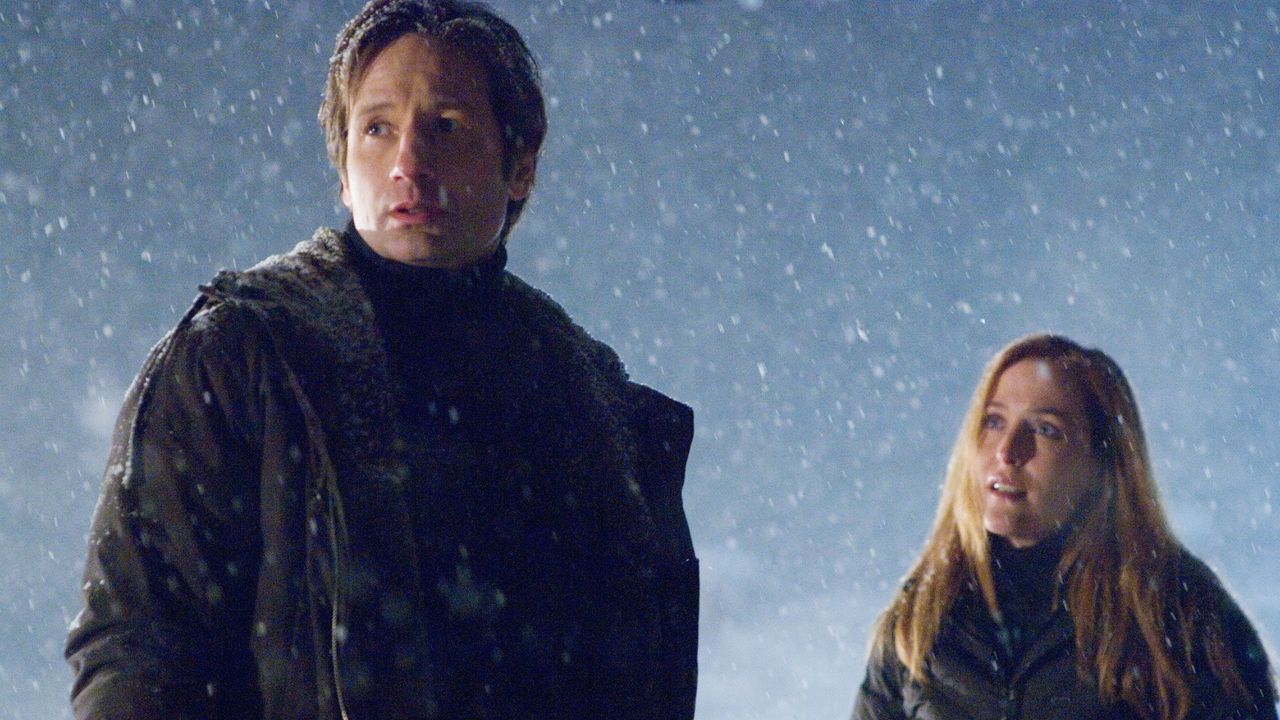
'The X-Files' creator Chris Carter says new director's cut of 'I Want to Believe' is 'the horror movie that we really wanted to make' (interview)
Key Points
'The X-Files' creator Chris Carter says new director's cut of 'I Want to Believe' is 'the horror movie that we really wanted to make' (interview) "In every conspiracy is the kernel of truth, and that's interesting to me as a storyteller." Eighteen years later, it still gives me a jump scare, even though I know it's coming.
'The X-Files' creator Chris Carter says new director's cut of 'I Want to Believe' is 'the horror movie that we really wanted to make' (interview)
"In every conspiracy is the kernel of truth, and that's interesting to me as a storyteller."
Eighteen years later, it still gives me a jump scare, even though I know it's coming.
Agent Mulder, hot on the trail of a group of murderers who are harvesting their victims' organs, breaks into a makeshift laboratory in an attempt to save an abducted woman. He finds a gruesome scene of bodies on ice and surgeons, scalpels in hand, preparing to transplant the villain's head onto the abducted woman's body. Mulder turns and — there it is! The villain's severed head on ice! And it opens its eyes.
It sounds less like a scene out of a science fiction mystery series and one more suited to a horror film. And that's precisely why Chris Carter, creator of "The X-Files", is revisiting the 2008 film "The X-Files: I Want to Believe" in a new R-rated director's cut coming to Hulu on Aug. 14.
Space.com got the chance to speak with Carter about the upcoming director's cut and the inspiration behind revisiting the standalone "X-Files" film nearly two decades after its release.
"I wanted to make the scary movie that I always had intended to make, intended to direct, and this is more in line with that," Carter told Space.com. "It gave me a chance to remember the making of the movie and what I had intended it to be, and how different it was from that original vision."
The director's cut features a new addition to the film's title — "The X-Files: I Want to Believe — Vrach Frankenshteyn". Carter said the name at the end (Russian for "Doctor Frankenstein") is a way of alluding to the tone and themes that he intended to focus on in the original film.
"It's a Frankenstein story, and the original inspiration for it was a doctor in Cleveland, Ohio, who transplanted the head of a monkey onto another monkey, and I thought that is perfect X-Files territory," Carter said.
Carter's original version of the film was re-edited two times in order for it to be released with the PG-13 rating that 20th Century Fox (now 20th Century Studios) insisted upon.
"When we first made the movie, we had a vision, and we tried to bring it to life. And when we took it to the executives at 20th Century Fox, they said, 'This isn't a PG-13 movie. This is torture porn.'
"And so we cut it back to what we thought was a PG-13 movie to placate the executives, and then we gave it to the motion picture censors, and they said this isn't a PG-13 movie."
With many of the horror elements cut or toned down, the 2008 theatrical release ended up focusing quite a bit of time on the relationship between Mulder and Scully — a fan-favorite part of the series for sure, but not one that Carter intended to be so central to "I Want to Believe."
The film's plot centers on a group of women who go missing. When a disgraced priest begins having supernatural visions of the missing women, agents Mulder and Scully come out of retirement to take on another case full of mysteries and unexplained events. Their investigation finds them uncovering an illegal organ harvesting operation, bizarre life extension experiments conducted by a murderous mad scientist, and unexplained supernatural occurrences and synchronicities: classic "X-Files" fare.
But despite being rooted in the long-running themes of the nine-season series, the film is accessible for first-time "X-Files" viewers or casual fans (or its underrated spin-off).
Rather than diving into the dense, overlapping conspiracies that form the series' core mythology of alien invasion and the government cover-up that keeps it a secret, "The X-Files: I Want to Believe — Vrach Frankenshteyn" is what is referred to as a "monster of the week" story. It's a standalone plot that doesn't require a deep knowledge of the series or its mythology to enjoy.
Interestingly, the film breaks with the tradition of director's cuts featuring loads of deleted scenes and footage that never made it past the cutting room floor. It actually features a shorter runtime than the theatrical release.
"And everyone asks me that; why is it with most directors' cuts they're always longer because they throw everything in that got cut out. In this case, I felt it could be streamlined a little," Carter said. "I lightened up a little bit on the Mulder and Scully relationship beats and focused more on the horror movie that we really wanted to make."
In keeping with "X-Files" tradition, the director's cut also leaves many of its core mysteries and supernatural elements unresolved. That central theme, the ongoing search for truth and meaning in a sometimes mysterious and unexplainable universe, reflects Carter's own views.
"I really think of science as a search for God, and there are so many big questions that are unanswered, and we are trying to find the answers to those things," Carter said. "And will those answered questions bring us closer to an idea or a how it how it all began? What came before the Big Bang?"
Perhaps in a case of life imitating art, another key theme of "The X-Files" has made its way into the halls of the White House and Capitol Hill in recent years.
The U.S. government has held several congressional hearings discussing disclosure of alleged UFO secrets. The Trump administration has even released dozens of files, images and videos of alleged UFOs, or UAPs, as they're now known. Conspiracy theories of all kinds, particularly when it comes to aliens, have become mainstream.
Does that mean the truth is really out there? It certainly shows that we, as a nation, want to believe. But whatever the case may be, it is that same wonder, the same drive to question authority and probe the unknown, that drives Chris Carter to explore "The X-Files" after more than three decades.
"In every conspiracy is the kernel of truth, and that's interesting to me as a storyteller," Carter said.
"The X-Files: I Want to Believe — Vrach Frankenshteyn" debuts on Hulu on Aug. 14, 2026.
You must confirm your public display name before commenting
Please logout and then login again, you will then be prompted to enter your display name.
Brett is curious about emerging aerospace technologies, alternative launch concepts, military space developments and uncrewed aircraft systems. Brett's work has appeared on Scientific American, The War Zone, Popular Science, the History Channel, Science Discovery and more. Brett has degrees from Clemson University and the University of North Carolina at Charlotte. In his free time, Brett enjoys skywatching throughout the dark skies of the Appalachian mountains.