
Science
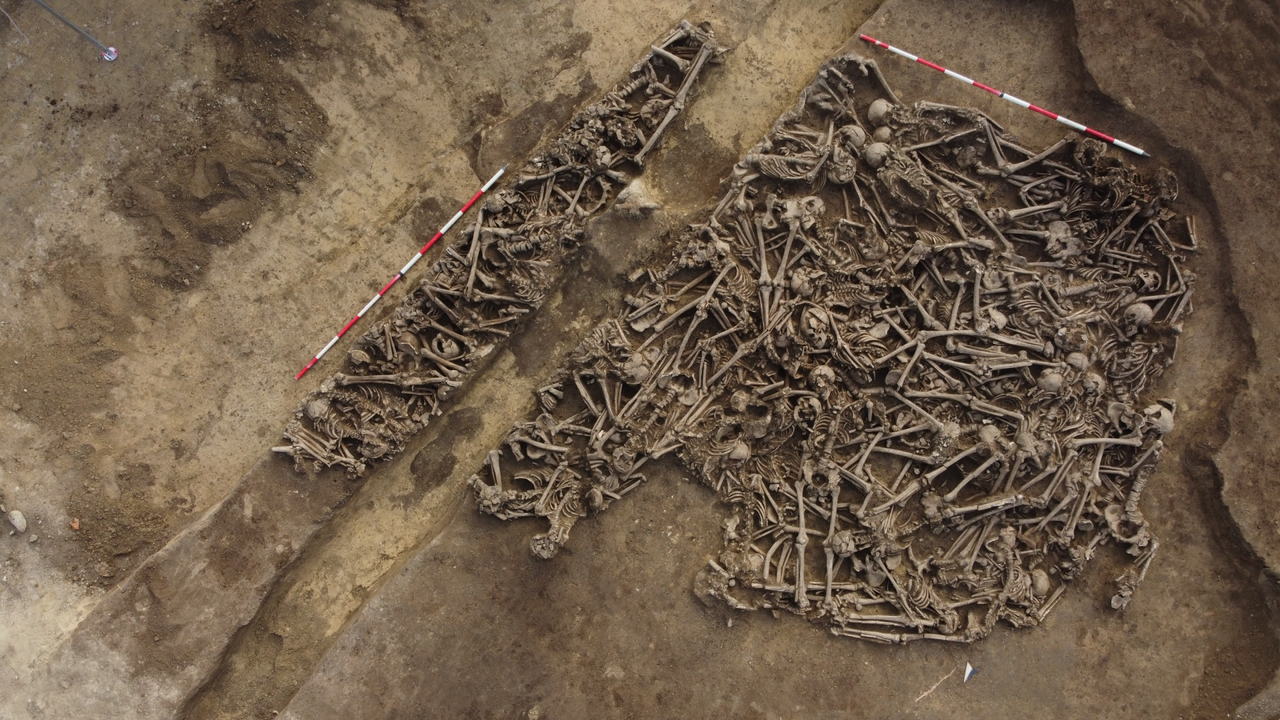
'The lance head was still inside the pelvis:' Mass grave found in Austria may hold casualties of unknown ancient Roman battle
Key Points
'The lance head was still inside the pelvis:' Mass grave found in Austria may hold casualties of unknown ancient Roman battle A new analysis of skeletons recovered from an ancient mass burial has revealed a surprising number of groin injuries. BERLIN — A Roman-era mass grave discovered underneath a soccer field near Vienna holds the skeletons of young men from all over the Roman Empire. And many of them suffered injuries to the groin before they died, archaeologists have found.
'The lance head was still inside the pelvis:' Mass grave found in Austria may hold casualties of unknown ancient Roman battle
A new analysis of skeletons recovered from an ancient mass burial has revealed a surprising number of groin injuries.
BERLIN — A Roman-era mass grave discovered underneath a soccer field near Vienna holds the skeletons of young men from all over the Roman Empire. And many of them suffered injuries to the groin before they died, archaeologists have found.
The grave, which held at least 129 people buried in an "extremely disorganized" manner, was excavated in 2024 and has been dated to the first to second centuries A.D. A new analysis is confirming what archaeologists initially suspected: These are likely the remains of Roman-era war dead.
"This is a spectacular find," Sheridan Strang, a bioarchaeologist with the archaeology firm Novetus, told Live Science. Strang presented new work on the skeletons on Aug. 6 at the 25th European Paleopathology Association meeting. The work is not yet peer reviewed.
The mass grave was discovered in Hasenleitengasse, a neighborhood in the outskirts of Vienna, which in Roman times was known as Vindobona. Archaeologists estimated that all 129 skeletons were males between the ages of 18 and 35. They did not find any typical grave goods in the burial but did discover a few weapons. At least two-thirds of the people buried in the mass grave had evidence of violent trauma inflicted around the time of death.
"We determined that these individuals were most likely soldiers, and they died from some kind of mass violence event, either a battle or a military campaign," Strang said in a research presentation attended by Live Science. "But we have no other evidence of a battle in this area around this time."
The Roman military camp of Vindobona was established in the late first century A.D. as part of the province of Pannonia. Situated on the Danube River, Vindobona was an important outpost that helped defend the border of the Roman Empire from Germanic tribes such as the Marcomanni. While historians know that battles were fought near Vindobona during the Marcomannic Wars (circa 166 to 180), nothing in the historical or archaeological records suggested there was ever a battle at Hasenleitengasse.
When Strang and colleagues investigated the traumatic injuries on the skeletons, they found evidence of sharp trauma, such as from swords or daggers, all over the skeletons, and blunt trauma mostly on the skulls. But projectile trauma was largely confined to the groin area.
Get the world’s most fascinating discoveries delivered straight to your inbox.
The most likely scenario for these pelvic injuries is an attacker on the ground using a throwing lance and targeting a gap in an enemy's armor as he rode horseback.
"We have one individual where the lance head was still inside the pelvis when we excavated him," Strang told Live Science. "The people who caused these injuries were aiming for these sensitive areas," she said.
The Hasenleitengasse mass grave is an important site for understanding projectile weapon use, Patrick Randolph-Quinney, a biological anthropologist at Uppsala University in Sweden who was not involved in the research, told Live Science. The fact that projectile trauma was focused on the groin and lower limbs "tells us about a possible lack of armor and protection in those areas — but also that the attackers knew how to incapacitate based on soft-tissue anatomy," he said.
But with no historical records of a specific battle and no archaeological evidence other than the skeletons, the researchers are now trying to figure out who the combatants were.
"We don't know if they were Romans, if they were the Marcomanni, or another Germanic tribe that was in the area," Strang said.
RELATED STORIES
- 'Extremely rare' Roman military camp found in Slovakia holds hastily buried remains of Marcus Aurelius' soldiers — with some dumped in wells
- Skeleton-filled well in Croatia likely holds remains of Roman soldiers, study finds
- French archaeologists uncover 'vast Roman burial area' with cremation graves 'fed' by liquid offerings
Preliminary DNA analysis of 25 of the skeletons confirmed that they were all chromosomally male. Additionally, the DNA revealed that those 25 individuals had diverse ancestry. Strang said that some of the men came from the Italian peninsula, others from mainland Europe, and three from the eastern Mediterranean and the Levant, a part of western Asia.
"These individuals may have been Roman military personnel," Strang said. "But they might not all be Romans. There's a chance that it is a commingled grave, with Romans and another Germanic tribe."
Further research on the skeletons is ongoing, Strang said. "Now that we have the remains, we can look at health, diet, and disease, and we can answer questions that were previously unknown from the archaeological record."
Strang, S. (2026, August 6). The mass grave of Hasenleitengasse: Perimortem trauma in a Roman-period mass grave site. 25th European Paleopathology Association Conference, Berlin, Germany. https://cfp.dainst.org/25th-european-ppa-meeting/talk/LCZ9CF/
From Augustus to Nero, see how much you know about ancient Rome's famous leaders with our Roman emperor quiz!
Kristina Killgrove is a staff writer at Live Science with a focus on archaeology and paleoanthropology news. Her articles have also appeared in venues such as Forbes, Smithsonian, and Mental Floss. Kristina holds a Ph.D. in biological anthropology and an M.A. in classical archaeology from the University of North Carolina, as well as a B.A. in Latin from the University of Virginia, and she was formerly a university professor and researcher. She has received awards from the Society for American Archaeology and the American Anthropological Association for her science writing.
You must confirm your public display name before commenting
Please logout and then login again, you will then be prompted to enter your display name.
Austria (LOCATION)
Roman (ORG)
BERLIN (LOCATION)
Vienna (LOCATION)
the Roman Empire (LOCATION)
Sheridan Strang (ORG)
Novetus (ORG)
Live Science (ORG)
Strang (PERSON)
European Paleopathology Association (ORG)
Hasenleitengasse (PERSON)
Vindobona (PERSON)
Pannonia (LOCATION)
the Danube River (LOCATION)
Germanic (ORG)