
Business & Finance
Down the rabbit hole: Social media is exploiting youthful angst for profit or politics
Key Points
Down the rabbit hole: Social media is exploiting youthful angst for profit or politics Teenage insecurities are nothing new, but social media has made it easier for commercial, political and ideological actors to identify what young people worry about, keep feeding those anxieties and offer products, communities or beliefs as answers. When Renee (not her real name) was around 14, beauty and skincare videos began filling her social media feeds, from products promising better skin, to...
Down the rabbit hole: Social media is exploiting youthful angst for profit or politics
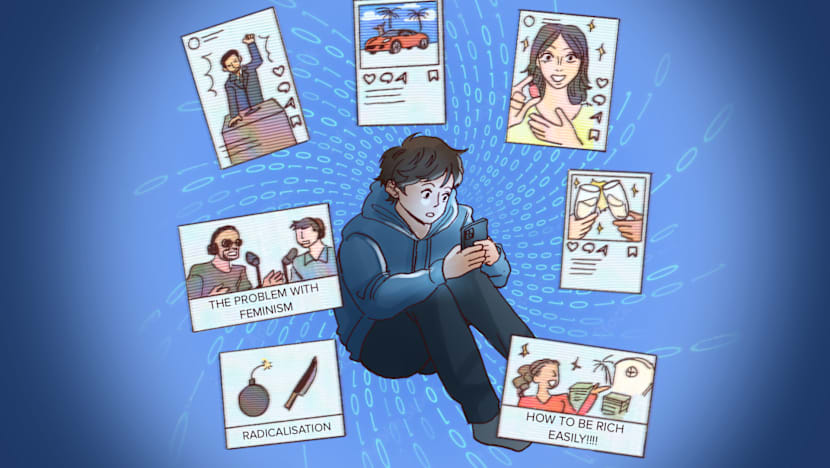
Teenage insecurities are nothing new, but social media has made it easier for commercial, political and ideological actors to identify what young people worry about, keep feeding those anxieties and offer products, communities or beliefs as answers.
When Renee (not her real name) was around 14, beauty and skincare videos began filling her social media feeds, from products promising better skin, to elaborate "everything showers" where users spend longer than usual on a full-body routine involving steps such as deep cleansing, exfoliation and haircare.
She asked not to be identified by her real name because of the sensitive nature of her experience and her young age.
Renee had initially sought out skincare and makeup content for clearer skin and to cover her acne, as well as videos on losing facial fat and weight and watched them because they seemed fun. But as the same kind of posts kept appearing even when she was no longer actively searching for them, she started comparing herself more closely with the faces and bodies on her screen.
"It was mostly insecurity," said Renee, now 15. "It made me feel, 'Oh, maybe I need to look better'. Then it became, 'How do I look better?'"
Before long, that question had a ready-made algorithmic answer: cosmetic products. At just 14, she became set on getting a S$100 (US$78) retinol cream – a product more commonly associated with reducing signs of ageing such as fine lines and wrinkles.
"I tried to convince my mum to buy it for me," she recalled, though her mother ultimately refused. "Looking back, it's stupid. Why do I need retinol (at this age)?"
For Aldrin Ardiansyah, 17, the influence of online content became apparent in lower secondary school, when some of his friends began echoing the views of Andrew Tate – a self-described misogynist and social media influencer known for promoting an aggressively masculine persona and views widely criticised as demeaning towards women.
Tate's clips were appearing on Aldrin's TikTok feed too. At first, he found himself watching them just as entertainment, but later stopped interacting with the videos because he did not want to help popularise them and hoped the algorithm would stop recommending them.
Because such content was already common on his own feed, he said he was not particularly surprised when schoolmates began repeating Tate’s ideas, sometimes in what he saw as a joking or satirical way.
The first-year polytechnic student believes his friends' ages made them more impressionable, while the lack of alternative viewpoints around them meant there was little to challenge what they were seeing online.
"I think the content targeted boys who felt small or powerless, and gave them the wrong kind of confidence by affirming certain ways of thinking," he said.
I think the content targeted boys who felt small or powerless, and gave them the wrong kind of confidence by affirming certain ways of thinking.
Tate and his brother, both in their late 30s, were arrested in Miami, United States, last month on an extradition request from Britain, which has charged them with rape. The two have denied wrongdoing.
While the experiences of the two Singaporean teenagers, Renee and Aldrin, differ, both show how ordinary adolescent insecurities and frustrations can be captured online and harnessed to promote products, communities or specific worldviews.
Experts told CNA TODAY that young people have become a prized demographic for commercial, political and ideological actors seeking to win their spending, loyalty or support.
At the extreme end, recent cases of self-radicalised teenagers in Singapore have shown how online influence can translate into extremist beliefs and plans for real-world violence.
These incidents have sparked much debate over whether stronger safeguards, including banning platforms such as Roblox, are needed to protect young users.
However, experts such as Dr Chew Han Ei, an online safety researcher and Associate Director (Impact) at Singapore Management University (SMU), cautioned that banning one platform may simply shift the risk elsewhere.
Instead, there is a need to understand what draws young people towards such content, and why they can be particularly susceptible to it.
Experts stressed that youthful insecurity and attempts to influence young people are hardly new. What has changed, they said, is the intensity and precision with which today’s personalised, always-on platforms can identify what captures a young person’s attention and keep reinforcing it.
Youths from time immemorial have always struggled with emotional pressures, but experts said the online environment can magnify them in ways previous generations did not experience, while also allowing those seeking young people's attention to target them far more deliberately.
WHY YOUTH MAKE EASY PREY
Young people are an attractive target precisely because adolescence is a period when questions of identity, belonging and self-worth are still being worked out.
Dr Ong Say How, senior consultant at the Institute of Mental Health's (IMH) Department of Developmental Psychiatry, said insecurity, loneliness or social rejection can make young people more receptive to online spaces that offer acceptance. They may also struggle to spot red flags because their judgment is still developing.
For some, that pull is stronger when support or connection is lacking offline, due to factors such as family conflict, anxiety or social rejection.
Dr Natalie Games, a senior clinical psychologist at Alliance Counselling, stressed that such receptiveness does not amount to weakness, but reflects ordinary developmental needs.
"Every adolescent is looking for belonging, significance, competence and a sense of identity," she said. "When those needs aren't being met consistently offline, online communities can become incredibly compelling."
Efforts by commercial, political or ideological actors to win young people's attention tend to be highly deliberate, even if they rarely appear that way to those being targeted.
Assistant Professor of Sociology George Wong at SMU said this subtlety is strategic – young people tend to be sceptical of messages that feel overt or preachy, so those seeking to influence them have to make the content feel natural.
"You cannot just push the ideology or agenda in their face," he said. "In youth language, you cannot be 'cringe'."
In terms of how this plays out in practice, Asst Prof Wong pointed to research on extremist propaganda on TikTok, where supporters of groups such as ISIS and Al-Qaeda used memes, coded symbols and other techniques to disguise extremist messages as ordinary platform content and thereby evade moderation.
A few searches or clicks can be enough for recommendation systems to latch onto an interest and begin reinforcing it, turning something a young person initially sought out into content that increasingly finds them.
Renee recalled how her journey into the rabbit hole was barely perceptible. She kept watching the beauty and skincare videos as they appeared, until they had become a regular feature of her feed.
"It got to a point where I couldn't help it, it would just show up," she said.
At the extreme, this feedback loop can lead users towards increasingly violent material. In one recent Singapore case, a 14-year-old detained under the Internal Security Act started with Roblox games, recreating school shootings on the platform before moving on to search for mass shooters and being exposed to more violent material online.
For other young people, the pathway may look far less alarming at first, beginning in spaces where they are seeking support, rather than harmful content.
Ms Wu, 22, who identifies as a lesbian and asked that only her surname be published as she is not fully out to her friends and family, said she first found support in online queer communities as a young teenager when she felt misunderstood at home.
By around 18, however, she was encountering content encouraging queer users to buy certain accessories or adopt particular styles to appear "more gay" – content she felt helped creators sell products.
She also came across more ideological posts, including one asking: "How can you not hate men when you're a lesbian?", followed by comments from some users saying they could not even tolerate their biological fathers.
"There is a lot of this kind of content in the community that makes use of our desire to find belonging," said Ms Wu, an undergraduate student.
At first, Ms Wu said she was shocked by such posts. But seeing many comments echoing the same views gradually made them seem more acceptable, and she began adopting some of the attitudes and ways of presenting herself that she saw online.
It was only later, after meeting peers whom she considered better influences, that she began distancing herself from such content.
WHY INFLUENCE HITS HARDER NOW
Teenagers worrying about how they look, where they belong or what others think of them is hardly a new phenomenon. What has changed is the environment in which those anxieties now play out.
Dr Games said social media does not necessarily create these vulnerabilities, but can act as a "powerful accelerator" by repeatedly feeding users content that reflects what already holds their attention.
Previous generations could leave school and get some distance from peer dynamics. Young people today carry many of those pressures with them throughout the day, while approval and popularity are rendered visible through likes, followers and views.
"Today's adolescents often carry those dynamics in their pocket," Dr Games said, adding that the constant exposure leaves less room to step away, reflect and work out who they are, away from an audience.
Social media is also responsive in a way older media was not. Associate Professor James Patrick Williams from Nanyang Technological University (NTU) noted that recommendation systems constantly observe, measure and interpret users' actions.
Someone repeatedly seeking content about an insecurity, such as their complexion, can consequently receive both more of that content and advertising related to it. The system may continue doing so even if the material worsens the insecurity because its incentives lie elsewhere.
"Algorithms are typically designed to increase revenue, not to increase an individual user's well-being," said Assoc Prof Williams.
Unlike earlier internet forums, where users largely chose what to click on next, social media platforms increasingly make that choice for them through recommendations and autoplay, he said. This gives users less agency over where their browsing takes them.
Asst Prof Wong said actors with vastly different aims – from brands to ideological communities – can tap into the same questions young people are trying to answer.
"They are telling youth: 'Hey, I have the answer', or, 'Join us to figure this out together,'" he said.
As recent youth-led protests in some countries have shown, the same dynamics can play out politically. Where youth movements historically formed around universities, schools or other physical institutions, young people can now encounter a grievance online and quickly discover others elsewhere who feel the same way.
Asst Prof Wong said this online mobilisation allows movements to draw in people across a wider range of backgrounds, at a quicker pace. The trade-off is that the lower barrier to participation can also make some involvement shallower, stopping at a like, share or post.
But in some cases, an online movement can gain enough momentum to spill over into the streets.
The 2025 protests in Nepal were one example, with young activists using platforms including TikTok, Instagram and Discord to organise around anger over corruption and a social media ban.
In Indonesia last year, days of anger on social media over lawmakers' housing allowances brought together people from student groups and other organisations, culminating in protests outside the parliament in Jakarta.
In India this year, the Cockroach Janta Party began as online satire before frustration over exam irregularities, jobs and the education system helped turn it into one of the country's biggest youth-led protest movements in years.
WHEN INFLUENCE TURNS HARMFUL
Where does typical teenage exploration end and harmful online fixation begin? For Dr Games, one useful test is whether a young person's online world is expanding their life or starting to shrink it.
Healthy engagement, the clinical psychologist said, tends to complement offline friendships, hobbies and learning. More concerning is when a young person's world begins to narrow around a single identity, community or belief system.
"What concerns me isn't curiosity. It's rigidity and loss of flexibility," Dr Games said, pointing to signs such as withdrawing from activities the young person once enjoyed, increasingly black-and-white thinking and growing secrecy around their online behaviour.
In Renee's case, the warning signs became harder to dismiss once they started spilling into other parts of her life.
Her grades suffered, and weight turned into a competition. If someone else lost weight, she felt she had to lose even more. At one point, she also cycled between not eating for days and binge eating, leaving her "miserable all the time", she recalled.
While she had never thought of herself as particularly skinny, she said she became increasingly conscious of her size as she spent more time on social media and compared herself with what she now sees as unrealistic standards.
The strain extended to her family too. Renee stopped living with her father and stepmother, whom she felt were too strict about her device use, and went on to have no contact with them for more than a year.
Renee's stepmother, Ms Janice (not her real name), who also asked not to be identified to protect Renee's identity, grew concerned by how much space the online obsession was taking up in the girl's life.
"She's a very bright and interesting individual," Ms Janice said. "So hearing that her inner world had kind of started consisting of all of these things, and only focusing on external appearance, that was concerning to me."
Ms Janice said the estrangement was a period of "deep emotional turmoil and grieving" for the family, particularly for Renee's father, who had previously been very close to her.
"Attempting to help your child while feeling like you cannot reach them makes you feel like you are struggling or failing as a parent," she said.
Watching Renee hide things from them and eventually cut off contact so she could continue behaving in ways they found worrying was painful, Ms Janice said.
To cope, Ms Janice and her partner spoke to close friends, many of them parents themselves. They were often advised that Renee needed space to make her own choices, and that they could only keep the door open for her to return.
For another youth, 17-year-old Chloe Tan, the pressure built up gradually until she could no longer hide her struggle.
She started using social media more actively at about 13. Insecure about her acne and body image, she spent heavily on skincare, followed workout routines and at times dressed more revealingly.
Those insecurities began to weigh more heavily on her from about 14, after she got her first boyfriend and became more conscious of comments about her looks, while social media exposed her to a steady stream of models and influencers who seemed "perfect and put together".
"I think there's always the appeal of wanting to be seen as cool, trendy and attractive," Chloe, now a polytechnic student, said. "My younger self was definitely quite desperate to prove myself and to be able to fit in."
By 16, fuelled by her social media consumption, her eating habits and body-image insecurities had escalated to the point where there were periods when she could not bear to look in the mirror and would do her skincare in the dark, while on worse days she ate as little as possible and drank water to keep herself full.
She eventually confided in her family, who talked through what she was struggling with and, as a religious family, prayed together.
But the platforms that had led her down this dangerous path showed her a way out too. Around the time that she was starting to question her habits and mindset, Chloe's feed began showing her a different kind of content: influencers promoting healthier eating, discouraging practices such as intermittent fasting at a young age and encouraging viewers not to see food as something harmful.
Chloe initially avoided such videos because they made her feel "quite called out". As they continued appearing, however, she started watching them and gradually became more receptive to their messages.
The pressure to look a certain way has not gone away, she told CNA TODAY. What has changed is that she is now more likely to question those standards instead of treating them as something she has to meet.
GUARDRAILS FOR YOUTH SAFETY
If young people are particularly vulnerable to these online pressures, expecting them to manage it all on their own is unrealistic, both youths and experts said.
Some interviewees felt stronger guardrails were needed. Aldrin, the 17-year-old, suggested raising the minimum age for social media use to 16 and requiring more robust age verification, rather than allowing users to simply enter a date of birth.
"There’s really nothing stopping them from consuming all this content especially when they're so impressionable," he said.
Ms Wen Yi, 26, believes that platforms should go further by limiting body-image and weight-loss content shown to younger users.
Her view is shaped by her own experience. At around 17, she followed influencers sharing weight-loss methods and for about six months ate only an apple and a cup of yoghurt the entire day. She was eventually hospitalised after becoming so malnourished that she struggled to walk, study or get out of bed.
"Teenagers may not have enough capacity to judge whether this content is good or bad, and to evaluate the consequences," Ms Wen, an honours student, said.
She did not cut back on social media, which she still saw as an important source of information. Instead, she said she became better at judging the content she encountered as she grew older.
Teenagers may not have enough capacity to judge whether this content is good or bad, and to evaluate the consequences.
That ability to assess what they encounter online is something young people need to develop alongside stronger safeguards, experts said.
Assoc Prof Williams from NTU said that preparing young people for the online world requires more than teaching them how to use digital tools safely and competently.
In Singapore, he noted that digital literacy efforts have tended to emphasise practical skills and online safety, such as using apps, avoiding scams and protecting personal information.
What young people also need, he said, is an understanding of the systems behind what appears on their screens, including how companies profit from their online behaviour, what they give up in privacy and how digital technologies can influence their habits, beliefs and relationships.
He said such issues could ideally be taught in schools, but that doing so would require educators to acknowledge that some mainstream economic practices and systems do not always serve individuals' best interests.
Experts also stressed the importance of youths' offline lives as a counterweight to whatever they may encounter online.
SHINE Children and Youth Services, a social work organisation, said trusted adults and offline communities can provide young people with stable relationships where they can question ideas and make mistakes without losing their sense of belonging. Sports, interest groups and volunteering can also give them sources of purpose and connection outside the screen.
Dr Games said parents need not understand every platform, but should remain interested in their teenager's world.
"Teenagers … need adults who are willing to understand them," she said.
Dr Ong, the senior consultant at IMH, likewise advised parents to encourage honest conversations about online experiences, listen without judgment and offer support rather than blame.
Drawing on her experience with stepdaughter Renee, Ms Janice said this meant looking past the most visible signs, such as clothing or makeup, to understand what was happening underneath.
"I think what's more important is to just be constantly asking: 'What do you mean by that?'" she said. "You may not always get a straight answer, but at least there is a line of communication that's open."
Several youths described how supportive relationships helped them gain distance from what they were consuming online. For instance, Aldrin said having older friends and parents he felt comfortable talking to gave him space to share what he was hearing from schoolmates and exposed him to perspectives that challenged those ideas.
For Ms Wu, support came from an older girlfriend who helped her "distinguish between online content and what was actually good" for her. She said parents should similarly try to understand not just what their children are doing online, but what difficulties may be drawing them there in the first place.
Asst Prof Wong from SMU cautioned, however, against responding to harmful ideas by simply replacing them with another set of beliefs adults deem "correct".
Young people need room to question what they are told, disagree and make up their own minds, he said. Organisations working with them should likewise involve them in shaping the spaces they participate in.
"As much as we have our own institutional goals of attracting youth, we all have a collective responsibility to ensure that youths are not exploited at vulnerable phases of their lives for nefarious gain," he said.
For Renee, pulling herself out began with recognising that the routines and standards she was chasing were making her miserable. "I don't want to feel like this forever," she recalled thinking.
She gradually drifted away from friends she felt were bad for her, reconnected with her parents and leaned on friends she could confide in. She also returned to interests she genuinely enjoyed, such as anime, comics and browsing bookstores, while becoming more selective about what she watched online.
“It's inevitable that I'm obviously going to be on social media, but it's about the type of content that I choose to consume,” she said.
[Image text:] 094
THE PROBLEM WITH
FEMINISM
RADICALISATION
HOW TO BE RICH
EASILY!!!