
Health
Meet the people keeping dialects and heritage languages alive in Singapore
Key Points
Meet the people keeping dialects and heritage languages alive in Singapore Beyond the buzz over Teochew box-office hit Dear You, some Singaporeans are determined not to let dialects and heritage languages fall out of use – by teaching, documenting and speaking them. A resident at a nursing home was sitting under an air-conditioner, visibly shivering, but she said nothing. Although a nursing assistant was just an arm's length away, the woman, who was more comfortable speaking in dialect,...
Meet the people keeping dialects and heritage languages alive in Singapore
Beyond the buzz over Teochew box-office hit Dear You, some Singaporeans are determined not to let dialects and heritage languages fall out of use – by teaching, documenting and speaking them.
A resident at a nursing home was sitting under an air-conditioner, visibly shivering, but she said nothing.
Although a nursing assistant was just an arm's length away, the woman, who was more comfortable speaking in dialect, could not easily communicate that she was cold.
Mr Eugene Lee, who witnessed the scene while volunteering at the nursing home years ago, still remembers it.
"There was a language barrier. She would rather suffer physical discomfort than say something," the 42-year-old said.
Over his years of volunteering, Mr Lee has come across many nursing home residents who struggle to communicate with people around them because they are more fluent in dialects or other heritage languages, leaving some of them socially isolated.
The co-founder of dialect learning platform LearnDialect.sg said that the difference can be striking. Seniors who had been staring vacantly at the television would suddenly light up when he spoke to them in Chinese dialects such as Hokkien or Teochew.
"Some of the seniors really come alive in conversation. The moment there is a language that they can engage in, they are, like, 'Ah, finally!' Most of them then start to share their life stories."
A large swathe of older Singaporeans still regularly speak dialects and heritage languages. Drop into any hawker centre and one is bound to hear strains of Hokkien, Malay and a variety of Indian languages.
At home, however, dialect use has been fading, with English becoming the dominant language.
Data from Singapore's Census of Population 2020 showed that only 8.7 per cent of residents aged five and above used dialects as the most common language at home in 2020, down 5.6 percentage points from 2010.
At the same time, the percentage of households that use English as the most common language rose from 32.3 per cent in 2010 to 48.3 per cent in 2020.
Yet, declining use does not necessarily mean declining interest.
There are signs that heritage languages still hold a powerful appeal in Singapore, and recent films have offered a glimpse of that appetite.
Singaporeans queued for hours last month to catch the Chinese box-office hit Dear You in its original Teochew, with some even travelling to Malaysia rather than settling for the Mandarin-dubbed version here. The film delves into the lives of the Teochew people who moved from China to Southeast Asia in the 1940s.
Similarly, Cantonese screenings of award-winning Hong Kong film The Last Dance sold out following its Singapore release in late 2024. The film, which focused on funeral rituals, explores the meaning of life and death.
Persistent demand by movie-goers led to extra screenings in 2025 at Golden Village cinemas and an extended screening by the Singapore Chinese Cultural Centre.
Such moments may thrust heritage languages back into the spotlight, but away from the big screen, people and groups have been quietly working for years to keep Hokkien, Teochew, Malayalam, Baba Malay and other heritage languages alive.
SPEAKING THEIR LANGUAGE
Mr Lee and his wife Ski Yeo, also 42, hatched the idea of starting a dialect-learning platform for Hokkien, Cantonese and Teochew in 2018 after noticing that fellow volunteers and other healthcare workers had trouble communicating with older residents in nursing homes.
Their first lessons were geared towards healthcare professionals and nursing home workers, most of whom were migrant workers from Cambodia, India and the Philippines.
Besides healthcare workers, their students also include Singaporeans who want to communicate with their elders.
Mr Lee vividly recalled the first time a student approached him with the intention of learning Hokkien so that she could communicate with her terminally ill grandmother.
"Across the years that we have been teaching, there are more and more of these instances ... At least for that student, she still had time."
They have also coached students who are getting married and wish to pick up their in-laws' dialects, Ms Yeo said. Some students even learn a dialect with the express purpose of impressing their new family during their wedding speech.
Mr Lee and Ms Yeo charge a fee for their lessons, but the number of students they teach is not quite enough to sustain both of them, and the couple see this as a passion project.
Mr Lee is a part-time sake sommelier, and his wife runs a wine-tasting educational platform.
Elsewhere, freelance instructor Anddi Goh, 40, has been teaching Hokkien since 2023 in addition to his day job as a hospital finance manager.
Mr Goh, who teaches at the Singapore Hokkien Huay Kuan Cultural Academy, said that he helps secondary school students connect with their parents and grandparents.
A part-time getai performer, he was approached by the academy after a performance to ask if he was interested in conducting language classes.
"The students hear their parents and grandparents speaking Hokkien at home, and they want to understand what the elders are saying.
"They feel that they're being left out in family conversations."
When they finally get to be in on these conversations at home, their excitement is "quite cute", he said with a laugh.
Sensing their joy in learning a new language also gives him some hope that he can help to slow the decline of dialect use and, by extension, the decline of interest in the getai performance art. It is usually staged during the Hungry Ghost Festival in the seventh lunar month.
Mr Jeremiah Soh, 41, the marketing manager of the academy, said that dialects might not be as essential as they once were for communication. However, they still help to break the ice with seniors.
He gives the example of domestic workers attending the workshops and learning enough Hokkien to say, "Ama, jin sui (Grandma, you're beautiful)".
He also brought up how dialects and cultural values are intertwined. For example, greeting elders at mealtimes with "Ama, Papa, Mama, jiak png (Grandma, father, mother, eat)" conveys respect.
Beyond surface-level interactions, heritage languages also allow people to express care and intimacy, especially towards the older generation, he added.
CREATING SPACES TO SPEAK AND LEARN
Before Singapore became independent, the population, which was made up mainly of the Chinese, Malay and Indian ethnic groups, spoke a wide variety of languages.
When Singapore gained independence in 1965, English, Malay, Chinese and Tamil were named the country’s four official languages.
Around that time, the government's bilingualism policy came into effect, which meant that students would learn English alongside their mother tongue.
With some dialects and heritage languages left out of the public education system, advocates had to create their own language-learning spaces.
Among them is the Malayalam Language Education Society Singapore (MLES) for the Malayalam-speaking community, who were originally immigrants from Kerala.
These immigrants had different religions – there were Christians, Muslims and Hindus – but it was their common language, Malayalam, that bound them together.
Mr Jayadev Unnithan, 60, the chairman of MLES, said that the society was founded around 2010 after a group of Malayalee parents with pre‑primary and primary‑school‑age children wanted their young to learn Malayalam.
They were also hoping to get it recognised as a subject in schools.
By then, other non‑Tamil Indian languages such as Hindi and Punjabi were offered in some schools as examinable subjects, he added.
The parents then sought advice from Mr Gopinath Pillai, a prominent member of the Singapore Malayalee community. He recommended creating a dedicated language organisation where its sole focus would be Malayalam, separate from existing cultural and welfare groups representing the Indian community.
MLES did try to campaign for Malayalam to be an examinable subject in schools, but was not successful because Cambridge in England does not offer the language, Mr Unnithan said.
Still, the volunteer-run non-profit organisation has stayed true to its mission of preserving Malayalam in Singapore.
Since 2010, about 1,000 students have passed through the doors of MLES, and there are now around 50 to 60 active students.
The Malayalam lessons mainly serve children from about age five through primary school, but there are also conversational language classes for adults.
"If there were no MLES, the state of Malayalam in Singapore would be everyone for themselves. Now, at least, nobody can say they never had a chance to learn," Mr Unnithan said.
"Ultimately, the main goal is to ensure that there is an opportunity for any Malayalee, or anybody for that matter, to learn the language."
Other heritage language enthusiasts agreed that accessible spaces to learn and practise speaking the languages are crucial in their preservation.
After all, a one-off movie hit such as Dear You is not enough to sustain interest in heritage languages and dialects, the enthusiasts said.
Mr Michael Jow, the co-host of Singapore Hokkien Meetup, a free-to-join monthly gathering where participants practise speaking Hokkien, said that dialects and heritage languages need a "living space" to survive, not just classroom time.
Many of the adult learners, mostly in their 20s and 30s who join the meetups, often have nowhere else to practise their Hokkien, which is why Mr Jow, 50, and his co-host, Mr Yap Keh Han, 52, have been keeping these events running for seven years.
Mr Yap, a retiree, recalled asking an acquaintance in his 30s recently why he was not interested in learning dialects. The man's answer was simple: "None of my friends speaks dialects."
Mr Yap said: "It's all about the environment. If you want to get better at dialects, you have to create your environment, whether at home or otherwise."
As the more fluent Hokkien speakers, Mr Jow and Mr Yap often end up as the de facto teachers during gatherings at the Food Arena in Suntec City mall.
While juggling the demands of his day job as a sales manager, Mr Jow makes time to prepare vocabulary sheets for each month's meeting.
"During normal lessons, sometimes, the teacher will teach, but you don't get a chance to practise. I think the best thing about this Hokkien meetup is that you have a chance to practise speaking," Mr Jow said.
"This is a spoken language. You won't learn it if you never practise speaking."
PRESERVING WORDS FOR THE FUTURE
For some Singaporeans, relearning a fading heritage language is only part of the equation.
Just as important is preserving it – capturing its words, sounds and structures, so that they are not lost to future generations.
This has inspired efforts ranging from academic fieldwork to self-started online resources, driven as much by personal discovery as by a desire to aid other language learners or to have a record of these languages before they disappear.
Dr Nala Lee, an associate professor with the English, linguistics and theatre studies department at the National University of Singapore (NUS), said that her PhD dissertation involved more than a year of fieldwork, interviewing older Baba Malay speakers and using the data she collected to write a grammar of the language.
A prominent Baba Malay researcher in Singapore, Dr Lee said that the language, mainly spoken by Peranakan Chinese in Singapore and Malacca, has been declining over the years.
Baba Malay has traditionally been a language spoken at home. However, as more Peranakan Chinese marry outside of the community, English or other languages have replaced Baba Malay as the language used at home, she noted.
She hopes to document the language so that younger Singaporeans can hear what it sounds like and, perhaps, pique their interest in it.
"Through that work, I also came to appreciate my own identity as a Peranakan Chinese much more deeply," she added.
"A great deal of that culture within my family was lost after my grandfather passed away when I was a child. We also had Baba Malay cherita dulu kala (translated Chinese classics in Romanised Baba Malay), which were eventually thrown away because, at the time, no one really understood their value."
Her work has also boosted efforts to revitalise the language; she contributed her linguistic expertise to ChakapBot, an artificial intelligence chatbot project developed by Temasek Polytechnic and supported by The Peranakan Association Singapore.
For the average person without formal linguistic training, even knowing where to begin reclaiming their heritage language and finding the resources to learn can be difficult.
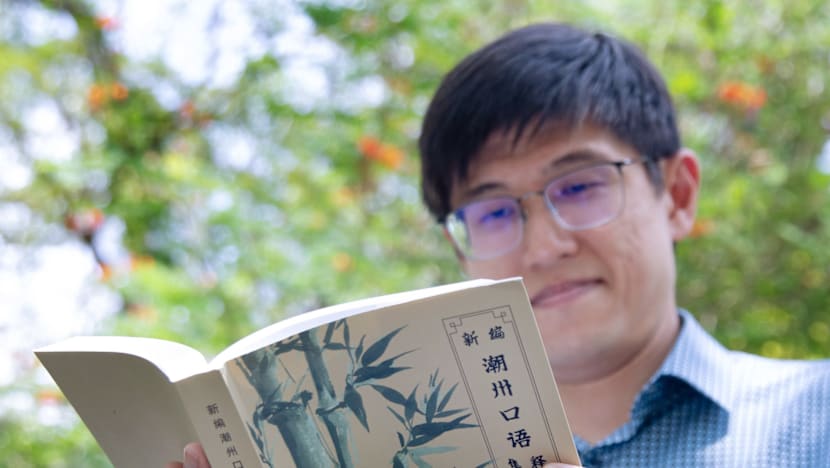
When Mr Brandon Seah, 39, started compiling Teochew learning resources in 2019, he remembered being frustrated.
"For me, the motivation was finding out how to say something more complex, because I could say very simple things like, 'Have you eaten?'
"But how do you express more communicative thoughts? You have to use more complex grammatical structures. That's something which you never learn."
The life sciences researcher found a lack of modern Teochew learning materials. Old dictionaries were organised by written characters, which are completely alien to most dialect speakers in Singapore.
"If you seriously want to learn a dialect, it's a bit of a slog. You have to find the resources, and then you realise they were never written for beginners like us."
After consolidating and organising all the resources he could get his hands on, and making them beginner-friendly where possible, he published everything on the website he built, Learnteochew.com.
"For many people my age, we understand what our elders are saying, but we find it hard to form sentences. That was one motivation for me to start the website," he explained.
While his family has not explored the nuances of Teochew to the same extent, Mr Seah said that his efforts to learn and document the dialect have connected him with others in the Teochew community.
He has even found his way into a Discord chat for the global Teochew diaspora and joined gatherings in France and the United States.
"The Teochew community is very small, but the (immigrants) are all over the world. People have very different backgrounds, yet they all mention the same thing – they don't want to lose the language."
WHAT WE LOSE WITH A LANGUAGE
The heritage language enthusiasts who spoke to CNA TODAY largely acknowledged the uphill battle ahead, but are determined to soldier on, given how much would be lost if their efforts falter.
Mr Raphael Lee, 23, an economics and mathematics student from NUS who has been curious about his roots and heritage, built Tiagong.sg in July.
On his website, users can brush up on Hokkien, Teochew, Hainanese, Hakka and Cantonese through flashcards and quizzes.
He eventually hopes to expand the user base and help connect dialect learners with mentors.
It has been difficult to get his peers interested in his website, he said, because most of them are pragmatic and would rather spend their time learning languages such as French or German, which may serve them well if they ever work overseas.
Dialects and heritage languages, on the other hand, do not seem as useful to them, he added.
"If you learn Teochew, maybe you can talk to people in Hougang?" he said half-jokingly, referring to the north-east neighbourhood where many Teochew speakers are known to live.
He figured that what might get younger people to learn dialects would be the idea that people always want to trace their roots. He himself is planning a visit to Shantou, China, with his parents next February to see the birthplace of his great-grandparents.
Mr Unnithan from MLES said that what is at stake when such languages are lost is more than just heritage.
"Ultimately, it's important for us all to be Singaporeans while also understanding our heritage.
"Otherwise, along the way, your foundations are not strong, then you, as a person, are not steady," he added.
Mr Eugene Lee, co-founder of LearnDialect.sg, said that beyond communication, heritage languages also serve as carriers of cultural heritage and have "deeper cultural flavour".
He fears that dialects such as Hokkien would be reduced to "simple greetings, food vocabulary and swear words".
"I do hope, one day, what we remember of the southern Chinese languages are not just restricted to the food items like Hokkien mee or Teochew fishball noodles," he quipped.
Dr Lee from NUS stated that it is "always worthwhile to document and preserve" any language.
"Every language offers a somewhat different perspective on the world, and every language has structural features that contribute to our understanding of what human language and, ultimately, the human mind, is capable of," she said.
Mr Alex Goh, 29, the founder of the Xin Long Feng Opera Troupe, is keenly aware that if dialect proficiency continues to drop, it will have an impact on his performance art.
The form of Hokkien opera that Mr Goh does is often entirely improvised on the fly, even with familiar stories that they have performed repeatedly, which makes every story seem a little bit different.
However, the downside of this improvisational nature is that having translations or subtitles is not feasible.
Whenever younger people attend the shows, Mr Goh has noticed that they often have to rely on reading the Chinese or English summaries of the storyline in order to understand what is going on.
Still, he is keen to take more young people under his wing at no charge, even if they might not be proficient in Hokkien.
Members in his troupe are aged from 21 to 80, which is somewhat unconventional for an artistic field dominated by senior citizens.
"I am trying to attract more youngsters to preserve this culture. I don't want it to disappear.
"Dialect is our life; it's our roots. It's not about being 'good' at it. Just learning and using it is already very important."