
Technology
China’s ‘electric eel’ sensor allows robots to feel an object without touching it
Key Points
Advertisement China’s ‘electric eel’ sensor allows robots to feel an object without touching it The robot’s fluoropolymer-coated sensor acts like a battery to create an electric field that can detect metal, plastics, glass and wood 2-MIN READ2-MIN Zhang Tongin Beijing Electric eels hunt in pitch-black, murky waters by generating electric fields around their bodies. Now, Chinese scientists have mimicked this natural radar, giving robots the ability to “feel” objects without making physical...
Advertisement
China’s ‘electric eel’ sensor allows robots to feel an object without touching it
The robot’s fluoropolymer-coated sensor acts like a battery to create an electric field that can detect metal, plastics, glass and wood
2-MIN READ2-MIN
Zhang Tongin Beijing
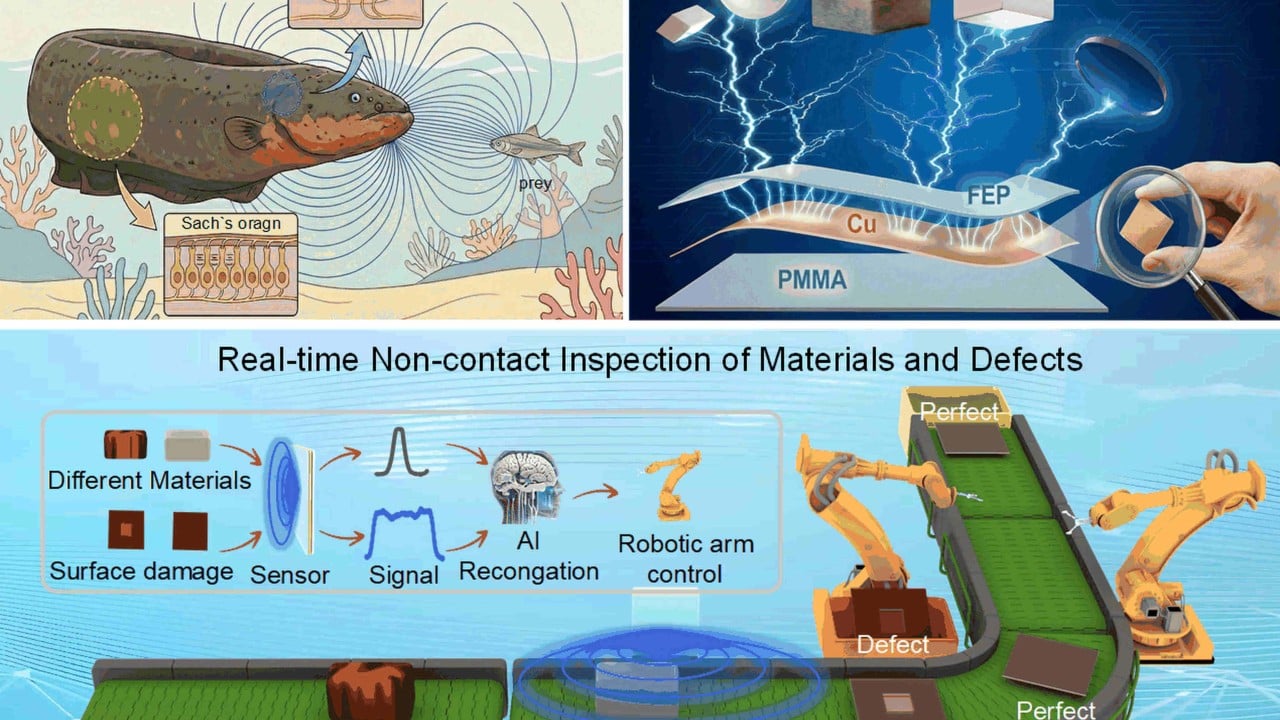
Electric eels hunt in pitch-black, murky waters by generating electric fields around their bodies. Now, Chinese scientists have mimicked this natural radar, giving robots the ability to “feel” objects without making physical contact.
“We want the machine to sense an approaching target – distinguish its material and surface condition – before any physical contact,” said Zhang Weiqiang, a professor at Xidian University, in a video interview last week.
Their work was published last month in the peer-reviewed journal Advanced Materials.
The team drew inspiration from the eel’s locating system. The hunter generates an electric field around itself and reads distortions in that field caused by nearby objects. The researchers borrowed the same logic – build a field, detect disturbances and extract information.
The sensor is made of a specially treated fluoropolymer that acts like a tiny static battery. Once charged, it keeps its charge for a long time, creating a steady electric field around it – like an invisible spider’s web.
“When an object draws near, the sensor picks up changes in the field and from those changes, it can infer the object’s electrical conductivity, dielectric properties and geometric shape,” Zhang said.
Advertisement
Select Voice
Select Speed
1.00x
[Image text:] Sach's oragn
oodddddo
CuDo
PMMA
FEP
Real-time Non-contact Inspection of Materials and Defects
Perfec
Different Materials
Surface damageSensor
Al
Robotic arm
Signal Recongation
control
Defect
Perfect