
Politics
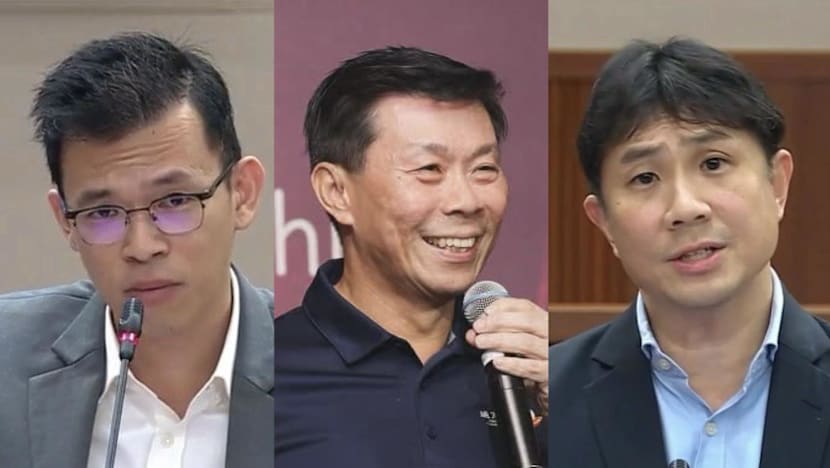
Ex-Senior Minister of State Lee Yi Shyan, WP MPs spar over party's stance on foreign firms
Key Points
Ex-Senior Minister of State Lee Yi Shyan, WP MPs spar over party's stance on foreign firms The exchange follows a Workers' Party parliamentary motion on Singapore's economic future tabled by MPs Kenneth Tiong and Jamus Lim on Aug 5. Former Senior Minister of State Lee Yi Shyan on Sunday (Aug 16) questioned what is the Workers' Party's alternative economic playbook, as he argued that recent economic growth motion was part of a familiar pattern of having "no coherent, consistent and...
Ex-Senior Minister of State Lee Yi Shyan, WP MPs spar over party's stance on foreign firms
The exchange follows a Workers' Party parliamentary motion on Singapore's economic future tabled by MPs Kenneth Tiong and Jamus Lim on Aug 5.
SINGAPORE: Former Senior Minister of State Lee Yi Shyan on Sunday (Aug 16) questioned what is the Workers' Party's alternative economic playbook, as he argued that recent economic growth motion was part of a familiar pattern of having "no coherent, consistent and well-grounded plan".
It drew a swift response from WP’s Aljunied GRC MP Kenneth Tiong, who had tabled the Aug 5 motion in parliament, that “the real world is not black and white, and neither are the trade-offs in it”.
Sengkang GRC MP Jamus Lim, who tabled the motion alongside Mr Tiong, also took to social media on Monday, calling the dichotomy of small- and medium-sized enterprises (SMEs) and multinational companies (MNCs) “such a distraction”.
The WP's original motion had called for an economy that works for all Singaporeans, laying out the opposition party's economic vision and playbook. It was later amended and passed, calling for a more equal and inclusive economy with a place for both local companies and global enterprises.
Mr Lee wrote in a Facebook post that he was "taken aback" after hearing Mr Tiong and Associate Professor Lim's proposed plans to boost local companies.
He said he had worked with entrepreneurs and SMEs that were growing and venturing abroad, in his time handling economic policies as a civil servant and then as a political office holder.
“I’ve also seen firsthand how MNCs in Singapore create opportunities for local companies, and help them build capabilities and reach new markets,” said Mr Lee, who held portfolios in the ministries of trade and industry, manpower and national development from 2006 to 2015.
Mr Lee left politics in 2020 and is currently the chairman of Business China and executive adviser to real estate and healthcare group OUE Ltd.
“So yes, we want dynamic local companies and healthy domestic demand. But neither can substitute for foreign investment and global markets.”
He highlighted that Singapore has a domestic market of only 6 million people. Its total trade, at more than three times its gross domestic product, is the result of decades of work connecting the country to the world, Mr Lee said.
“Our domestic market alone could never sustain the jobs and living standards Singaporeans aspire to.”
Countries everywhere are competing harder to attract and retain investments today, with governments offering large incentives to reshore strategic industries, he added.
“At a time like this, can Singapore afford to shift away from attracting multinational investments – and the jobs, technology and capabilities they bring?” asked Mr Lee.
Mr Lee also took aim at what he called the WP’s “political opportunism”.
“Too often, the WP formula seems to be this: when a government policy is popular, demand more of it; when it is unpopular, oppose it while playing down the consequences of the alternatives it offers,” he said.
He cited foreign worker numbers, the Build-to-Order flats programme and the Goods and Services Tax as examples.
Mr Lee added that such an approach does not represent "legitimate differences over policy calibration", but is instead about "taking the politically easier position at every turn".
“On the surface, the WP seems to present a fundamentally different approach from the government. But look more closely and there is often no coherent, consistent and well-grounded plan behind its ‘alternatives’,” he said.
In response, Mr Tiong said the WP had advanced the motion "in good faith, on a question that needs sustained and complex debate about trade-offs if we are to reach good answers".
“The real world is not black and white, and neither are the trade-offs in it. We are best served by a politics that puts policy first and leaves the point-scoring aside,” he said.
“We had a fruitful airing of ideas in the House. The mischaracterisations of a few should not be the last word on it.”
LOCAL VERSUS FOREIGN
In his post, Mr Tiong said the WP had not suggested choosing between local enterprise and MNCs, noting that this was settled before the final vote on the motion.
He said Transport Minister Jeffrey Siow, who is also Second Minister for Finance and co-chairs the Economic Strategy Review committee on global competitiveness, had accepted Assoc Prof Lim's clarification in parliament that this was "a false dichotomy that we did not draw", and that the WP takes the view that both MNCs and SMEs matter.
“What we suggested was to supercharge local enterprise: automatic support for new registrants, seconded experts, wider R&D tax deductions, grants to match MNC starting salaries, German-style internships,” he said. “None of it, a zero-sum policy.”
He added that the party did not say domestic demand alone could power Singapore's economy, but that "domestic demand is necessary, not that domestic demand is sufficient".
Mr Tiong cited Minister for Trade and Industry (Energy and Industry) Tan See Leng, who has said his experience building Parkway Holdings showed the domestic market was a good platform to build credibility, trust, reputation and proof of concept before expanding abroad.
Mr Tiong also addressed Mr Lee's claim that the WP had "backed down" as its arguments were tested during the debate, saying he had cherry-picked the phrases "wean ourselves", "pivot toward SMEs" and "conscious shift" from the opening of Assoc Prof Lim's speech while leaving out later parts.
This included the part where Assoc Prof Lim said he was not calling for "a wholesale overhaul of our GLC-heavy, MNC-led and foreign capital-reliant model" as it would "amount to killing off the golden goose", nor that he was "proposing that we abandon our foreign investment and shut the door to foreign capital flows", said Mr Tiong.
In his post, Mr Lee said that "the WP accepted the PAP's amendments to the motion affirming the importance of both global companies and local enterprises, and both external and domestic demand".
He said the disagreement in the debate was "largely over how much more we should do for SMEs, and how existing schemes can be improved".
“Those are perfectly legitimate issues to debate. But they do not amount to a fundamentally different economic strategy. After all the rhetoric about a ‘pivot’ and a ‘shift’, it was much ado about nothing,” said Mr Lee.
LIM DEFENDS WP'S VISION
In his Facebook post, Assoc Prof Lim defended the WP's proposals. He said Singapore has raised its per capita income over the past half century with forced saving through CPF, financial repression via an undervalued exchange rate, and ramping up inputs to production, such as importing foreign capital, redirecting national savings to investment and "educating the heck out of our workforce".
This approach, also taken by Japan, South Korea, Taiwan, Hong Kong and China, has been pushed to its limits by the government, he said.
“The problem, as we see it, is that the model is exhausted (as are our people). We can keep going, of course, but such rude growth appears ever more unsustainable. It’s hard to outrun rising input prices on the back of cost-cutting alone,” he said.
The WP's vision is hence for this economic model to evolve away from growth driven by accumulation to one led by productivity, something which is "best found in small, nimble, innovative firms, arising indigenously, rather than lumbering multinationals", he said.
“Of course, we still have much to learn from MNCs and will always still benefit from foreign capital and technology. We shouldn’t shut our doors, and to suggest that would be silly. It’s like killing a golden goose, while it’s still producing eggs,” said Assoc Prof Lim.
“But it does mean understanding priorities, and not blindly chasing growth for growth’s sake. It does mean stressing R&D – especially the ‘D’ part – that pushes our private sector to translate innovation into commercial products.”
Such a change would bring investments that foster home-grown national champions and better work-life balance, he said. Training would also feel less like a rat race and more a pursuit of potential, while laid-off workers would not be left to their own devices in seeking reskilling.
“The willingness to shift from an old model that has served us well, while scary, offers the promise of a new, sustainable, people-centered and SME-driven economy. This is creative destruction, of the best kind,” said Assoc Prof Lim.
Mr Lee said a genuine and important difference between the People's Action Party (PAP) and the WP lies in their approach to the national reserves.
The WP has repeatedly argued for greater use of the reserves accumulated by earlier generations, while the PAP safeguards the reserves for future generations and unforeseen emergencies, he said.
“We are entering a more difficult and uncertain world. Competition will intensify. Technology will disrupt jobs and businesses. Our population is ageing. Our spending needs will continue to rise,” said Mr Lee.
“It is easy to take positions that are politically attractive. It is much harder to make choices, confront trade-offs, and be honest about their consequences.”