
UK News
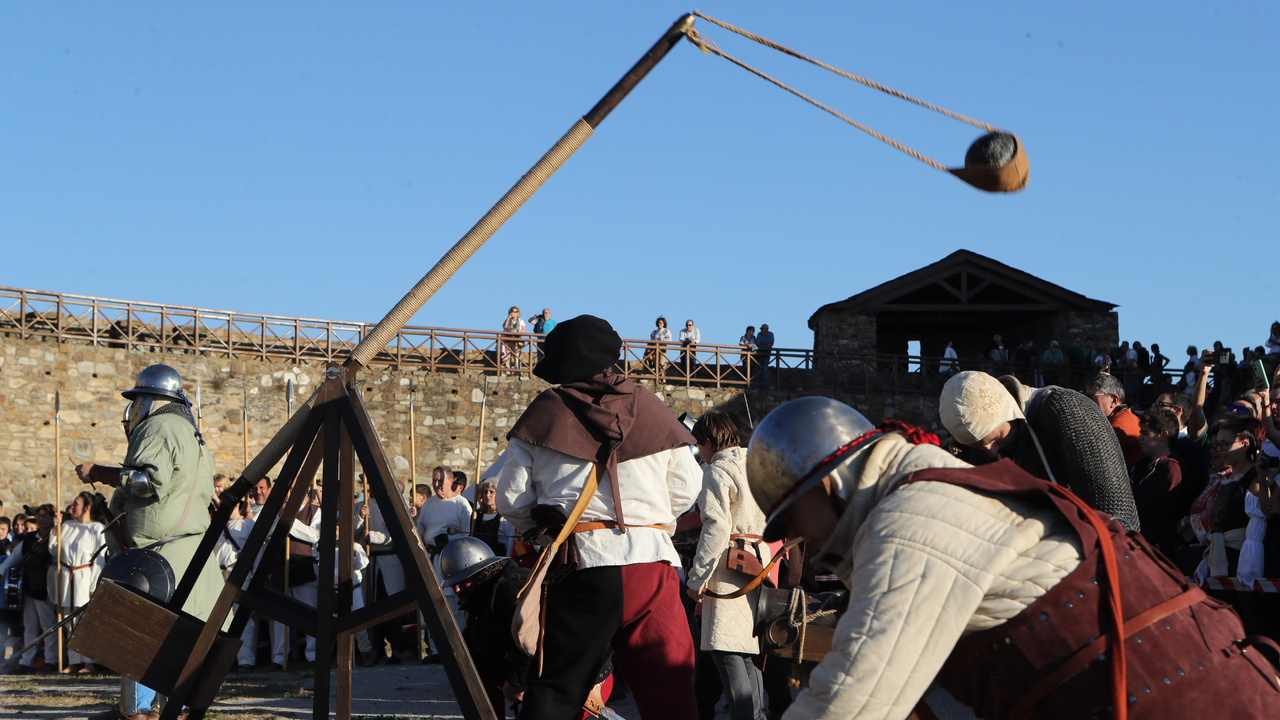
Skeleton with 167 fractures discovered at Scottish castle may have been first victim of Edward I's 'War Wolf' trebuchet
Key Points
Skeleton with 167 fractures discovered at Scottish castle may have been first victim of Edward I's 'War Wolf' trebuchet Dozens of fractures in a medieval skeleton found buried near a castle suggest the person may have been killed by a direct trebuchet hit. BERLIN — A 14th-century skeleton riddled with fractures may be the oldest known evidence of a death by trebuchet, or "siege engine," new research finds.
Skeleton with 167 fractures discovered at Scottish castle may have been first victim of Edward I's 'War Wolf' trebuchet
Dozens of fractures in a medieval skeleton found buried near a castle suggest the person may have been killed by a direct trebuchet hit.
BERLIN — A 14th-century skeleton riddled with fractures may be the oldest known evidence of a death by trebuchet, or "siege engine," new research finds. The individual, a medieval man whose remains were found inside Stirling Castle in Scotland, may have even been the victim of a famous trebuchet called the "War Wolf" built on the orders of the king of England.
The young man's remains, which researchers call Skeleton 150, were discovered in the Stirling Castle chapel alongside seven other medieval burials in 1997. In medieval times, the vast majority of people were buried in their parish church cemetery, so finding eight skeletons underneath the royal chapel was a surprise, Jo Buckberry, a biological anthropologist at Bradford University in the U.K., said in a research presentation Aug. 5 at the 25th European Paleopathology Association meeting.
Stirling Castle had an important role in the Wars of Scottish Independence between 1296 and 1357. Surrounded by steep cliffs, Stirling Castle had a strong defensive position for the Scots to defend themselves as the Kingdom of England was trying to control the Kingdom of Scotland.
All eight medieval skeletons buried in the castle had evidence of trauma inflicted on them around the time of death, including wounds from blunt objects, projectiles and a sharp blade, likely from a sword or knife. But only Skeleton 150 had a massive number of fractures.
"This is not what I'm used to seeing," Buckberry said in the presentation. "Could this be a weird form of medieval torture? Did he fall off Stirling Castle and bounce on the way down?"
Buckberry and colleagues meticulously studied all 167 fractures in the bones of Skeleton 150. They discovered that he had sustained 61 separate fractures to his skull and 57 rib fractures, in addition to breaks in his vertebrae, arms and right shoulder. But most of the damage was to the upper half of the man's body, and the fractures had an unusual zigzag pattern not usually seen in archaeological skeletons.
"I started looking at the forensic literature and the forensic collections," Buckberry said. "And there it was, the holy grail — a zigzag fracture to the rib" seen in someone who died in a road traffic accident. "That's great, but I'm in medieval Scotland," she said, "and a traffic accident is not likely to be the case."
Get the world’s most fascinating discoveries delivered straight to your inbox.
A carbon-14 analysis of the mysterious burials in the castle showed that Skeleton 150 dated to about 1300, in the middle of the First War of Independence and around the time that King Edward I of England was testing the use of siege engines in war, Buckberry said. Getting hit by a high-velocity projectile shot from a siege engine could possibly explain Skeleton 150's copious fractures.
When Edward I started to lay siege to Stirling Castle in 1304, he had up to a dozen siege engines, according to historical records. Edward even commissioned his military engineers to devise the largest trebuchet ever built at the time, called the "War Wolf," that reportedly sent a missile straight through two walls of Stirling Castle with ease.
"It's difficult to say whether or not the War Wolf was the weapon that caused the death of the individual, but it is likely that it was a siege engine similar to that that caused his demise," Buckberry said. "The trebuchet is the most likely."
The fractures also revealed that the young man was likely standing when he was hit by the high-velocity impact. "He certainly had his back to whatever was going on," Buckberry told Live Science. "He went from standing to the floor extremely rapidly," she said, suggesting it was likely an instantaneous death.
RELATED STORIES
"I don't think that he moved very far afterwards; it's not quite Wile E. Coyote," Patrick Randolph-Quinney, a biological anthropologist at Uppsala University in Sweden and a collaborator on the research, told Live Science.
When Skeleton 150 was excavated from Stirling Castle in the late 1990s, researchers assumed that all of his bony fractures were postmortem, perhaps caused by accidental trampling of the remains. But by using novel techniques developed over the past 30 years — including micro-CT scanning and 3D scanning, Buckberry was able to figure out that the fractures occurred around the time of death rather than after. And this allowed her to determine exactly how this Scotsman, who died in his 20s, perished over 700 years ago.
"If there's something there that's intriguing you, you keep following that question," Buckberry said, "because there's almost certainly a bigger story that you haven't quite tapped into yet."
Buckberry, J. (2026, August 5). Skeleton 150 from Stirling Castle, Scotland: The first evidence of trebuchet trauma in the archaeological record. 25th European Paleopathology Association Conference, Berlin, Germany. https://cfp.dainst.org/25th-european-ppa-meeting/talk/GHF9V8/
Can you identify these historical objects of war? Test your smarts with our weapons of the world quiz!
Kristina Killgrove is a staff writer at Live Science with a focus on archaeology and paleoanthropology news. Her articles have also appeared in venues such as Forbes, Smithsonian, and Mental Floss. Kristina holds a Ph.D. in biological anthropology and an M.A. in classical archaeology from the University of North Carolina, as well as a B.A. in Latin from the University of Virginia, and she was formerly a university professor and researcher. She has received awards from the Society for American Archaeology and the American Anthropological Association for her science writing.
You must confirm your public display name before commenting
Please logout and then login again, you will then be prompted to enter your display name.
Skeleton (ORG)
Scottish (ORG)
Edward (PERSON)
BERLIN (LOCATION)
Stirling Castle (LOCATION)
Scotland (LOCATION)
the "War Wolf (EVENT)
England (LOCATION)
Jo Buckberry (PERSON)
Bradford University (ORG)
U.K. (LOCATION)
European Paleopathology Association (ORG)
Scots (ORG)
the Kingdom of England (LOCATION)
the Kingdom of Scotland (LOCATION)