
UK News
1,700-year-old church discovered under a lake in Turkey may be the location of the First Council of Nicaea — but other experts disagree
Key Points
1,700-year-old church discovered under a lake in Turkey may be the location of the First Council of Nicaea — but other experts disagree A small church discovered beneath a larger one may have hosted one of the most important meetings in the history of Christianity, but some scholars not involved with the excavation disagree. Archaeologists say they have discovered the site where the First Council of Nicaea was held, an important gathering of Christian bishops in A.D. 325, according to the...
1,700-year-old church discovered under a lake in Turkey may be the location of the First Council of Nicaea — but other experts disagree
A small church discovered beneath a larger one may have hosted one of the most important meetings in the history of Christianity, but some scholars not involved with the excavation disagree.
Archaeologists say they have discovered the site where the First Council of Nicaea was held, an important gathering of Christian bishops in A.D. 325, according to the archaeologist who's leading the excavations. However, some experts who were not involved in the excavations have questioned this interpretation.
Nicaea was an ancient Greek city located in what is now Turkey, by the shore of Lake İznik (also known as Lake Nicaea).
The First Council of Nicaea, held in A.D. 325, brought together Christian bishops who aimed to settle theological differences and adopted what is now known as the Nicene Creed, a core statement of Christian beliefs. At that time, Constantine I (who lived circa A.D. 272 to 337) was emperor of the Roman Empire. He had legalized Christianity, and historical sources suggest he played a leading role in organizing the council.
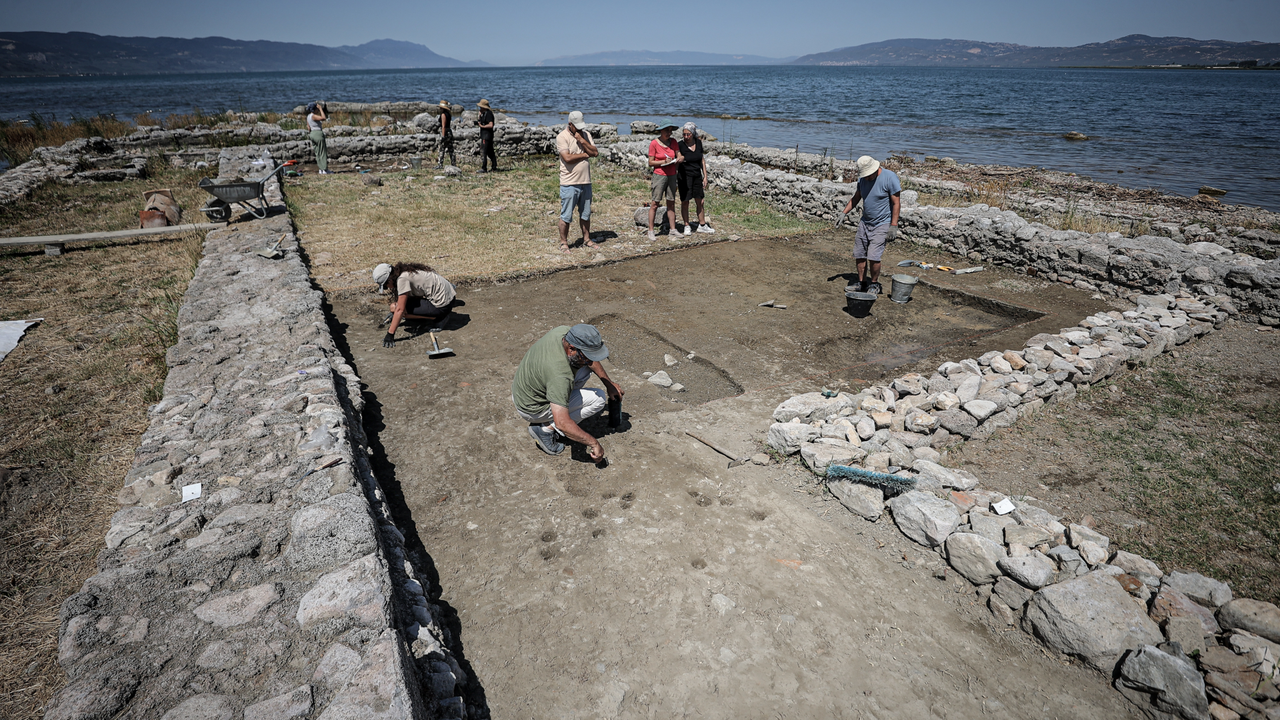
Archaeologists discovered a larger church beneath Lake İznik in 2014. Since 2015, excavations have gradually revealed the remains of a smaller church beneath the larger one. The team found a pavement floor from the smaller church that it is about a foot (30 centimeters) below the basilica, suggesting that the smaller church is older, said Mustafa Şahin, an archaeology professor at Bursa Uludağ University in Turkey who is leading excavations at the site.
One of the council attendees, named Eusebius of Caesarea, "explicitly states that the meeting took place in a 'house of prayer' or a small church," and this newly discovered church fits that description better than the basilica, Şahin said. His team hasn't determined the dimensions of the smaller church. However, based on historical records, he thinks it might be the "Church of Neophytos," while the larger church built on top might be the "Church of Holy Fathers." Neophytos was a Christian who lived in Nicaea and was killed in 303. The "Church of Holy Fathers" got its name to commemorate the Nicaea council.
It appears from historical records and archaeological remains that the smaller church was destroyed by an earthquake in A.D. 368, while the larger church was built on the site in A.D. 380.
No walls or decoration from the smaller church has been found so far. It's not clear what materials it was made from, as only the stone foundation pavement survives, Şahin said, but much of it may have been made of wood.
Get the world’s most fascinating discoveries delivered straight to your inbox.
Imperial palace
However, experts who were not involved with the excavations cautioned that it's not certain that the bishops met in this church and that, even if they did, the most important meetings would have been held in Constantine's imperial palace rather than in the church. But the imperial palace has not been found and may also lie under Lake İznik.
Young Richard Kim, a classics professor at the University of Illinois Chicago, noted that the smaller church has not been securely dated. In addition, Eusebius of Caesarea mentioned that the opening session of the council occurred in the "imperial palace" and that the council went on for three months. Therefore, we can't be sure that the church was one of the meeting places, he told Live Science in an email.
RELATED STORIES
Charles Odahl, a professor emeritus of history at Boise State University, also expressed caution about identifying the church as the meeting place. "The Council of Nicaea was held in an imperial palace beside Lake Nicaea," Odahl told Live Science in an email. "This underwater church was nearby, but not the site of the council's meetings under the emperor."
David Gwynn, a historian at Royal Holloway, University of London, told Live Science in an email that "the evidence that the earlier church may go back to the early 4th century and therefore have a potential connection to the Council of Nicaea looks promising." He cautioned however that he "would not exaggerate the importance of the physical church beyond adding a slightly greater glimpse of the world in which the council met."
Many people attended the Council of Nicaea. "The council itself lasted for more than a month and involved hundreds of bishops and perhaps 2,000 supporting clergy and staff," Gwynn said. "Nevertheless, these excavations do shed a further interesting light as well as attracting renewed attention to an event of huge importance to the development of Christianity."
Excavation and analysis of the site is ongoing.
What do you know about Jesus Christ, the man? Test your knowledge of biblical archaeology with our Jesus Christ quiz!
Owen Jarus is a regular contributor to Live Science who writes about archaeology and humans' past. He has also written for The Independent (UK), The Canadian Press (CP) and The Associated Press (AP), among others. Owen has a bachelor of arts degree from the University of Toronto and a journalism degree from Ryerson University.
You must confirm your public display name before commenting
Please logout and then login again, you will then be prompted to enter your display name.
Turkey (LOCATION)
the First Council of Nicaea (ORG)
Christianity (ORG)
Christian (ORG)
Nicaea (ORG)
Greek (ORG)
Lake İznik (LOCATION)
Lake Nicaea (LOCATION)
the Nicene Creed (ORG)
Constantine (PERSON)
the Roman Empire (LOCATION)
Mustafa Şahin (PERSON)
Bursa Uludağ University (ORG)
Eusebius (PERSON)
Caesarea (PERSON)