
Science
The S$700 storeroom: Inside Singapore's market for 'pocket-sized' rentals
Key Points
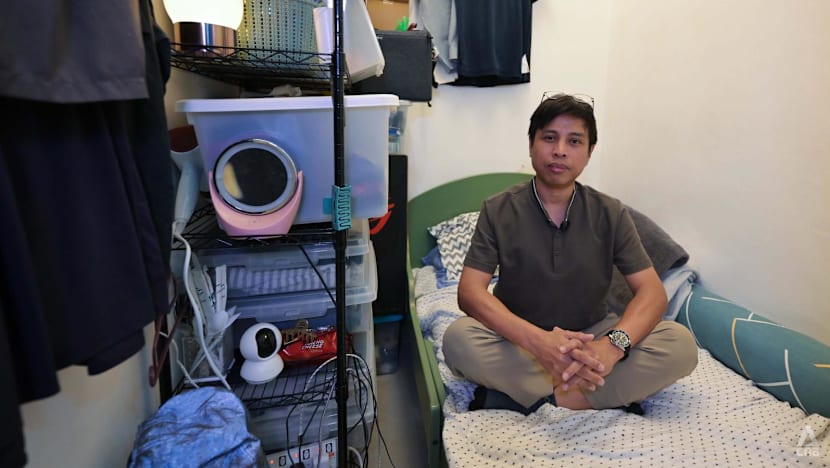
Inside Singapore's market for 'pocket-sized' rentals Amid high rents, some tenants are trading floor space for location and lower costs. SINGAPORE: When Mr Jao Santos moved into his rented room in December 2025, he had to send three guitars back to the Philippines and pack his desktop computer into its box. He also had to get used to sleeping in a bed smaller than the standard size.
The S$700 storeroom: Inside Singapore's market for 'pocket-sized' rentals
Amid high rents, some tenants are trading floor space for location and lower costs.
SINGAPORE: When Mr Jao Santos moved into his rented room in December 2025, he had to send three guitars back to the Philippines and pack his desktop computer into its box. He also had to get used to sleeping in a bed smaller than the standard size.
His room is just 2.9 sq m, measuring about 1.8m by 1.6m.
Mr Santos, 48, is part of a small group of people in Singapore renting very small rooms: utility rooms, storerooms, bomb shelters or rooms originally meant for domestic helpers. On property listing sites and Facebook, some agents call them "pocket rooms".
CNA's own checks found around 40 such listings on the PropertyGuru platform as of Monday (Aug 17). Telltale signs include a circuit breaker box, a bomb shelter vent, folding doors, or a lack of windows.
Some have space for a shelf or small cupboard; in others, a bed takes up the entire floor. A mounted rack may be the only storage available.
Listings on PropertyGuru show rents ranging from around S$500 to S$900 (US$390 to US$700) a month.
Mr Santos, a building information modelling coordinator at Changi Airport, pays S$700 plus around S$30 for utilities for a room in a private condominium located in Geylang.
He used to pay S$600 for a bigger room, but was willing to give up space and pay more for one thing: air-conditioning.
A PANDEMIC-ERA SHIFT
Statistics on the number of people who rent such rooms are not available, but the practice appears to have grown since the COVID-19 pandemic.
When border restrictions lifted, foreigners returned to Singapore and young locals began looking to rent their own space, said Mr Nicholas Mak, chief research officer at property platform Mogul.sg.
Supply was tight as construction had been halted during the pandemic. Rents began to climb, rising 29.7 per cent in 2022 and a further 8.7 per cent in 2023, pushing some landlords to carve out smaller rooms to rent out.
Mr Mak recalled a young German tenant who rented a very small room in 2023 and could not close the door at night because he was so tall that his legs stuck out of both the bed and the room when he lay down.
WHEN A LIVING ROOM BECOMES A BEDROOM
The practice of renting out very small rooms is more common in private condominiums than in Housing and Development Board (HDB) flats, Mr Mak said.
For HDB flats, only bedrooms originally built by the authority can be rented out; no other part of the unit may be used as a bedroom for tenants, according to HDB's website.
Private properties face no equivalent restriction. URA's rules instead cap occupancy at six unrelated people for units smaller than 90 sq m, with larger units able to apply to increase the cap to eight people, under a temporary relaxation that will end in 2028.
In private condominiums, Mr Mak said, matters like room subdivision are largely left to condo management to police.
Some landlords of private properties subdivide their apartments into multiple spaces to rent out. Mr Mak described one unit where the living room had been split into two bedrooms and the dining area converted into a third.
"It becomes almost like a fire hazard," he said.
By his estimate, a landlord could collect S$5,000 to S$6,000 a month renting a unit this way, against roughly S$3,000 for renting it out whole – with per-square-foot rates on the smallest rooms running over 30 per cent higher than for bigger rooms or full units.
"From the landlord's perspective, it's very lucrative," he said.
Under URA rules, internal partitioning within a residential unit does not require planning permission, as long as the unit continues to function as a single, self-sufficient home with essential communal spaces and amenities intact. Works that create new sub-units within the original dwelling are not exempt from that requirement.
CLOSING ONE EYE
A landlord who only wanted to be known as Ms Lay said she owns three apartment units, all managed by operators, though they seek her approval on tenant profiles.
One operator tried to subdivide her apartment but stopped after neighbours complained, opting instead to fit bunk beds to house more tenants. Ms Lay believes another operator once rented out her bomb shelter, after she found a portable air-conditioner inside it.
"Mostly, I close one eye as long as they don't flout the law," she said of her approach to managing the units.
Co-living operator Bespoke Habitat, which manages more than 600 units in Singapore, said small rooms are a "relatively niche" part of its inventory. Most of its rooms are conventional bedrooms of varying sizes, said founder Ernee Ong.
Smaller rooms tend to appeal to students, young professionals and international tenants who prioritise affordability and location, he added.
Whether a utility room can be rented out depends on several factors, Mr Ong said. "It depends on the landlord and the property. Bespoke considers factors such as property layout, tenant demand and suitability before deciding whether a particular room can be offered separately."
PropertyGuru, Singapore's biggest property listings platform, said listings for rooms of 100 sq ft or smaller have grown by more than half in the past five years, while the proportion of rooms priced above S$1,000 has nearly doubled to around 70 per cent.
As of mid-August, the platform carried around 9,000 listings for room rentals across public housing, private apartments and landed homes.
“This suggests that as rents increased across the market, affordability became a bigger consideration for renters,” said managing director Yao Lu. “Rather than moving further out, some are opting for smaller spaces to remain in well-connected locations.”
KEEPING EXPENSES LOW
That trade-off was exactly the calculation for a tenant who wanted to be known only as Ms S.
Wanting to stay close to her workplace, she found a room in a condominium near Great World City MRT station for S$600 a month, including utilities, down from the S$4,000 she used to pay for an entire unit.
She made the move as her lease came up for renewal and her health and wellness business lost clients, leaving her worried about cashflow. Keeping expenses low, she decided, would buy her time to resolve her business issues.
Her room measures around 1.8m by 1m, and her bed is 1.6m long.
When CNA visited shortly after she moved in, some of her belongings were stored on the bed itself, leaving her only about half of it to sleep on. She has since given away a set of golf clubs and plans to part with other items, including wine glasses and a safe.
“Living in a limited space encourages me to carefully choose what is truly essential and to be more mindful about my belongings and routines,” she said.
She was surprised by some of her landlord's rules, such as only being allowed to run the air-conditioning while she's in the room.
"That said, I chose to move into this room because I wanted to reduce my living expenses and create a period of preparation for the next stage of my life," she said. "Since my purpose is clear, I see this room as a temporary stepping period and a necessary part of the journey rather than a hardship."
Another tenant, who wanted to be known only as Nick and did not reveal where he stays, sees his small room differently: as a "smart and practical choice" that gives him the privacy and independence he wants.
The space is tight, but it comes with his own washroom and has everything he needs, he said.
“In Singapore, where space comes at a premium, I think it’s more about how functional and comfortable a place is, rather than just the size,” he said. “I’m comfortable with the arrangement and honestly quite happy with it.”
FIRE RISKS, HYGIENE
Mr Mak flagged fire safety and hygiene as recurring problems in units split among many tenants – common areas, he said, often become a "no-man's land" where rubbish piles up.
Some of the smallest rooms, he added, come "bordering on being a bit inhuman", though he acknowledged it would be difficult to enforce a minimum size for rented rooms.
Tenants of such rooms tend to have lower incomes, or are students on tight budgets – and few are in a position to push back against landlords when finding another room would be just as hard.
"That's how landlords are able to get away with it, especially if that place is quite near to amenities and transportation," he said.