
Health
Singapore’s first private assisted living development targets 30% first-year occupancy
Key Points
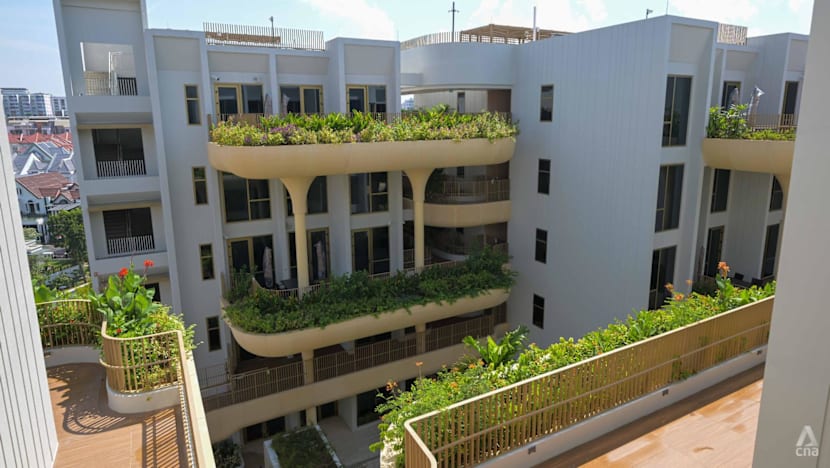
Singapore’s first private assisted living development targets 30% first-year occupancy CNA had a first look inside the 195,000 sq ft development, which began operations on Tuesday. Step inside an apartment at the newly launched Perennial Living and it looks more like a private home than a care facility. Floor-to-ceiling windows let in natural light, while the apartments come with kitchenettes and, for most units, private lift access.
Singapore’s first private assisted living development targets 30% first-year occupancy
CNA had a first look inside the 195,000 sq ft development, which began operations on Tuesday.
SINGAPORE: Step inside an apartment at the newly launched Perennial Living and it looks more like a private home than a care facility.
Floor-to-ceiling windows let in natural light, while the apartments come with kitchenettes and, for most units, private lift access.
Behind the residential touches are features designed for seniors who may need help, including fall detection, motion-sensor lighting, emergency call systems and devices for monitoring vital signs.
In the development at Parry Avenue, residents can see a doctor, undergo rehabilitation or receive traditional Chinese medicine treatments without leaving the compound.
There is also a swimming pool, gym, karaoke lounge and mahjong room, as well as a restaurant serving buffet and a la carte meals.
Spanning 195,000 sq ft, Perennial Living started operations on Tuesday (Aug 18), offering an alternative for seniors who need more support than they might receive living independently at home but do not necessarily require nursing home care.
Perennial Holdings, which has a decade of experience in eldercare in China, expects the development to reach about 30 per cent occupancy within its first year, before climbing to 80 per cent the following year.
The development comprises 200 assisted living apartments and 100 nursing suites.
Close to 30 prospective residents have expressed “very strong interest” so far, according to Perennial Holdings executive chairman and CEO Pua Seck Guan.
They include seniors who live alone after the death of a spouse and those whose children have moved overseas, according to Perennial.
Some use wheelchairs or have health conditions that need to be managed, while other enquiries have come from families seeking full-time care for relatives with dementia or Alzheimer's disease.
Speaking to CNA ahead of the project's start of operations, Mr Pua said the company's eldercare projects in China typically reach about 30 per cent occupancy within a year and 80 per cent the following year. This is a trajectory he expects Singapore to broadly follow.
However, he remains optimistic that Perennial Living could fill up more quickly.
“We only got 200 beds of assisted living, unlike in China, we've got thousands,” he said.
“It's a new product, (it) needs a bit of education, but we hope it will catch on very quickly.”
BETWEEN HOME AND A NURSING HOME
The apartments, which range from 302 sq ft to 569 sq ft, are intended for seniors who retain some independence but need varying levels of support.
Unlike nursing home residents, who typically have higher care needs and require round-the-clock nursing support, assisted living residents receive daily check-ins and vital-sign assessments, with additional nursing, rehabilitation and medical services available depending on their needs.
Residents can transition to higher levels of care within the development as their needs change.
The assisted living apartments, Perennial Wellness centre and The Olive restaurant began operations on Tuesday, while the nursing suites are open for bookings and expected to start operations in the fourth quarter of this year.
Assisted living packages start at about S$8,000 (US$6,260) a month, while nursing suite packages start at about S$7,600 a month, with final rates for both depending on the size, layout, level and facing of the unit chosen.
For assisted living apartments, there are four layouts, each with a different starting price: studios, one-bedroom apartments, one-bedroom suites and two-bedroom suites.
The assisted living package includes accommodation, meals, housekeeping and linen services, access to communal and fitness facilities, as well as social and wellness activities.
Residents will undergo a comprehensive pre-admission medical assessment, followed by subsequent health assessments, and are entitled to two consultations or treatments a month spanning Western medicine, TCM or rehabilitation.
For seniors seeking shorter-term support, the nursing suites will offer respite care with a minimum stay of three days.
UNDER ONE ROOF
Within the development sits a healthcare and wellness centre that is also open to the public.
Called Perennial Wellness, it brings together a medical centre with general practitioners and specialists, an imaging centre, rehabilitation and fitness facilities, and TCM and wellness services.
The rehabilitation centre provides physiotherapy, occupational therapy and speech therapy, and includes specialised rehabilitation equipment and a 460 sq ft hydrotherapy pool.
The development also opens directly onto an adjoining 1.5ha park with outdoor rehabilitation and senior-friendly fitness facilities.
There are two dedicated blocks of assisted living apartments, comprising 40 units, that will cater for residents with mild to moderate dementia. For those requiring memory care support in the apartments, they will have to pay an additional fee starting at S$1,200 per month.
Dementia patients who opt for the nursing suite package instead will have to pay an additional fee starting at S$1,500 per month.
Around 30 per cent of the beds in the nursing suites will be set aside for those with severe dementia.
A therapeutic garden features recreated everyday spaces, including full-sized heritage buses, a vintage hair salon, telephone booths and a working post box, aimed at stimulating memories and encouraging residents to move around independently.
CONVINCING SENIORS TO LEAVE HOME
Mr Pua said the development is targeted at the upper-middle class segment because of the cost of private eldercare in Singapore.
“I don't think the private sector can compete with the government in the subsidised sector,” he said.
“We are here to fill the private part of it, and I think to fill the upper-middle class of the private part of it.”
The economics of acquiring land and developing such a facility meant Perennial had “no choice” but to target that segment, he added.
Mr Pua said he sees greater demand potential for assisted living than nursing care.
One of the biggest challenges is persuading seniors to move out of their own homes.
Perennial does not expect healthy and fully independent seniors to make up the bulk of its residents. Instead, it is targeting those with care needs, including wheelchair users, frail seniors and those with chronic conditions, as well as seniors whose children live overseas.
“If you are very good, independent, don't come. You better stay home, enjoy your family, enjoy your grandchildren,” Mr Pua said.
With high home ownership in Singapore, seniors need a compelling reason to leave their homes, he added.
“You must provide (something) better than their home.”
CHALLENGES
Mr Pua acknowledged that whether seniors can be persuaded to make that move is also a key financial risk for the project.
With its capital investment already committed, Perennial now needs the concept to generate sufficient demand.
“The risk is, if such a concept doesn't catch on, you cannot generate the income,” he said.
But Singapore's ageing population means demand for care will continue to grow, Mr Pua said.
It ultimately comes down to whether Perennial can deliver the services seniors want, control its costs and generate a reasonable return, he added.
Another challenge is finding enough workers to deliver those services amid competition for healthcare manpower.
Perennial plans to progressively build up a workforce of about 150, recruiting from both the healthcare and hospitality industries.
Its staff are drawn from countries including Singapore, Malaysia and the Philippines, while employees from its China operations have been seconded to Singapore in support roles.
Mr Pua said finding caregivers who can communicate with elderly residents in the languages and dialects they are most comfortable speaking will be particularly important.
Perennial said the integrated development will be staffed based on the care needs of the residents in the assisted living apartments and nursing suites.
It plans to have a care staff ratio of approximately 1:8 in its assisted living apartments, with the two dedicated blocks for patients with dementia having a higher ratio of approximately 1:4.
Meanwhile, the nursing suites with memory care wards will be staffed 1:4 or 1:2, depending on the level of acuity, it said.
SPRINGBOARD FOR SOUTHEAST ASIA
While Perennial Living is small compared with the group's eldercare operations in China, Mr Pua sees the Singapore development as a showcase for what the company can take elsewhere.
Perennial has about 38,000 eldercare beds in its portfolio, including projects in the pipeline, he said.
The company is also looking to expand its eldercare model into Southeast Asia, where projects could be less capital-intensive than in Singapore.
Potential partners in the region have approached Perennial with existing facilities that it could renovate and operate, allowing the company to avoid high land and development costs, Mr Pua said.
He said one potential partner decided it wanted to pursue a deal after visiting the Parry Avenue development, although he declined to identify the company or country.
Over the next four to five years, Mr Pua wants Perennial to become a “global champion in care”.
But success should ultimately be measured by more than the number of beds it operates, he said.
His goal is to demonstrate measurable improvements in residents' health, including blood pressure, diabetes management, cholesterol levels, muscle strength and sleep.
“If after three months, after six months, after one year, their vitals improve, then I think I'm global champion,” he said.
He added: “I'm now global champion only on scale – not good enough.”