
Politics
What we do and don't know about guns in Australia
Key Points
The number of firearms nationwide is significantly higher than before the Port Arthur massacre. But there's also a lot authorities can't tell us about just how many guns are out there. The New South Wales government is aiming to remove more than 270,000 firearms from the community when its buyback scheme begins in November.
The number of firearms nationwide is significantly higher than before the Port Arthur massacre. But there's also a lot authorities can't tell us about just how many guns are out there.
The New South Wales government is aiming to remove more than 270,000 firearms from the community when its buyback scheme begins in November.
The "bigger than the Howard-era" scheme is part of legislation passed after the Bondi Beach terrorist attack in December last year.
But what do we really know about the number of guns in Australia? And who owns them?
4 million — The number of guns owned (legally) nationwide
Figures released by the Department of Home Affairs in January show there are a record number of firearms in Australia, with more than 4 million owned nationwide.
This equates to one firearm for every seven Australians.
Data from Home Affairs shows NSW has the most firearms, with more than 1.1 million, with Queensland a close second.
Tasmania and the Northern Territory have the highest per capita, with one firearm for every four people, according to a 2025 report from The Australia Institute.
25 per cent — The increase in guns since before Port Arthur
Despite significant gun reform following the Port Arthur massacre, Australia now has more firearms than before the mass shooting in 1996.
There are more than 4.1 million firearms in Australia, according to official data.
And that is up 25 per cent from the 3.2 million guns in Australia before Port Arthur, according to The Australia Institute.
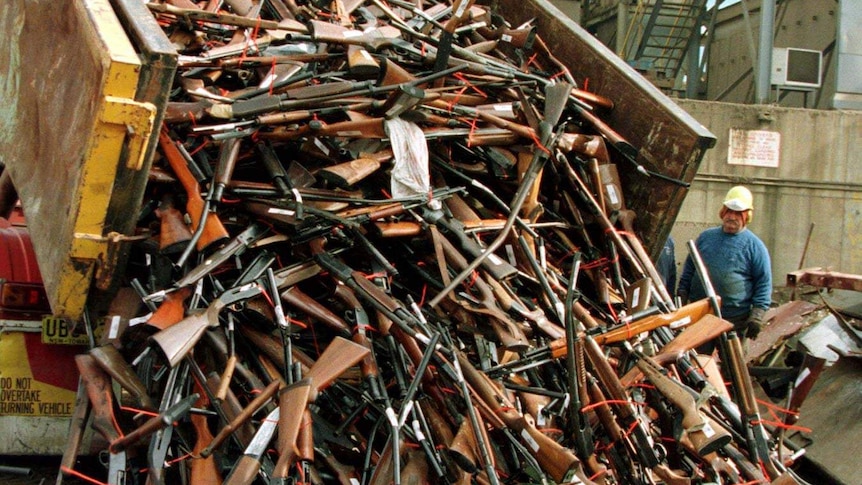
After the mass shooting, then-prime minister John Howard announced a buyback scheme that saw more than 650,000 firearms destroyed.
A second national amnesty was launched in the months after the Lindt Cafe siege in 2017, when more than 57,000 items were handed in.
There were also several permanent and temporary amnesties in state and territory areas from 1996 to 2015.
In 2021, a permanent national gun amnesty was introduced, where anyone with an unregistered firearm could surrender it anonymously and without repercussions.
4.4 — The average number of guns for each owner
The Department of Home Affairs says there are more than 4 million firearms in Australia — 4,113,735 to be exact, according to January figures.
The department also confirms there are 929,741 firearms licences across the country.
That means each licensed gun owner has an average of 4.4 firearms.
And analysis from The Australia Institute suggests that number has increased over time.
"In NSW, that figure has risen from 4.0 per licence in 2016 to 4.5 in 2024; in Victoria the figure has risen from 3.6 in 2016 to 4.1 in 2024," the report says.
41 per cent — The proportion of gun owners in NSW who live in major cities
When we think about guns in Australia, there is general acceptance that people in rural and regional areas may need weapons for farming and pest control purposes.
But a large proportion of gun owners are in the city.
NSW publishes the most comprehensive and easily accessible data of any jurisdiction, including licence holders' postcodes.
The Australia Institute analysis found four in 10 NSW firearms licensees live in major cities.
And it's not an isolated case, with police in Western Australia saying 46 per cent of its firearms are located in metropolitan areas.
371 — The number of guns a single person owns in inner-city Sydney
NSW Police publish data on gun ownership twice a year, including the number of guns individuals own and their corresponding postcode.
In the latest release from December, the person with the highest number of guns had 371 firearms and lived in the 2090 postcode, which encompasses the affluent, harbourside suburb of Cremorne and its surrounds.
The data release lists the top 100 individuals by number of firearms owned — excluding collectors and dealers — with the lowest entry on the list owning 91 guns.
What are the gaps in our gun knowledge?
Gun reform researchers say there's a lot we don't know about gun ownership and how it relates to violent crime, especially due to the limited data available in jurisdictions other than NSW.
"New South Wales has quite a good registry, and quite a good repository of data, and some of the other states absolutely don't," gun violence researcher at the University of Sydney Joel Negin said.
"It presents challenges like information sharing between jurisdictions, and there was a high-profile case in Wieambilla where the individual was a licensed firearm holder in NSW, but the information wasn't available to Queensland in real time, and two police officers were killed."
Of course, that data would only track guns that have been legally obtained.
"One of the key questions that does get asked is of violent crime or of firearm-related crime, what percentage of that is perpetrated by licensed holders or by or with registered firearms," Dr Negin said.
"That's an important question that police forces around the country actually don't have a great answer to, and that's one of the topics that we're particularly interested in trying to understand a bit better."
Dr Negin believes there is a "narrative" that most registered firearm owners are law-abiding citizens and all crime comes from unlicensed holders or those with unregistered firearms.
"The truth is probably somewhere in between," he said.
"Bondi and the incident in western Queensland that I mentioned were all with registered firearms and licensed holders, so the narratives and the data are mixed and we don't have a great sense of it across the country."
'No idea' about illegal firearm numbers
Samara McPhedran has researched gun-related violence for 30 years and works with the Violence Prevention Institute of Australia.
She said changes to the National Firearms Register (NFR) and the new buyback scheme won't prevent future gun violence because of the illegal weapons in the community that go untracked.
"We have research that is really clear that the number of legally owned guns does not relate to the level of firearm crime or violence," she said.
"By its very nature, the illegal ownership of firearms is largely invisible, we have no idea what the numbers out there really look like.
"Even numbers collected by arrests would be the tip of the iceberg."
The last major estimate from the Australian Criminal Intelligence Commission was in 2023, when it made a conservative estimate that there were about 200,000 illegally obtained or manufactured weapons in Australia.
The United Nations Office on Drugs and Crime advises that a country can estimate the number of illegal firearms as 10 to 20 per cent of the number of registered firearms.
"So if you did that in Australia, and again, these are rough estimates, but if you did that in Australia, you'd fall somewhere between 300,000 and 600,000 illegal firearms," Deakin University criminologist and forensic psychologist David Bright said.
These weapons, he said, likely entered the black market through theft, illegal importation and owners not surrendering them during amnesties.
3D-printed guns emerge as 'game changer'
The emergence of 3D-printed guns and gun parts presents a rising challenge.
"People can now make these weapons in suburban homes and they're just as good as a factory-made firearm and you couldn't say that five or ten years ago," Professor Bright said.
"The concern is people can get their hands on a working firearm in an extremely covert manner and we just don't have the policy or regulatory frameworks to actually deal with this problem."
In June, it was revealed one person was being charged every fortnight in Queensland alone with possessing a blueprint to make 3D-printed guns.
Dr McPhedran said evidence showed the ways people were obtaining illegal weapons had changed.
"Even though legal gun ownership has gone up, theft has gone down so that has changed the pathway in terms of how people are illegally obtaining firearms.
"3D printing has really been a game changer in terms of criminal acquisition of firearms."
With so many illegal weapons out there, she said federal changes to the NFR and buyback schemes were "purely symbolic" in terms of reducing the risk of gun violence.
"What's unfortunately happened, and we've seen this again after Bondi, is there will be a high-profile incident involving firearms, and then a very swift reaction from politicians to crack down on legal ownership.
"That is at odds with what the evidence tells us, which is that those illegally owned firearms … are the ones that are the highest risk because they are in the hands of people who are the highest risk."
Professor Bright said cooperation across all states was also essential to effective gun control.
About the data
- The Australia Institute report states that because data on firearms is not published consistently across states and territories, and there is no publicly available national database, its reporting aggregates data from various government sources, including state police force annual reports and third-party sources such as GunPolicy.org.
Credits
- Reporting: Georgie Hewson and Jessica Riga
- Production: Jessica Riga
- Editing: Matt Liddy
- Share options
- Copy link
- X (formerly Twitter)
Australia (LOCATION)
Port Arthur (LOCATION)
South Wales (LOCATION)
Howard (PERSON)
Bondi Beach (LOCATION)
the Department of Home Affairs (ORG)
Australians (ORG)
Home Affairs (ORG)
NSW (ORG)
Queensland (LOCATION)
Tasmania (LOCATION)
the Northern Territory (LOCATION)
The Australia Institute (ORG)
John Howard (PERSON)
Lindt Cafe (ORG)