
Education
India’s student protests exposed deeper anxieties over education and jobs as AI reshapes work
Key Points
India’s student protests exposed deeper anxieties over education and jobs as AI reshapes work In part two of a series on education issues in India following youth protests, CNA examines whether universities are keeping pace with a changing world of work, while young Indians grapple with their futures amid a shortage of quality jobs. For Delhi University student Shivam Kushwaha, 20, the two occasions he skipped class this year reflected the same concern: whether India’s education system was...
India’s student protests exposed deeper anxieties over education and jobs as AI reshapes work
In part two of a series on education issues in India following youth protests, CNA examines whether universities are keeping pace with a changing world of work, while young Indians grapple with their futures amid a shortage of quality jobs.
BENGALURU: For Delhi University student Shivam Kushwaha, 20, the two occasions he skipped class this year reflected the same concern: whether India’s education system was keeping pace with the future its students were preparing for.
The first was in February, when he attended the AI Impact Summit in New Delhi to learn about prompt engineering and working with artificial intelligence (AI) - skills he believed would be essential before they made it into his university syllabus.
Five months later, he was out of class again, this time joining thousands of students protesting a paper leak involving the National Eligibility cum Entrance Test (NEET) - India’s largest medical entrance exam.
“When the system is not enough, students have to take greater responsibility for their own futures - whether that means going outside the classroom to learn or going out to demand change,” he told CNA.
The protest culminated in India’s Education Minister Dharmendra Pradhan’s resignation on Jul 25. Two days later, India’s Parliament introduced a bill proposing stricter penalties, fast‑track courts and a special task force to tackle paper leaks.
But while lawmakers have focused on tightening the examination system, students, educators and recruitment firms told CNA that paper leaks are only one symptom of a much larger problem.
“The paper leaks were just the catalyst,” said Rohit Azad, a professor of economics at Jawaharlal Nehru University.
At the heart of the protests, he said, were long-simmering frustrations over youth unemployment, rising living costs and declining confidence in India’s higher education system.
As AI reshapes the world of work, universities are under pressure to better prepare students for a changing labour market. But even as they produce graduates, India is not creating enough quality jobs to absorb them, Azad said.
MORE THAN JUST A PAPER LEAK
Like Kushwaha, Ruhi Kabra joined the student protests because she believed what had happened to the NEET aspirants could happen to any student.
“If people are actively losing opportunities because of something as stupid as a paper leak ... it's just not fair,” said the 22-year-old Ashoka University liberal arts graduate.
“It was never just about one thing. There are so many systemic issues,” she added.
For many young Indians, the bigger question is no longer whether they can get admitted into a university, but whether it will prepare them for the future they hope to build, said students.
According to government employment data for 2025, the unemployment rate among Indians aged 15 to 29, who were participating in the labour force, stood at 9.9 per cent - more than three times the overall rate of 3.1 per cent for the total working population.
The youth unemployment rate has declined from 10.9 per cent in 2022, although it remains considerably higher in urban areas, at 13.6 per cent in 2025.
The unemployment rate among Indians with at least a secondary school education was lower, at about 6.5 per cent, compared with 11.2 per cent among those who had graduate-level degrees, according to government data.
This points to the challenges graduates face in finding jobs in India, said experts.
After interacting with more than 15,000 students across 150 campuses over the past eight years, Nikhil Taneja, founder of youth media platform Yuvaa, said the conversations he has with students have changed markedly.
“There is no sense of safety and no security, and that's where the anxiety stems from,” he said. “Young people keep asking themselves: 'How will education actually help me?’”
According to Taneja, this uncertainty is also changing students’ approach to university.
Increasingly, young people are building side hustles, taking on internships, learning new skills online and creating professional networks while still studying because they no longer see a single, predictable path to success, he explained.
Kushwaha, for instance, said his political science degree still largely prepares students for highly competitive exams in India. But to broaden his career options, he spends one to two hours every other day learning prompt engineering, generative AI and other AI tools alongside his coursework.
These are skills he believes will be useful in policy, research and think-tank jobs that he hopes to pursue after graduation.
“I can't afford to miss this AI bus,” he said. Rather than wait for the curriculum to catch up, he is learning the skills himself because he believes the education system is not adapting quickly enough.
“The only people who can really afford to fail are those who already have some starting capital from their families,” Taneja said. “For everyone else who doesn't come with that economic privilege, there is a lack of security and safety, and that's why students are anxiety-struck.”
BRIDGING THE GAP BETWEEN CLASSROOMS AND CAREERS
Students' concerns are not simply about what they are learning, but whether what they are learning today will still matter by the time they graduate.
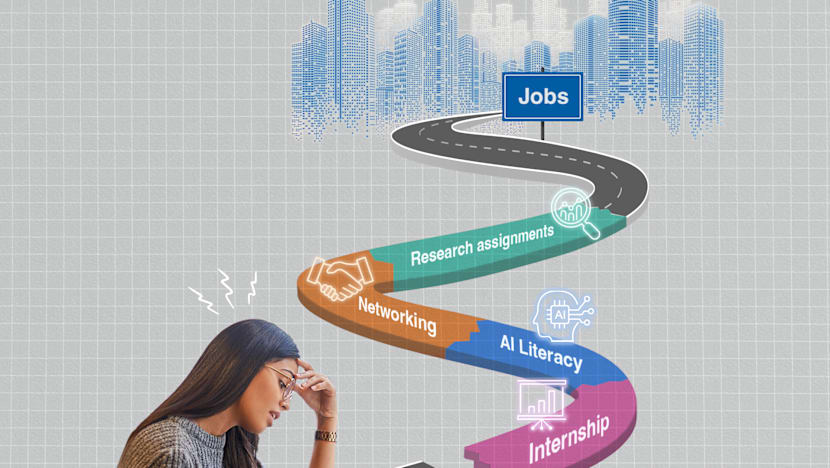
As AI rapidly changes entry-level jobs and employment opportunities, employers are increasingly seeking practical skills alongside academic qualifications, experts told CNA.
“The expectations have shifted from 'What does the candidate know?' to 'What can the candidate do with what they know?'” said Kishore Selva Babu, Director of the university student council at Bengaluru-based Christ University.
Alongside technical knowledge, recruiters increasingly expect graduates to demonstrate practical application, communication skills, adaptability and familiarity with AI tools, said Babu.
Students who have completed internships, worked on industry projects or can show evidence of applying classroom learning in professional settings are often viewed more favourably than those relying solely on academic performance, he explained.
He added that universities in India are trying to respond through live case studies, debates, industry projects and greater exposure to AI and digital tools, but acknowledged that curriculum reform naturally moves slower than industry itself.
Kamal Karanth, co-founder of recruitment firm Xpheno, said that the problem runs deeper than simply updating the university syllabus.
“The challenge with academic programmes is often the lag between market demand and the academic output window,” he said.
By the time universities introduced specialised programmes and certifications to meet demand, AI and automation had already transformed large parts of the industry, reducing the need for many entry-level human roles, said Karanth.
“Universities should prepare students for the future AI-native workspace,” he said. “Academics should run ahead of industry by at least three to five years and spot future industry shifts.”
He added that universities should think, plan and operate like the industries they are building talent for.
Babu said universities should prepare students to adapt to technological change, rather than train them for a fixed set of skills.
That means more internships, real-world projects and industry-linked assignments where students learn to apply what they know and work with emerging technologies.
While employers continue to struggle to recruit graduates with strong technical foundations, they increasingly cite communication, adaptability, learning agility and problem-solving as the biggest gaps among fresh graduates, said Karanth.
“These skills have become just as important as technical competency,” he said.
MORE GRADUATES, NOT ENOUGH QUALITY JOBS
Preparing students with better skills may improve employability, but it will not by itself address the anxieties that have brought young people onto the streets, Jawaharlal Nehru University’s Azad argued.
“There are two sides to jobs: supply and demand,” said Azad. He explained that while much of the debate has focused on whether universities are producing graduates with the right skills, he believes the equally pressing challenge is that the economy is not generating enough quality employment.
According to recruitment firm Xpheno, India's IT industry has seen the hiring of fresh graduates fall by nearly 80 per cent since its post-pandemic peak, from more than 600,000 recruits in 2022 to fewer than 150,000 annually today.
The last published government data for academic year 2023-24 shows that about 11 million students completed higher-education programmes - which includes under-graduate and post-graduate degrees - up by over 15 per cent from academic year 2020-21.
“The market is not generating enough opportunities to absorb the growing pool of graduates,” said Karanth. As AI automates more routine entry-level work, companies are becoming more selective about whom they hire and how much they invest in training fresh graduates, he said.
Azad warned that India's window to benefit from its young population is narrowing, making it critical to equip young people with the education and employment opportunities needed to turn that demographic advantage into economic growth.
The country's working-age population (ages 15–59) reached 936 million in 2024 and is projected to surpass 1 billion by 2036.
“When I look at my classmates and the students around me, I don't just see students worried about exams or grades. I see an entire generation that is uncertain about what comes after graduation, and that, to me, is one of the biggest problems our education system needs to address,” said Kushwaha.
He said one area that needs reform is how India's National Education Policy (NEP) 2020 - the country's most recent education reform policy - has been implemented in universities.
While the policy requires students to take multidisciplinary courses alongside their main subject, he argued that many of these are taught at a basic level and do little to improve employability.
“Students today are asking for an education system that doesn't just prepare them to pass an examination,” Kushwaha said.
“They want an education that prepares them to actually participate in the world they are going to graduate into.”
[Image text:] Jobs
Research assignments
Networking
AIE
Al Literacy
Internship