
Business & Finance
Nuclear power revival sparks global race, from uranium mines in Texas to seas of Japan
Key Points
Nuclear power revival sparks global race, from uranium mines in Texas to seas of Japan With uranium demand expected to double by 2040, countries are reopening mines, expanding enrichment capacity and exploring alternative fuels, seawater extraction and fusion technology, CNA’s The Nuclear Option finds. It is 5.30am in southern Texas, and Jesus “Jesse” Garza Jr is preparing for his shift at the Alta Mesa Uranium Project. His grandmother Mary Lou Rodriguez once worked at the same mining site,...
Nuclear power revival sparks global race, from uranium mines in Texas to seas of Japan
With uranium demand expected to double by 2040, countries are reopening mines, expanding enrichment capacity and exploring alternative fuels, seawater extraction and fusion technology, CNA’s The Nuclear Option finds.
SAN ANTONIO: It is 5.30am in southern Texas, and Jesus “Jesse” Garza Jr is preparing for his shift at the Alta Mesa Uranium Project.
His grandmother Mary Lou Rodriguez once worked at the same mining site, and their family used to wake up to the sound of heavy machinery in the uranium mines around their town.
During the Cold War, when Texas helped to fuel the United States’ nuclear programme and civilian power sector, the state was producing enough uranium to power approximately eight million homes a year.
But falling demand and cheaper imports made local operations unviable by the late 1990s. The Fukushima accident in 2011 also renewed nuclear safety concerns, weakening the market further.
But that retreat is reversing. Garza joined Alta Mesa as a foreman in 2024 after his grandmother told him about its resumption of production. Last year, it became the second-largest uranium producer in the US.
“I want to continue the (family) legacy and leave my mark,” he said. “Nuclear power is clean power. It’s the future, and I want to be part of it.”
The nuclear revival extends beyond Texas. More than 40 countries plan to build new reactors or are considering it as governments seek reliable, low-carbon electricity while industries such as artificial intelligence and crypto mining intensify the demand for energy.
Part of nuclear power’s appeal lies in uranium’s energy density. A uranium fuel pellet about the size of a fingertip supplies as much energy as a tonne of coal or 17,000 cubic feet of natural gas.
But the global interest in nuclear capacity follows a long period of subdued uranium production. Demand is expected to double by 2040 and could begin outstripping supply after 2030, with warnings of a fuel shortfall over the next two decades.
Russia’s invasion of Ukraine in 2022 has also exposed how much of the nuclear fuel supply chain is controlled by a few countries.
That year, 84 per cent of the uranium used in American civilian nuclear reactors was purchased from five countries — Canada, Kazakhstan, Russia, Uzbekistan and Australia — with Russia also supplying 24 per cent of the enriched uranium used in the US.
There is now a race to secure the fuel and dominate the technologies and supply chains of the new nuclear age.
Where will all that fuel come from, who will control it and can the nuclear revival be sustained? CNA’s The Nuclear Option searches for answers across eight nations.
WATCH: Race for uranium — Who will fuel the nuclear revival? (46:35)
LOOKING FOR URANIUM IN DIFFERENT PLACES
Uranium is about 500 times more common than gold, but the largest known recoverable reserves are concentrated in fewer than 10 countries. And the world’s largest producer is Kazakhstan.
In the Kharasan-2 mine in southern Kazakhstan, uranium is extracted through in-situ recovery (ISR). Wells pump a solution underground to dissolve uranium, which is then brought to the surface and processed into yellowcake, a concentrated powder used to make nuclear fuel.
ISR accounts for more than half of global production and has helped Kazakhstan produce about 40 per cent of the world’s primary uranium.
But getting uranium out of the ground is only the first step. Kazakhstan relies primarily on Russia to enrich its uranium before it can be used as reactor fuel.
The war in Ukraine has also complicated its export route through Russia, with some Western customers requesting shipment via the Middle Corridor instead: across the Caspian Sea, then through Azerbaijan and Georgia to the Black Sea.
As attention shifts to alternative suppliers, Australia is drawing renewed interest. It holds the world’s largest known uranium resources — twice the amount in Kazakhstan. Turning those reserves into supply, however, can take close to a decade.
Andrea Marsland-Smith, chief executive officer of Alligator Energy, which owns and operates the Samphire Uranium Project in South Australia, said companies may spend about five years drilling and assessing a deposit, followed by another five years seeking permits.
Access is also politically and socially sensitive. In Western Australia, where no new uranium mining projects have been permitted since 2017, some deposits lie buried in land of deep significance to Aboriginal communities.
Mining could bring jobs and infrastructure — with uranium supply and demand pushing prices up from roughly US$40 to US$85 a pound over the past decade. But it may also disturb landscapes tied to ancestry, spirituality and identity.
At the Morapoi outback station, Wangkatha tribal elder Gregory Stubbs said: “If it’s going to be uranium mining, what will be the effects? Some of us aren’t quite ready.”
Discussions about Australia’s energy future are taking place, however, with “conversations that we haven’t had before in regard to the importance of uranium mining moving forward”, said Glenn Wilson, the mayor of mining city Kalgoorlie-Boulder.
“There are obviously some factors that could push that a lot sooner, especially the energy crisis that Australia faces at the moment.”
Similarly, in Sweden — which holds 27 per cent of Europe’s known uranium — its reserves have remained untapped, lying in abundance in alum shale, which can release heavy metals into groundwater and streams if disturbed.
Amid environmental concerns and broader political considerations, Sweden banned uranium mining in 2018. But as electricity prices soar in Europe, there is mounting pressure to reduce reliance on imported fuel, especially from Russia, and strengthen energy security.
Sweden lifted the ban with effect from January, while maintaining environmental oversight.
One country that imports uranium for all its nuclear power needs and is pursuing another option is Japan. It is exploring extraction from the sea.
The oceans contain roughly 500 to 1,000 times more uranium than the known recoverable reserves on land, “enough to keep nuclear power plants round the world running for 60,000 years”, said Canon Institute for Global Studies research director Taishi Sugiyama.
Japanese scientists have tested braided materials that capture uranium compounds from seawater. But because uranium is so diluted in the ocean, extraction is costly.
Scientists are now trying to reduce the cost. “To achieve this, we’re working to improve the materials so they can be reused multiple times,” said National Institutes for Quantum Science and Technology project leader Noriaki Seko.
They are even doing tests at the famous Kusatsu Onsen, capturing metals that the highly acidic hot springs bring up to the surface. Commercial viability of the technology and materials could then offer Japan a path towards energy independence.
PUSHING TO PRODUCE TOMORROW’S NUCLEAR FUEL
Securing uranium is only part of safeguarding a country’s energy future, however. To reduce reliance on foreign suppliers, governments also want the capacity to enrich uranium for use in nuclear reactors.
Much of the current interest centres on small modular reactors (SMRs). They are expected to be quicker and cheaper to build than conventional nuclear plants and can be scaled up as electricity demand grows.
Their compact size could also allow nuclear power to be deployed in places where a large plant would be impractical. Many SMR designs, however, require high-assay low-enriched uranium (HALEU), which contains more fissile material than in conventional reactor fuel.
According to Dan Wachs, the national technical director for the US Department of Energy’s Advanced Fuels Campaign, a HALEU fuel assembly can last multiple times longer between refuelling while producing about a quarter of the standard amount of spent fuel.
Russia and China are currently the only countries that can produce HALEU on a commercial scale. The US is trying to close that gap.
In June last year, Centrus Energy became the first American company to produce and deliver close to a tonne of HALEU. While it was a national milestone, it also revealed the scale of the challenge.
“That could fuel one medium-sized reactor,” said nuclear engineer Nick Touran. “You’re going to need tens of thousands of kilograms per year to build out a significant fleet of advanced reactors.”
Centrus is among three American companies backed by a US$2.7 billion Department of Energy programme to expand domestic enrichment capacity.
Countries like the US are turning to advanced fuels to also use uranium more safely. At the Oak Ridge National Laboratory in Tennessee, scientists are developing tri-structural isotropic (TRISO) fuel.
Each TRISO fuel particle — the size of a poppy seed — seals a uranium core within layers that can trap radioactive material and withstand test temperatures of up to 1,800 degrees Celsius, beyond those expected during a reactor accident.
The fuel can also transfer heat, allowing the core to cool itself during overheating, potentially reducing the need for complex reactor safety systems, said Touran.
Safety innovations such as this are especially important for there to be a nuclear expansion.
“One of the primary things that have held back nuclear energy is the perception of danger,” said Charles Oppenheimer, who hopes the public will look beyond their fears and consider the science, engineering and safety standards underpinning the industry.
The other challenge, as it had been during the time of his grandfather J Robert Oppenheimer — the father of the atomic bomb — is to cooperate to produce nuclear fuel while choosing not to turn it into weapons, he noted.
“We could have a system where the whole world benefits from this science instead of being threatened by it.”
GOING BEYOND URANIUM
Both science and geopolitics are reasons other countries are looking at ways to reduce their dependence on uranium, whose reserves on land are estimated to last about 120 to 130 years at current consumption rates.
“Geopolitics could mean that even if uranium is available, you might not be able to buy it,” said Lin Boqiang, the dean of Xiamen University’s China Institute for Studies in Energy Policy.
China, which imports more than 80 per cent of its uranium, is testing a molten salt reactor fuelled by thorium — a naturally occurring radioactive element — in the Gobi Desert.
Whereas water-cooled reactors must operate at high pressure, molten salt does not boil at those high temperatures. If overheating occurs, the fuel drains into a holding tank; if a leak occurs, the salt cools and hardens around the radioactive material.
Proponents of thorium say it could also yield more energy from less fuel, produce less waste, with less radioactivity, and be harder to weaponise.
According to Lin, China’s reserves could meet demand for about 10,000 years. But first come plans for a 100-megawatt-thermal demonstration reactor by 2035, which would be enough to power tens of thousands of households.
India, which has one of the largest thorium reserves, is forging a similar path towards greater energy independence.
“Thorium in India is primarily found (in) beach sands. … Literally the entire coastline is full of thorium,” said Anil Kakodkar, the former chairman of India’s Atomic Energy Commission.
“We’re sitting on a great opportunity here to not only fulfil our energy requirements but also be a major energy supplier.”
India operates 24 reactors and aims to increase its nuclear capacity elevenfold by 2047. Thorium is central to its strategy, but turning ambition into commercial reality will take time.
For now, India has entered into an agreement with US-based Clean Core Thorium Energy to deploy a thorium-HALEU fuel blend designed for heavy-water reactors, as scientists explore how thorium could help fuel reactors that run on uranium.
Looking further ahead, scientists are dreaming of fusion, which releases energy by combining atoms — the process that occurs in the sun.
Recreating it on Earth requires fusing hydrogen into plasma, a type of gas, at temperatures above 100 million deg C and holding it in place with powerful magnets kept at almost minus 270 deg C.
“You’ve got the coldest thing in the universe a few feet away from the hottest thing in the universe,” said Touran.
To withstand those extremes as well as fast-moving neutrons that can weaken reactor walls, China has developed radiation-resistant super steel.
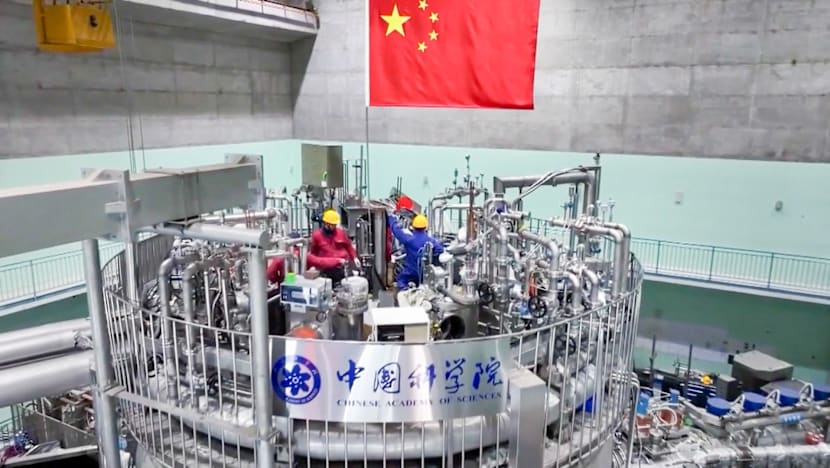
And its Experimental Advanced Superconducting Tokamak facility has sustained plasma at almost seven times the sun’s core temperature for more than 17 minutes.
WATCH: The nuclear comeback — What will it take to power it? (44:59)
In the United Kingdom, which has committed £2.5 billion (US$3.4 billion) to fusion research and development, researchers are forging steels that produce less radioactive waste.
But even if fusion machines can be made to work, fuel is an obstacle. Fusion commonly combines deuterium, found in seawater, with tritium, a rare form of hydrogen that is a byproduct of nuclear processes.
UK-based Astral Systems and Japan’s Kyoto Fusioneering are among the companies testing ways to increase tritium’s supply.
Helium-3 could also fuse with deuterium, without generating long-lived radioactive waste or neutrons that damage reactor components. But the most abundant deposits of this form of helium are on the moon.
China’s Chang’e-5 mission in 2020 returned with lunar soil containing helium-3. And today, US-based Magna Petra is developing technologies to harvest helium-3 from lunar dust. “It’s the ultimate unlimited fuel for clean energy,” said Jeffrey Max, its CEO.
One thing is clear: As energy needs on Earth grow, so too is the willingness to push the boundaries of what is possible.
Watch the latest instalments of The Nuclear Option here: Episode 3 and Episode 4.
Texas (LOCATION)
Japan (LOCATION)
CNA (LOCATION)
The Nuclear Option (ORG)
SAN ANTONIO (LOCATION)
Jesus “Jesse” (PERSON)
Garza Jr (PERSON)
the Alta Mesa Uranium Project (ORG)
Mary Lou Rodriguez (PERSON)
the Cold War (EVENT)
the United States (LOCATION)
Fukushima (LOCATION)
Garza (PERSON)
Alta Mesa (ORG)
US (LOCATION)