
Science
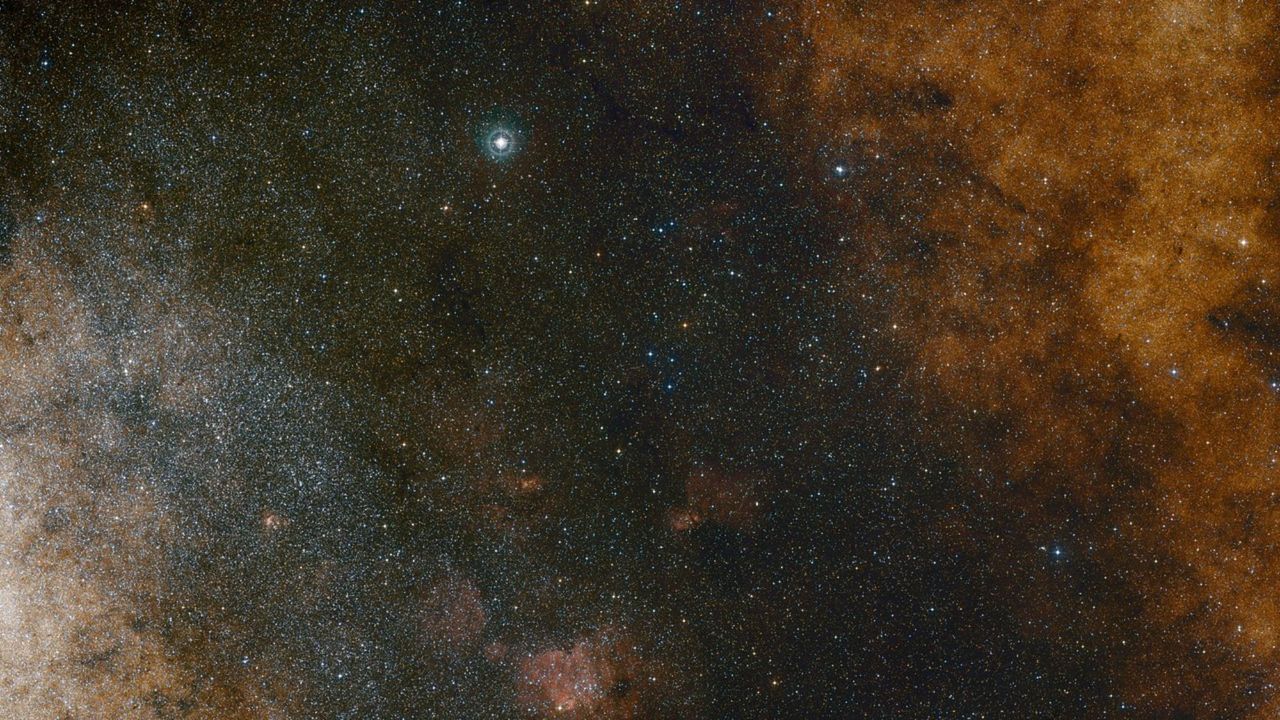
Scientists just found the fastest known star in the Milky Way. It zooms around our black hole at 15,500 miles per second
Key Points
Scientists just found the fastest known star in the Milky Way. It zooms around our black hole at 15,500 miles per second The star is traveling more than 8% the speed of light. Astronomers have found the fastest known star in the Milky Way, a faint object racing around Sagittarius A*, the supermassive black hole at the heart of our galaxy.
Scientists just found the fastest known star in the Milky Way. It zooms around our black hole at 15,500 miles per second
The star is traveling more than 8% the speed of light.
Astronomers have found the fastest known star in the Milky Way, a faint object racing around Sagittarius A*, the supermassive black hole at the heart of our galaxy. Dubbed S301, the star reaches about 15,500 miles (25,000 kilometers) per second at its fastest — more than 8% the speed of light.
"What is special about this star is that it's orbiting Sagittarius A* on a very tight orbit, taking just 8.7 years to complete it, and is approaching the black hole at a mere 12 times the distance of Earth to the sun. That is unprecedented," study author Felix Mang, a Ph.D. student at the Max Planck Institute for Extraterrestrial Physics in Germany, said in a statement.
The discovery gives astronomers a new way to probe the roughly 4.3-million-solar-mass black hole. General relativity predicts that a rotating black hole drags spacetime along with it, an effect known as frame dragging, or Lense-Thirring precession. That distortion should gradually alter S301's orbit — because the star ventures so close to Sagittarius A*, those changes may become measurable within about a decade.
For the first time, we would actually be able to measure very directly the spin of a massive black hole, which would be a key test of Einstein's theory," said study co-author Stefan Gillessen, also of the Max Planck Institute.
Researchers spotted S301 in 2023 using the GRAVITY instrument on the European Southern Observatory's Very Large Telescope Interferometer in Chile, then traced it back through observations from 2021 and 2017. Its highly elongated orbit suggests S301 may once have belonged to a binary system that wandered too close to Sagittarius A*. The black hole could have captured S301 while flinging its companion outward at tremendous speed.
Astronomers plan to keep tracking S301 with GRAVITY+ and, eventually, ESO's Extremely Large Telescope. With its next close pass expected in 2031, observations spanning two full orbits could reveal Sagittarius A*'s spin for the first time.
The team's research was published on August 19 in the journal Nature.
You must confirm your public display name before commenting
Please logout and then login again, you will then be prompted to enter your display name.
Space.com contributing writer Stefanie Waldek is a self-taught space nerd and aviation geek who is passionate about all things spaceflight and astronomy. With a background in travel and design journalism, as well as a Bachelor of Arts degree from New York University, she specializes in the budding space tourism industry and Earth-based astrotourism. In her free time, you can find her watching rocket launches or looking up at the stars, wondering what is out there. Learn more about her work at www.stefaniewaldek.com.
Sagittarius (ORG)
Earth (LOCATION)
Felix Mang (PERSON)
the Max Planck Institute for Extraterrestrial Physics (ORG)
Germany (LOCATION)
Einstein (ORG)
Stefan Gillessen (PERSON)
the Max Planck Institute (ORG)
the European Southern Observatory's (ORG)
Very Large Telescope Interferometer (LOCATION)
Chile (LOCATION)
Space.com (ORG)
Stefanie Waldek (PERSON)
a Bachelor of Arts (ORG)
New York University (ORG)