
Technology
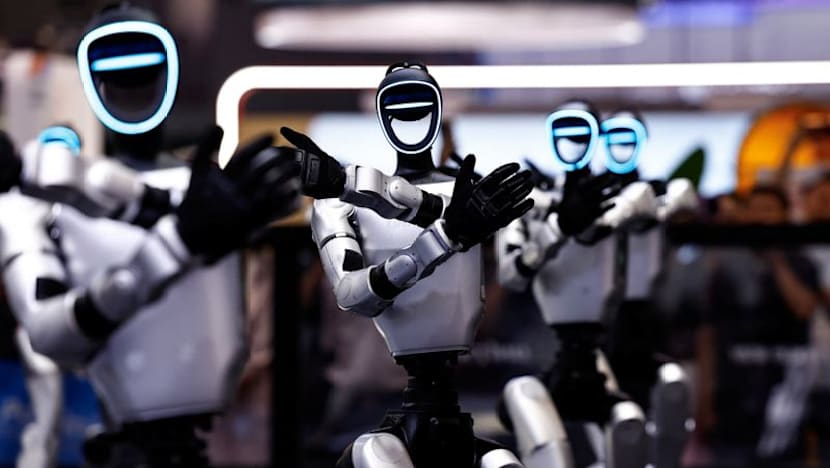
Robots poised for 'ChatGPT moment', says Unitree CEO
Key Points
Robots poised for 'ChatGPT moment', says Unitree CEO The industry is nearing a breakthrough where robots can be placed in unfamiliar environments and complete most tasks through simple voice or text instructions, says Unitree CEO Wang Xingxing. The CEO of Chinese humanoid robot unicorn Unitree said on Thursday (Aug 20) that the industry is edging towards a "ChatGPT moment" for robot brains, after the company's blockbuster Shanghai listing crystallised China's ambitions to lead the next...
Robots poised for 'ChatGPT moment', says Unitree CEO
The industry is nearing a breakthrough where robots can be placed in unfamiliar environments and complete most tasks through simple voice or text instructions, says Unitree CEO Wang Xingxing.
BEIJING: The CEO of Chinese humanoid robot unicorn Unitree said on Thursday (Aug 20) that the industry is edging towards a "ChatGPT moment" for robot brains, after the company's blockbuster Shanghai listing crystallised China's ambitions to lead the next frontier of artificial intelligence-powered machines.
Shares in China's best-known humanoid robot maker fell 11 per cent on Thursday, a day after soaring nearly sixfold in their market debut, highlighting intense investor enthusiasm for a fledgling sector that enjoys strong backing from Beijing.
"We are marching towards a 'ChatGPT moment' in embodied intelligence," said Wang Xingxing, the Hangzhou-based startup's founder and CEO, at the World Robot Conference in Beijing.
The global AI boom that has reshaped the world economy was sparked in late 2022 by ChatGPT's breakthrough large language model, a watershed moment that drove mass adoption.
No comparable inflexion point has yet emerged for world models, the physical AI simulation systems designed to help robots understand and navigate real-world environments.
Wang said the industry is nearing a breakthrough where robots can be placed in unfamiliar environments and complete most tasks through simple voice or text instructions.
"We hope that in the future, we can see a robot be introduced into an unfamiliar household and it can achieve approximately 80 per cent of tasks successfully through voice or text commands," he said.
"It is an important tipping point for the robot industry to usher in explosive growth."
MAJOR LEAP IN ROBOT SOFTWARE STILL A FEW YEARS AWAY
At the same time, Wang cautioned that a major leap in robot software could arrive within two to three years in an optimistic scenario, or within five to 10 years at the latest.
"Relative to the mood around World Robot Conference and Unitree’s spectacular IPO, Wang Xingxing was notably sober about current capabilities," said Georg Stieler, head of automation at robotics consultancy Stieler.
Unitree is the world's largest producer of robot dogs and the second-biggest maker of humanoid robots by shipments, according to industry data.
It rose to fame with impressively choreographed performances of robots dancing and performing gongfu showcased on Chinese television, and is increasingly deploying its machines in real-world industrial settings. Its IPO prospectus shows most customers are universities and research institutions.
Wang He, founder of Chinese robotic startup Galbot, expects the sector's "ChatGPT moment" to arrive by 2028, defining it as the point when robots can perform about 70 per cent to 80 per cent of everyday tasks without specialised training.
"With continued accumulation of data and further technological breakthroughs, we expect to reach the 'ChatGPT moment' for embodied intelligence by 2028," he said.
Unitree's Wang said the company's biggest current investment in terms of capital and manpower is in world models and that it is "lagging behind" in the real-world application of physical AI models.
He also said humanoids are not yet capable enough for mass deployment, pointing to limitations in the AI models that power robots' decision-making and interactions as the industry's biggest bottleneck.
Even so, Wang expects the sector to enter a decade of rapid autonomous evolution of humanoid robots, as the AI boom accelerates and AI language models learn to improve themselves.
DOMINANCE IN GLOBAL HUMANOID MARKET
China delivered over 40,000 humanoids in the first half of this year alone, and accounts for 97 per cent of global shipments of humanoid robots, a Chinese humanoid industry body said in a report Thursday.
Beijing is betting that robots can eventually replace human labour in repetitive, low-value and dangerous settings as it faces a shrinking workforce due to demographic decline.
While humanoids are gradually being introduced to factory floors and logistics warehouses, they remain less efficient than human workers in most applications.
Humanoid robots have also become a new front in the United States-China technology rivalry.
Last month, the US Federal Communications Commission banned future imports of foreign-made humanoid and quadruped robots citing national security concerns, in a major blow to Chinese producers.
Several companies at the World Robot Conference in Beijing told Reuters they were looking to expand overseas.