
Science
Three varieties of 'vegan Dracula' lampreys found in unlikely places
Key Points
Three varieties of 'vegan Dracula' lampreys found in unlikely Queensland places In short: Queensland scientists now believe there are three distinct species of the so-called "vegan Dracula" fish. Lampreys are nicknamed vampire fish because they have sharp teeth and feed on the blood of other fish, but these are non-parasitic. With the help of a state government grant, researchers will travel to K'gari and other locations in Queensland to map the true range of the peculiar creatures.
Three varieties of 'vegan Dracula' lampreys found in unlikely Queensland places
In short:
Queensland scientists now believe there are three distinct species of the so-called "vegan Dracula" fish.
Lampreys are nicknamed vampire fish because they have sharp teeth and feed on the blood of other fish, but these are non-parasitic.
What's next?
With the help of a state government grant, researchers will travel to K'gari and other locations in Queensland to map the true range of the peculiar creatures.
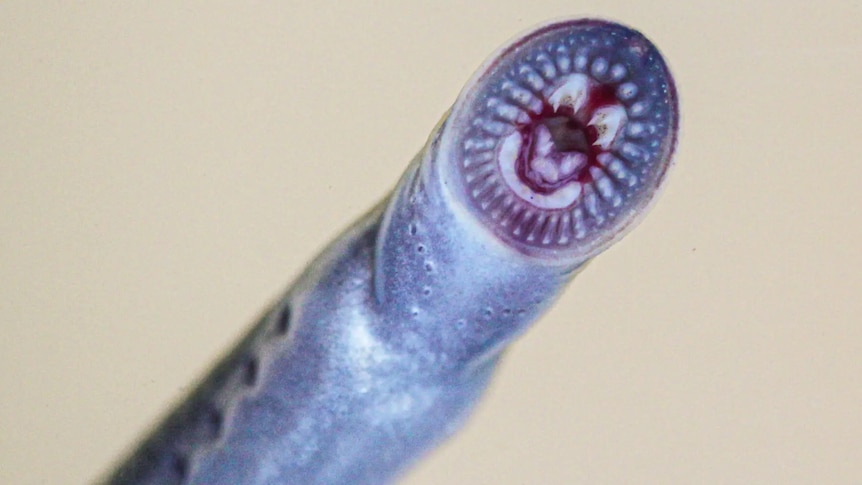
With its suction-cup mouth and circular rows of sharp teeth, a close-up view of an Australian brook lamprey is rather frightening.
But unlike many bloodthirsty lampreys around the world, this species prefers a plant-based diet, gobbling up organic matter on creek beds instead.
The jawless fish measures just 10 centimetres in length, making it difficult to spot in the wild.
Griffith University aquatic ecologist Luke Carpenter-Bundhoo has become somewhat of a lamprey whisperer.
He unearthed the species by accident on K'gari in 2022 while studying the impacts of the Black Summer bushfires on the island's ecosystem.
"There's about 50 lamprey species throughout the planet and most of them are parasitic, they suck onto the side of a fish and either eat some flesh or drink some blood," Dr Carpenter-Bundhoo said.
"These guys are non-parasitic so they're kind of like a vegan Dracula."
The discovery led him to team up with Queensland's Department of Environment, Tourism, Science and Innovation (DETSI) principal scientist David Moffatt.
The pair has since found two more slightly smaller, as yet unnamed varieties of non-parasitic lampreys.
Loading...Mr Moffatt first stumbled across the Queensland species in the Noosa River catchment in 2004, but initially believed the fish were "just vagrants" from southern states.
"We kept finding these things just on and off for eight years, and it was fairly obvious then that there was a resident population. They looked quite different as well," Mr Moffatt said.
The scientists have since found the tropical lampreys in the most unlikely of places, including on the Sunshine Coast below the Bruce Highway, and as far north as Rockhampton.
"They're existing in these really fragmented populations so they're quite at risk because these are a freshwater fish," Dr Carpenter-Bundhoo said.
"They can't swim out to the ocean and then just pop back into the next creek. They can't go across the land because they're aquatic.
"If something happens to one of those populations it's kind of a big deal."
Ancient secrets unlocked
There are five species of lamprey in the Southern Hemisphere, and Australian brook lamprey (Mordacia praecox) is listed as endangered.
The scientists have just received a $90,000 Queensland government research grant to expand their research.
"These animals aren't necessarily in remote locations; they're just very cryptic, and they're very hard to see," Mr Moffatt said.
"We're at the risk of silent extinction, where we have things go extinct that we didn't even know were existing."
Dr Carpenter-Bundhoo said knowing their locations would increase opportunities for their protection, although lampreys have been around for a long time.
They are known as living fossils.
"They are older than, say, the Australian lungfish, which everybody likes to tout as the dinosaur fish," Dr Carpenter-Bundhoo said.
"Lampreys actually existed before and after dinosaurs. What we see 150 million years ago is effectively what we see as a lamprey today."
He said they were used as a "model organism" for genetic research.
"This is an essential blueprint on how to make a vertebrate," Dr Carpenter-Bundoo said.
"So anything we find with them we may be able to apply to more sophisticated organisms, like humans."
Dracula (PERSON)
Queensland (LOCATION)
Australian (ORG)
Griffith University (ORG)
Luke Carpenter-Bundhoo (PERSON)
the Black Summer (EVENT)
lamprey (ORG)
Carpenter-Bundhoo (PERSON)
Department of Environment, Tourism, Science and Innovation (DETSI (ORG)
David Moffatt (PERSON)
Moffatt (PERSON)
Noosa River (LOCATION)
the Sunshine Coast (LOCATION)
the Bruce Highway (LOCATION)
Rockhampton (LOCATION)