
Education
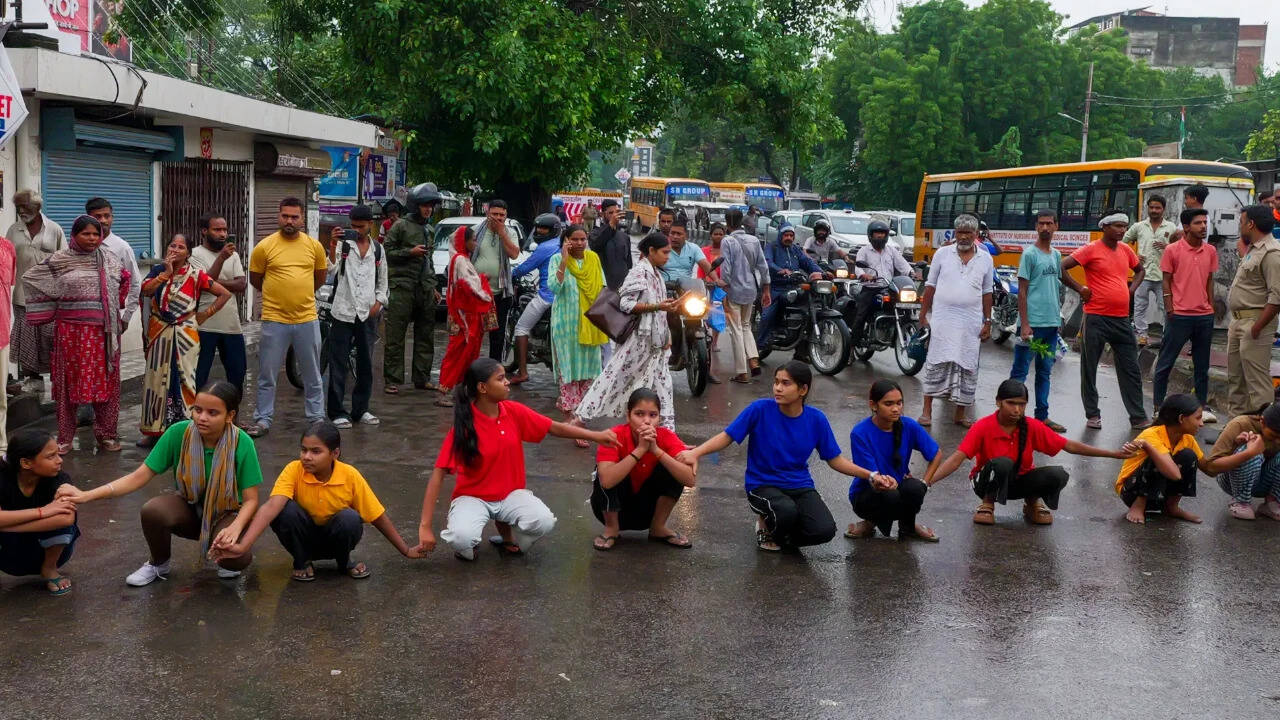
Gen Alpha protests mirror government report: Big gaps in school education
Key Points
Student protests highlight gaps in teachers, toilets and basic school infrastructure across India NEW DELHI: Another kind of student protest is beginning to surface on social media - schoolchildren demanding small fixes: a teacher, a usable toilet, a playground, sometimes even a proper road to school. The complaints may be local, but data suggests the gaps they point to are widespread.
Student protests highlight gaps in teachers, toilets and basic school infrastructure across India
NEW DELHI: Another kind of student protest is beginning to surface on social media - schoolchildren demanding small fixes: a teacher, a usable toilet, a playground, sometimes even a proper road to school. The complaints may be local, but data suggests the gaps they point to are widespread.In Hamirpur, 300 children marched 6km to the collectorate seeking a usable road to school; in Lucknow, 250 girls marched over teacher shortages and basic amenities; in Jaipur, students with disabilities protested over toilets, sanitation and unsafe classrooms.The problems are neither confined to one region nor of the same kind everywhere. Jharkhand has 36 pupils per teacher, West Bengal has internet in only 19.7% of schools and Meghalaya has toilets for children with special needs in just 6.3%. Karnataka has 8,042 single-teacher schools, 10.8% of its total. Kerala, despite having internet in 92.6% schools and functional computers in 99.1%, records 68 schools with no enrolled students. Tamil Nadu has internet in 99% of schools, but digital libraries in only 0.8% of state govt schools.
Data shows uneven school infrastructure, with major gaps in internet, computers and accessibility.
State govts run 68.4% of India's schools and private unaided managements 23.3%. Of the country's 14,66,682 schools, 10,03,051 are state govt-run and 2,194 are central govt schools. Another 3,41,689 are private unaided recognised schools and 79,261 govt-aided.Unified District Informat-ion System for Education Plus NE-26 report records 24.7 crore enrolments and 1 cr-ore teachers, with a pupil-teacher ratio of 24. Infrastructure coverage is uneven: 67.4% of schools have internet, and 63.1% have functional computers, while digital libraries are available in 7.1%. Playground coverage is at 81.9%. For children with special needs, 40.1% schools have friendly toilets, 79.7% have ramps and 58.2% have ramps with handrails.
Teacher deployment presents one of the sharper contrasts. UDISE+ records over 29 lakh students enrolled in 1,00,843 single-teacher schools. At the same time, it records 20,667 teachers in 5,663 schools with zero enrolment.Functional girls toilets are available in 95.3% of state govt schools and 96.9% of private unaided schools. The gap is wider for functional toilets for children with special needs - 35.6% in state govt schools and 44.7% in private schools.Digital libraries are available in 5.6% of state govt schools and 11.2% of private schools. Private schools are ahead of govt schools on internet connectivity (79.2% as against 63.1%) and functional computers (74% as against 59.4%). The position reverses on accessibility: govt schools lead on ramps (88.2% as against 60.4%) and ramps with handrails (66.9% as against 36.8%).
Manash Pratim Gohain is a seasoned journalist with over two decades at The Times of India, where he has built a rich body of work spanning education policy, politics, and governance. Renowned for his incisive coverage of the National Education Policy (NEP) 2020, accreditation reforms, and skilling initiatives, he has also reported on student politics, urban policy, and social movements. His political reportage—both reflective and news-driven—adds depth to his writing, bridging policy with public impact. Through his 2,500 articles and related outlets, he has emerged as a trusted voice in national discourse, particularly in linking education reform to broader societal change.