
Politics
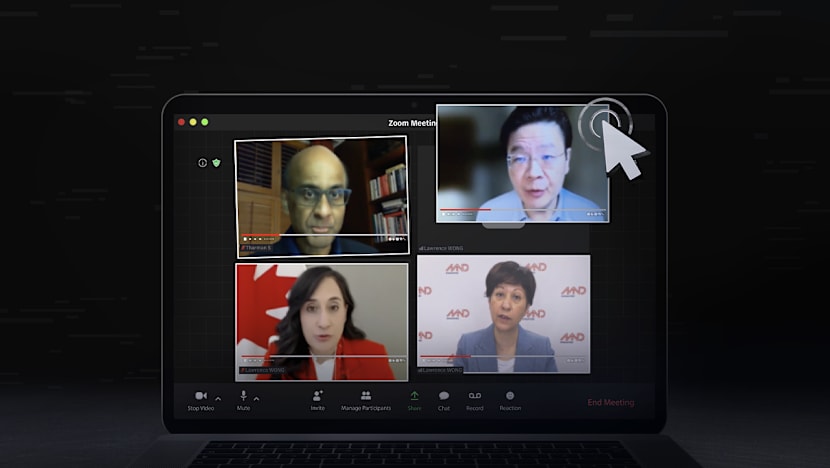
Dissected: How scammers built a fake Zoom call from real videos of PM Wong and other Singapore leaders
Key Points
Dissected: How scammers built a fake Zoom call from real videos of PM Wong and other Singapore leaders Analysis of full footage shared exclusively with CNA found that the scammers used obscure or dated YouTube videos of high-profile figures, alongside other deceptive techniques, to make their fabricated virtual event convincing. SINGAPORE: In April 2022, then-Finance Minister Lawrence Wong dialled into a widely reported government press conference via video link from the United States, to...
Dissected: How scammers built a fake Zoom call from real videos of PM Wong and other Singapore leaders
Analysis of full footage shared exclusively with CNA found that the scammers used obscure or dated YouTube videos of high-profile figures, alongside other deceptive techniques, to make their fabricated virtual event convincing.
SINGAPORE: In April 2022, then-Finance Minister Lawrence Wong dialled into a widely reported government press conference via video link from the United States, to announce details of the easing of Singapore’s COVID-19 pandemic safety measures.
Four years later, scammers would use footage from that call to convince an unsuspecting individual that Mr Wong, now Singapore's Prime Minister, was among a group of Singaporean and global leaders seeking financial help to stabilise trade flows through the conflict-ridden Strait of Hormuz.
The victim had found himself in a fake Zoom conference that was spliced together using footage not just of Mr Wong, but also President Tharman Shanmugaratnam, Minister in the Prime Minister’s Office Indranee Rajah, and several other prominent political and financial figures.
The victim ended up transferring at least S$4.9 million to the scammers, the Singapore Police Force (SPF) said in May.
A full recording of the Zoom call was shared exclusively with CNA by SPF. CNA’s analysis uncovered a number of previously unreported techniques used to pull off the scam, chief among them the extensive usage of real but obscure videos that remain accessible on YouTube.
The scammers, in other words, did not create their cast of Zoom characters from scratch. Instead, they constructed a live, convincing hoax almost entirely using real videos that were mixed with doctored audio, stolen identities and graphic overlays.
REAL PEOPLE, REAL VIDEOS
Nine real, high-profile individuals or institutions were presented as participants in the scam call.
One was Ms Indranee, who appeared in the call claiming that the “urgency of coordinated action” was needed to ensure “free and secure navigation through the Strait of Hormuz”.
CNA’s investigation found that the footage of Ms Indranee was in fact taken from a March 2023 interview with radio station Money FM 89.3, where the Second Minister for Finance and National Development discussed housing and urban planning initiatives.
For the Zoom scam, audio from that real interview was replaced with fake or manipulated speech, but the video of Ms Indranee herself - including her hand gestures and head movements - appeared unedited.
Subsequent analysis confirmed that at least seven visual segments in the Zoom scam were extracted from YouTube videos that are still publicly accessible. These videos are either dated or have low view counts.
Among these was footage of Mr Tharman in a virtual panel, hosted by the Centre for Economic Policy Research and uploaded in November 2020 – three years before he became president.
The original video of Mr Tharman’s panel had fewer than 200 views, as of August 2026. The clip of Ms Indranee’s interview on Money FM 89.3 had just over 350 views.
While the video that contained Mr Wong’s COVID-19 announcement had around 30,000 views, the specific sequence used by the scammers starts at around the 41-minute mark of the hour-long video – making it hard for casual viewers to pinpoint its origin.
Associate Professor Hannah Yee-Fen Lim, AI governance lead at the Nanyang Technological University (NTU)’s Global Institute of Finance, Technology and Society, said the little-watched nature of the source videos meant victims were less likely to have seen them – which in turn could have reduced the suspicion that they were fake.
She added that it was also much cheaper and easier to use publicly available footage than to generate the likeness of a person using AI.
FAKE AUDIO, FAKE BRANDING
The scammers took several steps to prevent elements in the real footage from giving them away, particularly logos identifying their original publishers.
For instance, the original footage of Ms Indranee and Mr Wong bore the watermarks of Money FM 89.3 and The Straits Times respectively, where the footage was sourced. In both cases, the watermarks were positioned in the top-right corner of the frame.
To mask these, the scammers overlaid the logos with a “Live Zoom Recording” graphic. This tactic likely went unnoticed by the victim, but authentic Zoom calls do not contain such logos inside individual participant screens. Instead, Zoom displays recording indicators on the wider meeting and app interface.
As with Ms Indranee’s case, the original audio tracks in most clips were replaced with synthetic speech, possibly either AI-generated or recorded by another person and digitally altered to mimic the public figures’ voices.
Analysis of the audio clips using a deepfake detection tool found they were likely manipulated.
This resulted in lip movements visibly not lining up with speech, a finding that was initially disclosed by the SPF as well.
While this inconsistency may be a clear sign that a video is inauthentic, Assoc Prof Lim said victims may not be paying close attention if they are “already coerced into fear or some other strong emotions”.
There was also a scene in the fake Zoom call which CNA could not trace to any source videos.
In a 15-second sequence near the start of the recording, Mr Wong and Ms Indranee appear seated next to each other, before Mr Wong stands and leaves to take a phone call.
A deepfake detection tool flagged that this portion was likely manipulated. Researchers from the National University of Singapore's (NUS) Centre for Trusted Internet and Community also examined the segment for CNA, and said it may have been produced by using AI to stitch separate pieces of real footage together, or by feeding real footage into an AI model to generate a new video altogether.
WHERE REAL MASKED FAKE
The one original audio track which the scammers likely left untouched featured Canada’s Foreign Affairs Minister Anita Anand.
On March 25, Ms Anand held a virtual press conference from Paris, fielding questions on Canada’s role in ensuring safe passage through the Strait of Hormuz.
The scammers took advantage of this: Her original remarks were close enough to the scam call’s premise of funding aid tied to the Strait, such that they needed no alteration.
And because Ms Anand’s words remained synchronised with her mouth movements, her segment – the longest in the call, at over 7 minutes – provided “an anchor” for the scam, said behavioural and data scientist Reuben Ng, an associate professor at NUS' Lee Kuan Yew School of Public Policy.
“It’s an exercise to erode suspicion and build trust. By placing her video near the start, it prevents a potential victim from raising alarm bells and lowers their guard.”
He added that any lip-sync or other visible discrepancies elsewhere in the call could thus be dismissed as lag, connection or compression issues.
“Subconsciously, the victim may have already been convinced, and everything else may not matter.”
CRACKS IN THE FACADE
For all their efforts, the scammers still had visible slip-ups.
The clearest example could be seen at the bottom-left of the main visual feed, where Zoom displays the name of the account transmitting the video.
Throughout the 19-minute call, that name never changed – it read “Lawrence Wong” from start to finish, even as the face on screen cycled through Ms Indranee, Ms Anand, United Arab Emirates presidential adviser Anwar Gargash and a moderator who introduced himself as a lawyer.
At points, a second name could be seen on top of the “Lawrence Wong” label, as though one video feed had been overlaid on another.
These details, which were also uncovered by SPF, point to a single account playing a sequence of recorded clips – either compiled beforehand or switched manually during the call.
Apart from this main feed, the scammers also operated four other Zoom accounts during the call – each with a different identity, and all passively participating without saying a word.
These included Mr Tharman as well as a representative of American investment firm BlackRock. CNA found that the two Zoom feeds of Mr Tharman and the BlackRock representative were playing in a loop, in yet another visual tell.
For a victim absorbed in the apparent urgency and authority of the live video call, however, these details could have been easily missed.
SCAMS OF THE FUTURE
Ms Jennifer Soh, Asia-Pacific head of high-tech crime investigations at cybersecurity firm Group-IB, said these types of scams have become “alarmingly easy to replicate”.
“No hacking skills are needed, just … a cheap voice-cloning app, and a handful of fake accounts to join the call,” she said. “You only need a laptop, a public video, and a tool that costs less than a cup of coffee.”
Group-IB said that in the second quarter of 2025 alone, it tracked US$347 million worth of deepfake-related fraud losses worldwide.
Ms Soh cited a similar case in 2024 where a finance worker in Hong Kong was tricked into wiring US$25 million to scammers. He had joined a video call where every single participant, including the person he believed was his chief financial officer, turned out to be a deepfake.
In Singapore, government official impersonation scams more than doubled last year – rising from 1,504 in 2024 to 3,363 in 2025.
Scams involving deepfakes will soon be difficult to identify with the naked eye, if not already the case, said experts.
The next – and worse – step will likely be live, interactive deepfakes where scammers perform in real-time and respond convincingly to questions on the spot, said Ms Soh, adding that AI could also be used to “coach” low-skill scammers through the con.
Beyond the increasingly realistic nature of scams, Assoc Prof Ng of NUS believes they will also become more targeted than ever.
Making use of cyber attacks or data leaks on the dark web, bad actors can create a “deep behavioural profile” of anyone, and concoct a scam that an individual will be particularly susceptible to.
“For instance, if there’s a healthcare system vulnerability and scammers find out that you have high cholesterol, they may send an email enticing you to click on an invite to a fake clinical trial,” said Assoc Prof Ng.
“Scammers are good at anticipating what you want and creating that vulnerability in a timely manner.”
Wong (PERSON)
Singapore (LOCATION)
CNA (LOCATION)
YouTube (ORG)
Lawrence Wong (PERSON)
the United States (LOCATION)
Singaporean (ORG)
Strait (LOCATION)
Hormuz (LOCATION)
Tharman Shanmugaratnam (PERSON)
Indranee Rajah (PERSON)
the Singapore Police Force (ORG)
SPF (ORG)
Ms Indranee (PERSON)
the Strait of Hormuz (LOCATION)