
World News
CNA Explains: Why is Trump pushing to meet Kim Jong Un again?
Key Points
CNA Explains: Why is Trump pushing to meet Kim Jong Un again? US President Donald Trump scaled back joint military exercises with key ally South Korea this week, while signalling plans to meet North Korean leader Kim Jong Un later this year. SINGAPORE: The day before South Korea and the United States began annual joint military exercises, President Donald Trump unexpectedly announced that the drills would be scaled back.
CNA Explains: Why is Trump pushing to meet Kim Jong Un again?
US President Donald Trump scaled back joint military exercises with key ally South Korea this week, while signalling plans to meet North Korean leader Kim Jong Un later this year.
SINGAPORE: The day before South Korea and the United States began annual joint military exercises, President Donald Trump unexpectedly announced that the drills would be scaled back.
This year's 11-day Ulchi Freedom Shield drills - designed to strengthen the allies’ ability to respond to North Korea’s evolving military capabilities – were shortened to five days.
Trump cited his “very good relationship” with North Korean leader Kim Jong Un, as well as South Korea’s refusal to support the US in its conflict with Iran.
The move came as Trump renewed his push to meet Kim, saying he would meet the North Korean leader later this year. North Korea has long demanded an end to the drills, but has shown little enthusiasm for Trump's overture.
So is Trump using the exercises as a bargaining chip, what does he want from Pyongyang - and does North Korea even need another summit with the US president?
Why did Trump scale back the drills?
Trump has suggested that South Korea’s refusal to help the US in its conflict with Iran was one reason for scaling back the drills.
“We have 39,000 soldiers over there, guarding you from Kim Jong Un, your next-door neighbour, and you're not going to help us on a very easy military operation in Iran. That's strange,” he told reporters.
South Korean Foreign Minister Cho Hyun said on Wednesday that Trump was trying to pressure Seoul on several issues, including its investments in the US.
"I think President Trump's message includes pressure over several pending issues concerning the South Korean government, as well as a message to North Korea and an intention by the US to break a stalemate in the Iran war," Cho said.
But analysts said there could be broader calculations at play. A renewed opening with North Korea could give the president a foreign policy success at a time when his efforts to resolve the conflict with Iran have stalled.
“Trump's foreign policy track record during this second term has either been lacklustre or unsuccessful,” Dr Nah Liang Tuang, a research fellow at S Rajaratnam School of International Studies (RSIS), told CNA.
“I suspect that he's trying to create an opening for diplomacy with North Korea so that he will hopefully have some foreign policy success before the November mid-term elections.”
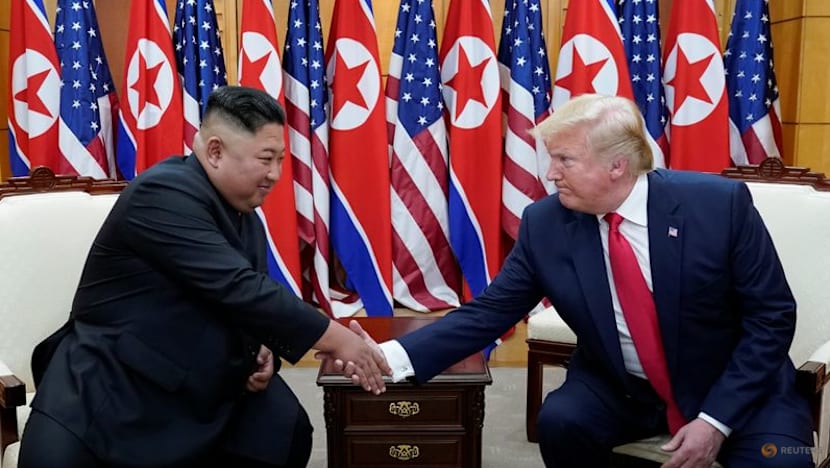
Trump and Kim met three times during his first term, including at a historic summit in Singapore in 2018. He also became the first sitting US president to enter North Korea when he met Kim at the Demilitarised Zone in 2019.
Their nuclear diplomacy eventually broke down, but Trump has continued to speak warmly about Kim.
“Trump has been clear about his desire to meet Kim again, and the scaling down of the (joint military exercise) is the latest signal,” said Dr Victor Cha, Korea Chair at the Center for Strategic and International Studies (CSIS).
“What’s different this time is that it is a concrete action rather than just words and social media posts.”
In some ways, Trump's move resembles his approach in 2018.
After his first summit with Kim, Trump suspended major US-South Korea military exercises, arguing that they were expensive and provocative - similar reasons he has given for reducing the drills this time.
North Korea has long demanded an end to such exercises, describing them as preparations for an invasion.
That makes military drills a potentially useful bargaining chip for Washington if Trump wants to bring Pyongyang back to the negotiating table.
Another possible reason Trump wants to engage Kim is to pull him away from Russian President Vladimir Putin.
North Korea has developed much closer military ties with Russia since Moscow invaded Ukraine, providing weapons and troops for the war.
But Dr Cha also suggested that Trump could simply be trying to change the political conversation.
“Trump may (also) want to change the headlines from Iran to something else,” he said.
Could South Korea have played a role?
South Korean President Lee Jae Myung has separately been pushing for improved relations with the North.
Just two days before Trump’s announcement, he proposed talks with Pyongyang to replace the Korean War armistice with a formal peace arrangement. The 1950-1953 war ended with a ceasefire rather than a peace treaty, meaning the two Koreas remain technically at war.
That creates an overlap between the priorities of Trump and Lee.
Both have expressed an interest in reducing tensions and opening dialogue with North Korea.
Dr Jaehan Park, assistant professor at RSIS, said Seoul might have signalled to Washington that it was willing to play a role in helping restart US-North Korea diplomacy.
“I don’t think it is too off the mark to speculate that the Lee administration might have had some say in Mr Trump’s decision to scale down the military drill and … subsequent comments as to the possibility of meeting with Mr Kim,” he said.
But this should not be taken to mean Seoul and Washington coordinated the decision to scale back the joint drills. South Korea's foreign minister said the government was not informed in advance of Trump's plan to reduce the exercises.
Washington could have made the decision independently after hearing that Seoul was prepared to play a role, Dr Park suggested.
There is another issue that could bring Seoul's interests closer to Trump's.
Lee has pushed for South Korea to gain greater independent control over its military. Under the current arrangement, South Korea has peacetime operational control of its forces, while the US would assume wartime operational control if conflict breaks out.
“I think these things are sort of coming together to create a momentum where Mr Trump is proposing certain things, and Seoul might have an incentive to sort of partake in this process,” said Dr Park.
What does North Korea want?
Some analysts believe Kim has less reason to engage Trump than in 2018, as Pyongyang is now in a different position.
Its ties with Russia have deepened significantly, providing North Korea with new sources of revenue and military cooperation. Its trade with China has also recovered following the COVID-19 pandemic.
According to a Bloomberg analysis of government trade figures and intelligence, North Korea's foreign revenue has soared since Russia invaded Ukraine, due to its arms sales and deployment of troops to support Moscow.
From August 2023 to December last year, Pyongyang could have earned as much as US$14.4 billion from these activities, South Korea’s Institute for National Security Strategy reported in March.
But the report estimated that North Korea had received only around 4 per cent to 19.6 per cent of those projected earnings.
Trade with China has also recovered, reportedly reaching almost US$3 billion. South Korea’s central bank estimated last month that North Korea’s economy grew by more than 3 per cent for a third consecutive year in 2025.
That gives Kim more room to withstand US sanctions and potentially less incentive to make concessions to Washington.
But Dr Cha believes Kim may still have reasons to engage with Trump.
Pyongyang might have learnt from America's recent conflict with Iran that maintaining contact with Trump may be useful in managing an unpredictable US president with a willingness to use military force, he wrote in an analysis for CSIS.
The June deal with Iran also signalled that the US now mainly delivers "grand but vaguely worded statements", where the promise of future talks may not necessarily produce any real prospect of agreements, said Dr Cha.
For Kim, this means a new summit could avoid detailed denuclearisation negotiations and an opportunity for him to secure recognition of North Korea's status as a nuclear-armed state, reduce US military presence on the peninsula and end what Pyongyang describes as Washington's hostile policy.
Does Kim even want to meet Trump?
For now, Pyongyang's public response has been lukewarm at best.
Kim Yo Jong, the North Korean leader’s powerful sister, said on Wednesday that she was “completely unaware” of Trump's claims that the two sides were communicating.
She also dismissed the significance of the reduced military exercises, saying they remained provocative.
That was followed by North Korea's missile launches on Thursday.
At the same time, Kim Yo Jong acknowledged that her brother and Trump still have an “excellent” relationship, suggesting that the personal channel between the two leaders has not necessarily disappeared.
Dr Park said the personal rapport between the two leaders could help.
The pair could have good chemistry, he added. “Trump, he’s in a way a larger-than-life figure … and Mr Kim … is in a way, I’ve been told, machismo.”
"Trump admires authoritarians who have not done anything to offend him. Like Putin, Trump seems to like Kim and is thus predisposed to not take a hardline against the latter," said Dr Nah.
The amicability could go both ways, he said.
"But it could also be that Kim realises that Trump is the only American president susceptible to flattery, and is hence using that as a weapon against the latter," he added.
Whether or not the two men genuinely have a good relationship, personal rapport can only go so far. The two countries continue to have fundamentally different objectives, Dr Park noted.
Washington wants to prevent the emergence of a hegemonic power on the Eurasian mainland, with nuclear non-proliferation an important part of that strategy.
“And from North Korea’s vantage point, having a powerful, prosperous and free South Korea on its border is not a good thing. On top of that, the US forces have been on South Korean soil for the past seven years plus,” said Dr Park.
He believes Kim will be cautious about what to expect from a meeting given the failure of their previous nuclear diplomacy.
“I’m not sure if it is realistic to expect a lot of breakthroughs in the US-North Korea relations,” he said, pointing to how Trump’s summit with Chinese President Xi Jinping delivered nothing out of the ordinary and the US president has remained hawkish towards Iran and Cuba.
A meeting outside North Korea will also carry high stakes for Kim, he added. “If he wants to make a foreign trip, the logistics are very complicated.
“And if he doesn’t make any significant achievements in those meetings, it is going to be - if not detrimental - politically costly for him.”
What does this mean for East Asia?
Dr Chang Jun Yan, the head of RSIS' military studies programme, cautioned against reading too much into Trump's move to scale back the drills, as it may simply be a bargaining tool for other political manoeuvres.
The scale of Ulchi Freedom Shield has also been reduced over the years. Based on publicly available data, the number of participating troops was about twice as large a decade ago, he noted.
But the military exercises with South Korea have also been an important demonstration of Washington's commitment to its ally for decades.
If Trump increasingly treats the drills as playing chips - rather than simply as part of military readiness - other US allies in the region will be watching closely.
Dr Nah said East Asian states may increasingly have to become more self-reliant on national security, particularly while Trump and the MAGA (Make America Great Again) movement remain influential in US politics.
Dr Park noted that similar debates were already emerging in countries such as Japan over how they should respond if Washington becomes less reliable.
“The trigger will be what’s happening with the US-Korean alliance,” he said, noting that expediting the debate over wartime operational control between Seoul and Washington could significantly alter the region’s security architecture.
Any major change to the command structure would alter the way the alliance operates and could have consequences for the wider regional security architecture.
But the US remains focused on competing with China, and its strategic priorities in East Asia are unlikely to disappear despite some reconfigurations, said Dr Park.
For now, the shortened Ulchi Freedom Shield exercise is less important for the six days of training lost than for what it represents. Trump is once again testing whether a personal relationship with Kim can open the door to diplomacy.
Want an issue or topic explained? Email us at digitalnews [at] mediacorp.com.sg. Your question might become a story on our site.