
UK News
Why is it so hard to let go of the things we own?
Key Points
Why is it so hard to let go of the things we own? After nearly 19 years in a London flat, one writer confronts the coats, books, crockery and other possessions that quietly accumulated into a life – and discovers why decluttering can feel surprisingly emotional. For nearly 19 years, I have kept a flat on the top floor of an 1850s three-storey house in London.
Why is it so hard to let go of the things we own?
After nearly 19 years in a London flat, one writer confronts the coats, books, crockery and other possessions that quietly accumulated into a life – and discovers why decluttering can feel surprisingly emotional.
For nearly 19 years, I have kept a flat on the top floor of an 1850s three-storey house in London. From the bedroom sash window, past a giant cedar whose branches move slowly even when nothing else seems to be stirring, I can see a jumble of 19th-century rooftops framed by a plume of plane, oak, ash, maple and poplar trees that go from green to gold to bare and back again, marking the years more reliably than any diary ever could.
Filled with light and a sense of open space that’s rare in London, it is, by any measure, a home that I have come to love. It is also, I’ve come to realise, very full, though not in any way I noticed happening at the time. We bought a sofa once because it looked extraordinary in the pages of a glossy magazine, upholstered in some impossibly expensive fabric – and then never got around to buying a proper reading lamp for that corner, so it has sat there for years, magnificent and essentially unused. There’s a delicate portrait of two Balinese dancers, inherited from my uncle, that has hung in three different flats and looked entirely at home in none of them. Huge, sexy coffee-table books bought in cities I can no longer place with certainty. Rugs carried back from shady markets in Lahore and Marrakech. Few things were bought with much foresight. It simply accumulated, one object at a time, until it all became an entire knotted life.
None of this mattered until we decided to close the London chapter of our lives and focus more on Asia. The trouble immediately became about space. Singapore already has its own accumulated life – its own furniture, its own books, a decade and a half of being lived in on its own terms. There was simply no room left for two households’ worth of history under one roof, however small or cherished any single object happened to be.
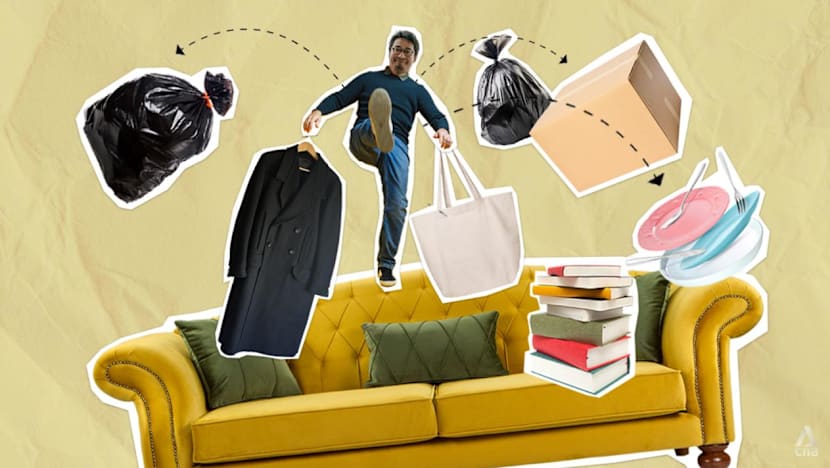
It was the coats that undid me first. Fifteen of them in wool and cashmere laid out across the bed. I stood there for a long time, not really sorting, just looking, and asking myself a question I hadn’t expected to find difficult: why did I ever think I needed this many coats, or had I simply never stopped to ask? Most of them, I realised, I had kept only because getting rid of a coat – especially one bought with such pride at Giorgio Armani – felt like giving up on some future, busier, colder version of my life that had never quite arrived. It’s strange to grieve when packing a coat for a charity shop, and yet I grieved it anyway.
The tote bags came next – 25 of them, all expensively labelled.
Then the crockery – not one dinner service but three, or perhaps four, depending on how generously you define a set, in a life where I have never once had more than four people to dinner. Turns out I had been keeping table settings for a version of myself who entertains constantly and remembers everyone’s allergies. That person had never lived in this flat, and yet I’d been quietly laying a place for him for years.
Then there was the library. A literal wall of books: half of them unread, spines and pages still stiff; the other half read, loved and kept on the promise of a second reading that never quite arrived. I hadn’t built a library so much as a record of every book I’d loved.
This is roughly the point at which one is supposed to summon Marie Kondo, so let’s. Her gift was making tidying sound like a love language rather than a chore, asking whether an object sparks joy as if joy were a thing one could calibrate, like gas. It’s a cheerful, hippy-dippy, yoga kind of optimism, and it works beautifully as an Instagram meme. It works rather less well on a small glass paperweight bought from a workshop in Murano, which has done nothing since but sit on a shelf gathering dust – sparking nothing you could honestly call joy, yet remaining entirely unthinkable to throw away.
For that, you want the Swedes, who, typically, have already named the feeling and removed all the sentimentality from naming it. The term is dostadning, or “death cleaning”: the practice of clearing your belongings systematically before you die, so your children aren’t left doing it while grieving and arguing over the good china. It isn’t about joy. It’s about mercy, extended, in my case, not to future heirs but to my present self, standing in a flat with a tape measure and a creeping understanding that I am the one who has to live with the consequences of my own sentimentality.
Because what I now know about giving things away is that it does not get easier whether the object is cheap or expensive. I now realise that anything – whether a hotel tote bag, an old diary or your late parents’ silver – comes attached with a small, irrational grief or even guilt, a sense that you’re losing a memory or giving away love. Multiply that by every drawer in an almost 19-year-old flat and you arrive at something that deserves to be called, without too much melodrama, psychic trauma. Not the kind anyone needs to send flowers for, but, trauma, nonetheless.
What I landed on was a coping mechanism that was really nothing more than a private bargain with myself: keep what had earned its space by being used or by being irreplaceable, and let everything else go quietly, gratefully, to someone who’ll actually use it. So, keep one coat, not 15. One dinner service, not three or four.
In the end, it happened quickly, almost rudely – black bin bags and cardboard boxes, a van idling outside, burly movers who didn’t know and didn’t need to know what any of it meant. The clothes, the paperweight, the library, the kitchen – all gone within an afternoon, with none of the ceremony the years inside them deserved. I had braced myself for grief and got something quieter instead: a faint, hollow surprise at how little fuss the knotted years actually took to undo.
The cedar tree, mercifully, I didn’t have to pack. It stayed exactly where it was, swishing for whoever lives beneath it next, which is rather the point: the view was never mine to keep. Only to have noticed and cherished, while I had it.
Less, it turns out, isn’t loss. It’s simply admitting, finally, which things I still reached for and which I’d just been keeping.