
Business & Finance
Climate change and corruption are also driving up interest rates
Key Points
analysis As Paul Keating would say, the pet shop galahs are talking about the reason long-term interest rates are surging: the competing demands for money from big-spending governments and AI companies. All other borrowers are getting trampled as the two bond-issuing elephants compete for cash. But there are two other things the galahs should consider: corruption and the weather.
analysis
As Paul Keating would say, the pet shop galahs are talking about the reason long-term interest rates are surging: the competing demands for money from big-spending governments and AI companies.
All other borrowers are getting trampled as the two bond-issuing elephants compete for cash.
But there are two other things the galahs should consider: corruption and the weather.
I'll get onto those in a minute, but first, let's talk about elephants — and the bond vigilantes, who flexed their muscles last week.
As the US government's debt mountain hit $US40 trillion ($56 trillion) on Tuesday, the bond market started charging 5.3 per cent for its 30-year money, the highest since 2007.
At about the same time, Australian government debt hit $1 trillion, and its 30-year bond rate went to 5.6 per cent for the first time (these only started being issued 10 years ago).
But these were two very different debt milestones: the American economy is 16 times Australia's, but its government debt is 56 times ours.
And Australians don't care as much about bond rates as Americans do because our mortgages are mostly variable rate, set by the RBA cash rate; in the US, most mortgages are 30-year fixed rate, and the interest rate is set to the 30-year bond.
The US government is now forking out $US1.2 trillion a year on interest, which is why Treasury secretary Scott Bessent acted last week to get the interest rate down — buying both 10 and 30-year bonds to drive the prices up and the interest rates down.
It worked, briefly: the 30-year rate dropped from 5.33 to 5.19 per cent, but by Friday it was back at 5.25 per cent because markets understood that Bessent had just moved some deck chairs on the ship steaming towards an iceberg.
To raise the cash to buy those bonds, Treasury had to issue shorter-term ones, so neither the amount of debt changed nor the budget deficit that keeps adding to it.
Loading...Something structural this way comes
Bond rates rise when an economy is doing well and it looks like inflation is moving up.
But while inflation is part of the story this time, it's only a small part — this time something much deeper and more structural is going on. Two things, in fact.
First, government budgets have been deteriorating for decades, and although there was an effort to reduce deficits after the GFC, that didn't happen after the COVID pandemic.
Second, the global corporate sector is in the midst of one of the greatest capital-raising programs in history, building the computing power needed for AI.
It's greater than the railroad building of the 19th century, the electrification of the first half of the 20th century, and the telecommunications infrastructure of the second half.
Whether the revenue from AI will justify the spending is unknown; probably it won't, but for the moment, the spending is soaking up global savings at the same time as governments are doing the same.
Meanwhile trust in all institutions, including governments, is in decline — in tech companies as protests break out over data centres on top of anxiety about the impact of AI, and in governments, because of corruption.
Transparency International has just released its corruption perception indices for 2025, and it's getting worse almost everywhere, including Australia, down from 10th place to 12th.
The United States is ranked 29th and is now seen as one of the most corrupt developed countries in the world, beaten only by Spain, Italy, Greece and Portugal.
The corruption perception indices are also rising steeply in the UK, with some deterioration in Canada, New Zealand, France and Ireland.
What's going on?
Faith in public finances declining
The perception of corruption is correlated to polarisation and inequality, which are also rising everywhere, nowhere more than in America.
The latest report from the think tank that measures democracy and polarisation, V-Dem, says: "The US democracy is currently in a much faster deterioration process than any other democracy in modern times."
In just the past year, the US's score on the V-Dem Liberal Democracy index has declined by 24 per cent, and its world rank dropped from 20th to 51st place out of 179 nations.
Last week the former editor, and now editor at large of the Wall Street Journal, Gerard Baker, not a man known for being left-wing or anti-corporate, wrote an op-ed that contained this long and surprising (for him) sentence:
"The widespread popular dissatisfaction with the working of modern American capitalism may be the product of some real, objective problems in the way American capitalism is working: income and wealth inequality on a scale not seen in a century; the concentration of economic, cultural and increasingly political power in a class of technology leaders whose products are dissolving the bonds that keep society together; the tightening nexus between business elites and the people who control the political process; rampant corruption and a political establishment that doesn't seem interested in accountability; the revival, after decades of stable prices, of inflationary pressures that are pushing the cost of living to painful levels."
He added: "Most of the causes of America's economic dysfunction are the result of a capitalism that has mutated into a system run by and for large corporate interests."
Bond investors might not talk about corruption and political polarisation because they tend to be part of the system that Baker is calling out, but faith in public finances declines as perceptions of corruption rise, and that, in turn, drives up credit risk and interest rates.
LoadingClimate costs will dwarf AI
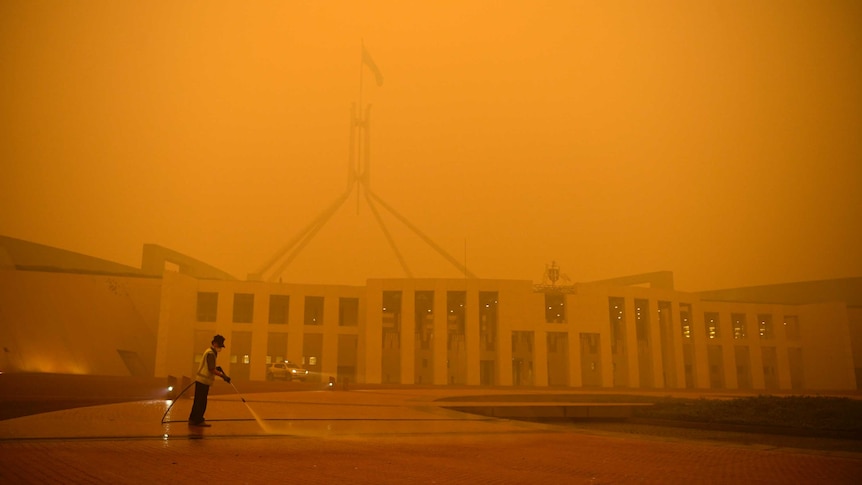
As for the weather, 2026-27 looks like being a double whammy: the most brutal El Niño since 1983 on top of the hottest year on record because of climate change.
The Southern Oscillation Index, which measures El Niño events via air pressure anomalies between Tahiti and Darwin, is at minus 29.1, the lowest since it reached minus 33.3 in February 1983.
The 1982-83 El Niño resulted in Australia's worst ever drought, a collapse in agricultural production, a massive dust storm in Melbourne, and above all the horrendous Ash Wednesday bushfires on February 16, 1983, in which 75 people died, and 2,545 families lost their homes.
Meanwhile, scientists have detected a sharp acceleration in the pace of global warming, which is behind the horrendous fires in Europe this northern summer.
This year looks like being the hottest year on record, with the global average temperature already reaching the 1.5 degrees of warming that was the maximum everyone agreed at the Paris climate conference in 2015.
This academic paper published in March reported that global warming has accelerated. The plain language summary says:
"In this study, we subtract the estimated influence of El Niño events, volcanic eruptions and solar variations from the data, which makes the global temperature curve less variable, and it then shows a statistically significant acceleration of global warming since about the year 2015. Warming proceeding faster is not unexpected by climate models, but it is a cause of concern and shows how insufficient the efforts to slow and eventually stop global warming under the Paris Climate Accord have so far been."
According to the Climate Action Tracker, current policies in place around the world are projected to result in about 2.6 degrees Celsius of warming above pre-industrial levels.
If the long-term or net zero targets agreed at Paris are included (that is "pledges and targets" not actually adopted yet), warming would be limited to between 2.2C and 2.4C.
All those temperatures would be various degrees of catastrophic … and expensive, for governments, companies and households.
APRA's recent "Insurance Climate Vulnerability Assessment" estimated that with 1.8C of warming, 26 per cent of Australian households won't be able to afford insurance by 2050.
That's a million more than are uninsured now, and that's only with 1.8C, which we're not far off.
The capital, savings and government debt required to pay for flood, fire and cyclone damage, not to mention a more urgent effort to cut carbon emissions, will make the AI investment boom and current government deficits seem like a snack.
Alan Kohler is a finance presenter and columnist on ABC News. He hosts the podcast That’s Business with Alan Kohler in the ABC Business Daily feed on Friday. He also writes for Intelligent Investor.