
Science
Sediments reveal secrets from before the Great Barrier Reef was underwater
Key Points
Work underway to uncover secrets of Great Barrier Reef area when it was dry land In short: Researchers and Indigenous rangers are trying to find out what type of landmass the Great Barrier Reef was before it was underwater. Because of the way sediment collects on the sea floor, they are using samples as "time capsules" to create a map of the area's past. Data and samples collected during the trip on a CSIRO boat will also be used for current and future mapping to help with the reef's future...
Work underway to uncover secrets of Great Barrier Reef area when it was dry land
In short:
Researchers and Indigenous rangers are trying to find out what type of landmass the Great Barrier Reef was before it was underwater.
Because of the way sediment collects on the sea floor, they are using samples as "time capsules" to create a map of the area's past.
What's next?
Data and samples collected during the trip on a CSIRO boat will also be used for current and future mapping to help with the reef's future health.
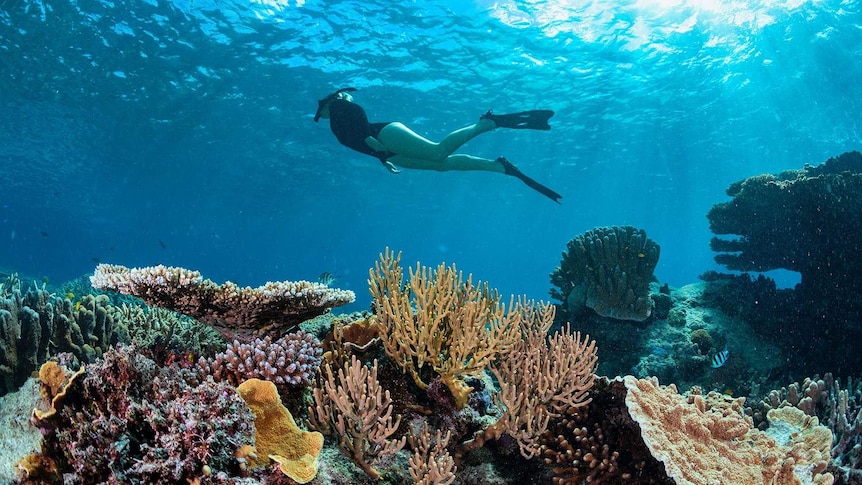
Beneath the sea off the Central Queensland coast is a tapestry of colourful coral, marine life and pristine ecosystems, but there are also ancient secrets.
About 65,000 years ago, when sea levels were 80 metres below present-day levels, the Southern Great Barrier Reef area was a landmass that could have been grasslands, dense rainforests or mangrove swamps.
It is something University of Queensland professor Helen Bostock is trying to find out.
She recently led an expedition to the area to try to uncover what it might have looked like when it was dry land.
"Our research has revealed submerged rivers, lakes, estuaries and beaches in stunning detail," Professor Bostock said.
"We were trying to understand and map out the past sea country … these submerged landscapes that are now covered by a thin veneer of sediment, a little blanket of sediment."
On Thursday, she returned from the 24-day voyage with Indigenous rangers on CSIRO research ship RV Investigator.
The team collected samples from the seabed between the Swain Reef and the Capricorn Bunker Group off the Yeppoon and Gladstone coastlines.
They spent most of their time in water ranging from 50 to 200 metres deep.
Of the layers of sediment that build up over time on the sea floor, the top layer is the most recent.
"If we start at the top of a sediment core that we've collected down through those sequences, we can basically go back through time from the top down towards the bottom of our cores," Professor Bostock said.
"Each of those layers of sediment records a whole range of different characteristics. It'll be changes in the grain size, the chemistry, but also little microfossils that lived in those environments, like pollen.
"We're hoping to generate some nice maps of what the submerged landscape used to look like to understand the cultural history of the area along with the environmental history."
She said the expedition was also about collecting oceanographic data to understand sediment movements, nutrients and water temperatures, which would influence the future health of the reef.
Involving traditional knowledge
Indigenous Land and Sea Rangers from the Darumbal and Woppaburra traditional owner groups were part of the voyage, to help merge the scientific findings with cultural knowledge.
Professor Bostock said her research over the years had involved conversations about cultural stories of people walking across to Swains Reefs.
"That was … one of the inspirations behind the original voyage … some of the stories from Auntie Sally [Vea Vea] and a few of the other elders," Professor Bostock said.
Tshinta Barney, Woppaburra land and sea rangers supervisor, said she was excited to see what the sediment would reveal.
"When you put in the Western science and see the degree that they go to, you can really see where our stories and our family ties all come into one," she said.
"We can acknowledge the fact that Western science helps us prove [cultural knowledge] as well.
"I'm keen to be able to pass [the knowledge] onto our younger generations and show them that they are able to do this kind of work if they want to get into it."
Darumbal land and sea ranger Nataliah Backo said she hoped the journey made her ancestors proud.
"It's just amazing that we got to be on the sea country that our ancestors used to live, walk and hunt on," she said.
Professor Bostock said results from the oceanography research were expected within the next year; however, the sediment samples would take longer to analyse.
the Great Barrier Reef (LOCATION)
Great Barrier Reef (LOCATION)
Central Queensland (LOCATION)
the Southern Great Barrier Reef (ORG)
University of Queensland (ORG)
Helen Bostock (PERSON)
Bostock (PERSON)
CSIRO (ORG)
RV Investigator (ORG)
the Swain Reef (LOCATION)
the Capricorn Bunker Group (ORG)
Yeppoon (ORG)
Gladstone (LOCATION)
Indigenous Land and Sea Rangers (ORG)
Darumbal (ORG)