
Science
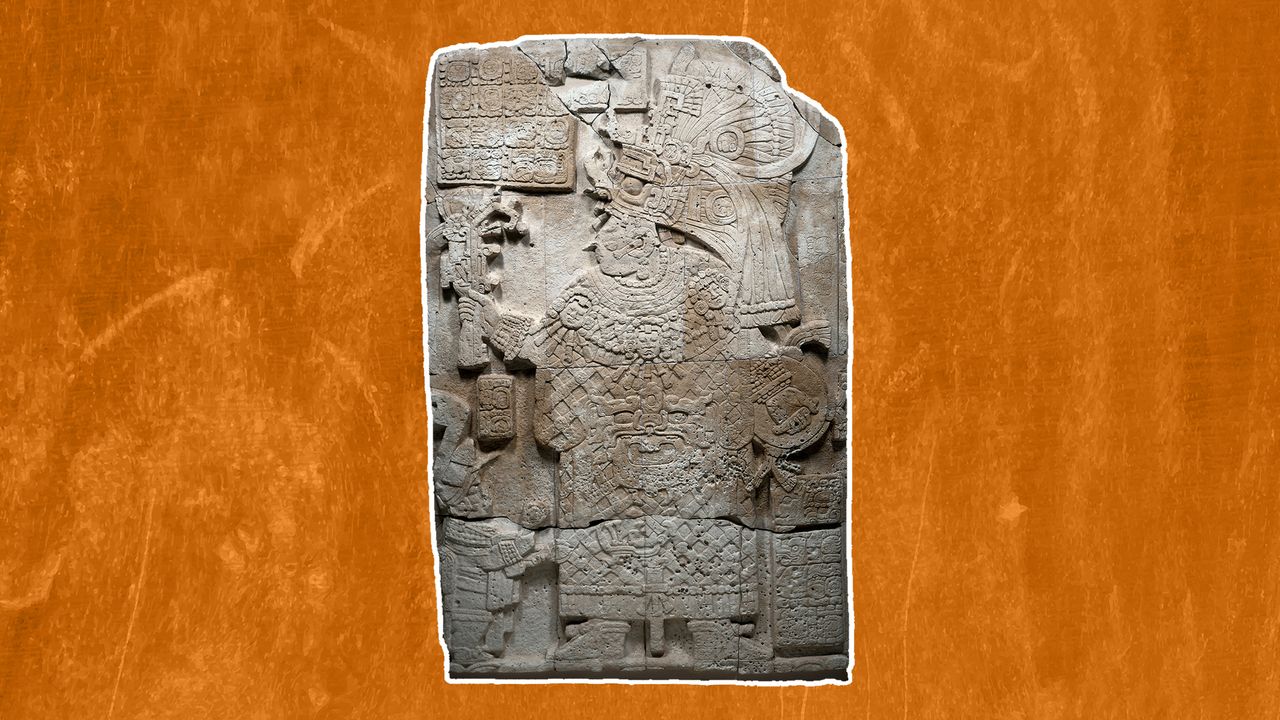
Front face of a stela: A 1,300-year-old carving of a powerful Maya 'Lady Supreme Warlord' that weighs over 2 tons
Key Points
Front face of a stela: A 1,300-year-old carving of a powerful Maya 'Lady Supreme Warlord' that weighs over 2 tons This monumental carving depicts a powerful Maya queen called Lady K'abel, who ruled an ancient city in Guatemala at the end of the seventh century. Name: Front face of a stela What it is: A limestone carving Where it is from: Petén, Guatemala When it was made: A.D. 692
Front face of a stela: A 1,300-year-old carving of a powerful Maya 'Lady Supreme Warlord' that weighs over 2 tons
This monumental carving depicts a powerful Maya queen called Lady K'abel, who ruled an ancient city in Guatemala at the end of the seventh century.
QUICK FACTS
Name: Front face of a stela
What it is: A limestone carving
Where it is from: Petén, Guatemala
When it was made: A.D. 692
This massive limestone carving depicts a Maya queen known as Lady K'abel (meaning Water Lily Hand) and Na Kan Ajaw (meaning Divine Woman of the Snake Polity). The stela, or carved stone slab, was likely erected in A.D. 692 to mark the end of a k'atun, a 20-year period in the Maya calendar.
The stela is in the collection of the Cleveland Museum of Art (CMA). It has been reconstructed from more than 40 fragments of carved limestone but is only the front part of the original freestanding monument. The enormous carving is roughly 9 feet (2.74 meters) tall and weighs about 2,500 pounds (1,134 kilograms). It was found in a provincial Maya town called El Perú-Waka' in the Petén region of northern Guatemala.
In Petén, this carved portrait of Lady K'abel stood next to a similar one of her husband, K'inich Bahlam II, a man of lower rank. As a member of the powerful Kaanul or Snake dynasty, Lady K'abel ruled El Perú-Waka' as the military governor, according to the CMA. The stela also describes her as Ix Kaloomte', meaning Lady Supreme Warlord, and experts think Lady K'abel may have led an army from the city of Calakmul against the city of Tikal.
On the stela, Lady K'abel is "smothered in finery," Susan E. Bergh, then curator of Pre-Columbian and Native North American art at the CMA, wrote in 2014, which "allies her with a Maya supernatural being, either the maize god or the moon goddess." Her headdress is a fan of green quetzal (Pharomachrus mocinno) feathers, and she wears a netted garment and necklace, both made of jade beads. The net dress is belted with the head of a fish-like creature, and Lady K'abel carries a scepter and a circular shield, alluding to her role as Lady Supreme Warlord. In the lower-left corner is a person with dwarfism, likely an attendant or courtier.
The stela was created to celebrate 20 years of Lady K'abel's rule. Portraying her as the maize god conveys themes of creation and renewal, archaeologist Phil Wanyerka wrote in a 1996 study. "By wearing the attire of a god, a mortal being becomes divine, and here a woman is transfigured into the maize god to summon the associated powers of renewal and rebirth for the passage of the old k'atun and the inauguration of the new," Wanyerka wrote.
Although Lady K'abel's stela was acquired in 1967, her tomb was not discovered until 2012, when archaeologists excavating at El Perú-Waka' stumbled across it when digging at the bottom of a previously unknown staircase near where the stela was found.
According to archaeologist Olivia Navarro-Farr, who led the excavation, the royal tomb was full of artifacts made from jade, obsidian and shells, including a bivalve shell placed on the skeleton's pelvis. The shell exactly matches one depicted on Lady K'abel's pelvis on the stela. In the tomb, the archaeologists also found a small alabaster carving with hieroglyphs that named Lady K'abel as its owner, almost certainly linking the occupant of the tomb with the imposing limestone stela that was discovered outside.
Get the world’s most fascinating discoveries delivered straight to your inbox.
"It's not rare to find royal tombs," Navarro-Farr said. "But it is rare to have the perfect confluence of evidence that leads one to be able to make that kind of historical identification."
For more stunning archaeological discoveries, check out our Astonishing Artifacts archives.
Can you put together last week's Astonishing Artifact?
Kristina Killgrove is a staff writer at Live Science with a focus on archaeology and paleoanthropology news. Her articles have also appeared in venues such as Forbes, Smithsonian, and Mental Floss. Kristina holds a Ph.D. in biological anthropology and an M.A. in classical archaeology from the University of North Carolina, as well as a B.A. in Latin from the University of Virginia, and she was formerly a university professor and researcher. She has received awards from the Society for American Archaeology and the American Anthropological Association for her science writing.
You must confirm your public display name before commenting
Please logout and then login again, you will then be prompted to enter your display name.