
Science
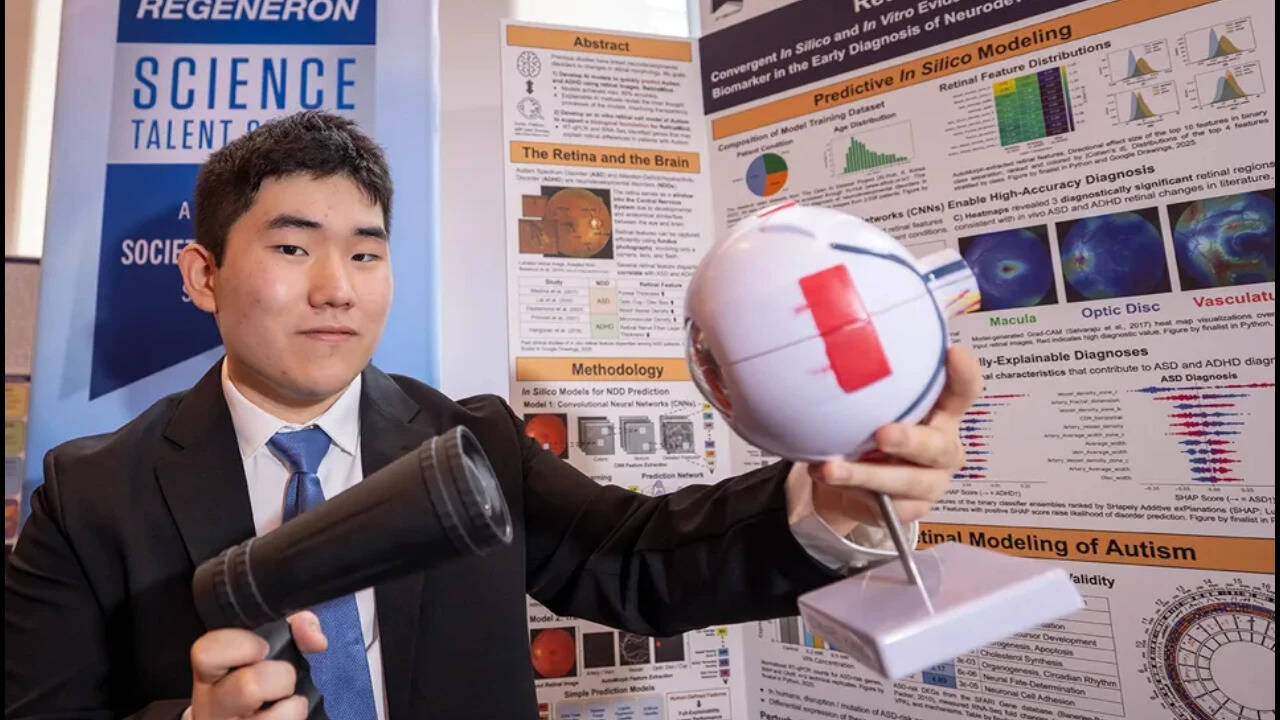
Meet Edward Kang, 17, who trained AI to screen for autism and ADHD
Key Points
What if a simple picture of the eye could help doctors diagnose neurodevelopmental conditions earlier? For 17-year-old Edward Kang of Hackensack, New Jersey, that question became the foundation for an ambitious science project that combines neuroscience, artificial intelligence and cell biology. His research, RetinaMind: Novel In Silico and In Vitro Retinal Models of Neurodevelopmental Disorders, investigated the potential for retinal images to provide clues related to autism and...
What if a simple picture of the eye could help doctors diagnose neurodevelopmental conditions earlier? For 17-year-old Edward Kang of Hackensack, New Jersey, that question became the foundation for an ambitious science project that combines neuroscience, artificial intelligence and cell biology. His research, RetinaMind: Novel In Silico and In Vitro Retinal Models of Neurodevelopmental Disorders, investigated the potential for retinal images to provide clues related to autism and attention-deficit/hyperactivity disorder (ADHD), reports Society for Science. The project won Kang a $175,000 science prize, highlighting his work as a prime example of how young researchers are tackling complex challenges in medicine, the report adds. Scroll down to read the details.
Investigating the connection between the eye and the brain
If we go by the medical science, a diagnosis of autism or ADHD can take a long time – sometimes months or even years. And Kang’s project was inspired by research that suggests the eye may contain useful biological clues about these conditions. The retina, the light-sensitive tissue at the back of the eye, is closely related to the brain. The retina and brain are derived from related tissues, and differences in the retina have been observed in association with some neurodevelopmental disorders.
Kang wondered if artificial intelligence could detect those slight differences in retinal photos and perhaps help with screening.
Training AI to detect retinal differences
According to the report published by Society for Science, for his project, Kang trained AI models to detect patterns associated with neurodevelopmental disorders from a large public dataset of retinal images. Instead of one approach, he used several techniques to improve the performance of the models. He also looked at what features influenced the AI’s predictions. It’s crucial to know why an AI system makes a certain decision — especially in healthcare, where researchers need to understand if a model is detecting a real biological signal or just some unrelated pattern. Kang then investigated the possibility of using the models as a screening tool, and built a prototype, called RetinaMind, to demonstrate how such a system could operate.
Beyond artificial intelligence
Kang, who has done research and taken leadership positions, is a student at Bergen County Academies. He is a member of his class council and the safety co-chair and judge for his middle school science fair.
And the project didn’t stop at computer models. Kang also explored the biology behind the retinal differences he saw. To investigate gene changes that might help explain the patterns observed in the images, he developed a model of a retinal cell. He then confirmed his findings with a second cell model, adding another layer of biological proof to his study. As per the report, Kang bridged the gap between what AI could detect in retinal images and potential underlying cellular and genetic mechanisms by combining computational analysis with laboratory-based experiments.
A young researcher with an increasing scientific profile
Kang, who has done research and taken leadership positions, is a student at Bergen County Academies. He is a member of his class council and the safety co-chair and judge for his middle school science fair. He has done a lot of things besides RetinaMind. Kang was a runner-up in the International Research Olympiad, and he co-founded a club that teaches students how to read scientific research. These experiences demonstrate not only his desire to conduct research, but also to make science more accessible to others.
From Lab to Carnegie Hall
Kang's passions extend well beyond science. He has added music to his already diverse list of accomplishments, and is a baritone in the New Jersey All-State Mixed Chorus, having performed at Carnegie Hall. He also volunteers as a counselor at a summer camp for homeless children, which demonstrates his commitment to community service beyond his academic interests, the report by Society for Science states. Kang has combined AI, neuroscience and laboratory research with RetinaMind to pursue a potentially useful path for neurodevelopmental screening. While the project is a research endeavor and not a clinical diagnostic tool, it demonstrates how emerging technology and innovative thinking might shape future ways of understanding autism and ADHD.
Images Courtesy: Society for Science