
Business & Finance
'Just plain insulting': Sellers on Shopee and TikTok call out auto-generated AI ads that mislead customers
Key Points
'Just plain insulting': Sellers on Shopee and TikTok call out auto-generated AI ads that mislead customers In one AI-generated video on Shopee, a book by a local author, which deals with themes such as emotional and verbal abuse, was described as a "fun" story. SINGAPORE: When Singaporean author Xie Shi Min stumbled across her own novel, Ghost Hunters of Geylang, on Shopee in March, she was startled to find an artificial intelligence video peddling a bizarre version of it. Her protagonist's...
'Just plain insulting': Sellers on Shopee and TikTok call out auto-generated AI ads that mislead customers
In one AI-generated video on Shopee, a book by a local author, which deals with themes such as emotional and verbal abuse, was described as a "fun" story.
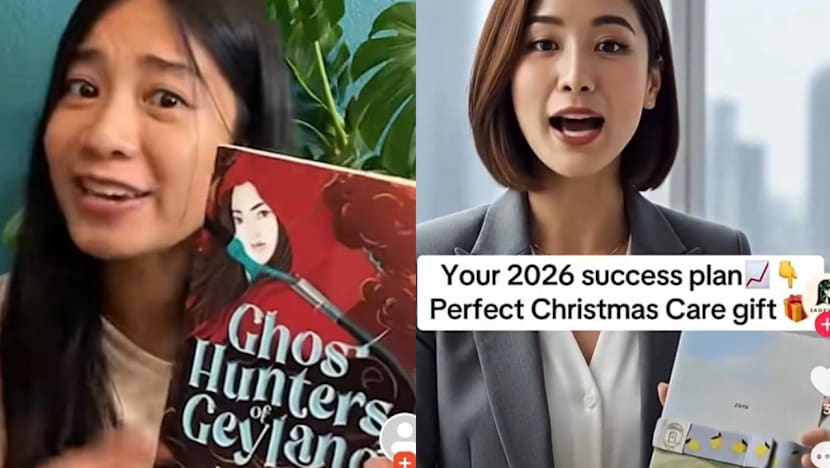
SINGAPORE: When Singaporean author Xie Shi Min stumbled across her own novel, Ghost Hunters of Geylang, on Shopee in March, she was startled to find an artificial intelligence video peddling a bizarre version of it.
Her protagonist's symbolic sword on the cover had been warped into a pole. An AI avatar marketing the novel claimed she could "smell durian" from the pages. Worse still, a young adult story grappling with generational trauma and abuse was repackaged as a "fun" and "wholesome adventure" for children.
"The effort that my cover designer used to create the unique cover art that makes it stand out in a bookstore and to have to see it perverted like that (is heartbreaking)," the award-winning author told CNA on Friday (Aug 21) of her disbelief when she first saw the unsolicited ad.
"To have it be put through AI is just plain insulting."
Ms Xie is among a growing number of creators and sellers frustrated by a lack of control over AI-generated videos marketing their products on Shopee and TikTok since late last year.
Shopee introduced the video feature in late 2025 to provide shoppers with additional information about products to help them make more informed purchasing decisions.
TikTok Shop recently updated its video maker tool, allowing creators to automatically generate AI videos with embedded product links.
But those who spoke to CNA say the videos misrepresent what they sell.
In Ms Xie's case, the oddities in the video likely arose from AI hallucinations. Durians were mentioned in just one line in the book and are not related to the main plot, Ms Xie said.
More troubling for her was how the video portrayed her young adult book with horror elements as a "fun" one, which she said was "detrimental" to her audience.
"So for Shopee to present it as a children's book adventure, like 'oh Geylang is our playground, we play there and we fight ghosts', it's just wrong."
DIFFICULTY REPORTING THE VIDEOS
Ms Xie immediately alerted her publisher Epigram Books to the video, which reported it to Shopee. The publisher also suggested that she file a report to the platform.
Speaking to CNA, Epigram Books' online sales and marketing manager Chloe Chee said about five to six authors had reached out with similar concerns and the independent publisher likewise advised them to report the products.
The company has reported about 10 affected listings since March, though Ms Chee said she was not sure if the videos have been taken down.
She added that she contacted Shopee several times through messages and by highlighting the issue on its seller platform, but could not tell if she was interacting with an actual person or a chatbot.
"On our side, on the back end, there are (some) features to turn off AI-generated images, but not videos," she said.
Even when the feature is turned off, the changes are not reflected immediately on the platform.
"I'm not sure if it actually solves the issue. But it seems like it still hasn't; the videos are still there," said Ms Chee.
When Ms Xie checked the listing for her book again on Aug 20, she noticed a different AI-generated video this time.
"It's like a Hydra, you kill one video and then another comes up," she said, referring to the snake-like monster with many heads in ancient Greek mythology.
Ms Koh Wan Yi, the sole proprietor of Helumi, a design studio selling paper products such as planners and journals, encountered similar AI-generated videos first on TikTok and later on Shopee.
In the second half of last year, she saw that affiliate creators on TikTok - who earn commissions from promoting products on the platform - had posted videos of AI-generated people showcasing her products.
"It may not even be in English. It could be in Spanish. I've gotten that as well. I'm not sure why, (the business) is only on TikTok Shop Singapore, but somehow the videos are in different languages," said Ms Koh, 33.
The products shown in the videos were also not accurate.
"One of the videos I saw last year was my yearly calendar being shown, and the size of the calendar compared to the person holding it was completely wrong - it was huge," Ms Koh said.
In others, the stickers that Helumi sell on TikTok were oversized or shown in the wrong colours.
"That's why I was quite concerned because if a customer sees it, they might get the wrong idea about the product, and when they get it, they'll be like 'oh, the calendar is smaller than I thought'."
Ms Koh asked the account manager for her TikTok Shop if she could block the specific affiliate creators but was told she could not. Instead, she was recommended to turn off an "open collaboration" option that permits creators to share and promote her products.
At that point, Ms Koh did not do so and chose to contact the creators herself to see if they would take the videos down. "Some of them did do it. Some of them were very nasty about it … to them, they have the right to create whatever video they want because it's going on their profile but of course it links to my product," she said.
While she left it at that then, she recently decided to turn off the option as she prepared for the launch of her new collection.
"(This) is quite a pity, because there are some affiliate creators that I enjoy working with, or they are genuine users of the products. But now, it's not so easy to work with them anymore."
Ms Koh only noticed similar AI-generated videos on Shopee recently, as she had been focusing more on TikTok, where her sales are better.
Responding to CNA's queries on Saturday, a Shopee spokesperson said it has reached out to the affected sellers to provide further assistance on this matter.
On the video feature, the spokesperson said: "Product videos on Shopee can also include content contributed by users, and this may include AI-generated content."
The platform has safeguards in place to detect and address video content that may be unsafe or violate policies, and sellers who have concerns about the videos on their listings are encouraged to report these for review, the spokesperson said.
"We take feedback from our seller community seriously and will continue to improve our processes to ensure product videos remain useful to shoppers while appropriately representing sellers and their products."
Shopee did not address CNA's questions on whether sellers are informed of the AI-generated videos, nor did the platform address concerns that sellers do not have the option to remove the videos or replace them with their own.
CNA has also contacted TikTok about its AI marketing videos.
"DESTROYS OUR REPUTATION"
The use generative AI in advertising videos has caught on in Singapore, as CNA reported on Monday.
While some sellers want to see themselves at the forefront of AI, poorly made AI content is more likely to turn consumers away instead. To this end, the Advertising Standards Authority of Singapore has noted that consumers are concerned about brands using generative AI to create misleading ads.
Likewise, sellers were worried that their brand reputation had taken a hit due to the AI-generated videos that were made without their approval, they told CNA.
Epigram Books' Ms Chee said authors contacted the publisher after seeing AI-generated videos of their books to express their disappointment as they had thought it was the publisher that had commissioned these clips.
"They reach out to us like 'hey, how can you do this?'. To them, it feels like we are the ones who did it, but actually it's not. We can't control it," she added.
The publisher took to Instagram last week to clarify that it was not behind the AI-generated videos on its listings.
The distorted book covers seen in the AI videos made the publisher's work appear substandard, said Ms Chee.
"It would tarnish our brand, when in future other authors approach us, and then if they don't notice it, or they assume that the videos are created by us … it definitely destroys our reputation."
In Ms Koh's case, she too believes the videos have affected Helumi's brand reputation too, as she has certain aesthetic standards and brand messaging that she wants her customers to connect with.
"But then once you go into the profile and then you see this AI-generated video pop up, it just completely ruins a lot of that credibility we have built up. It is not what we want our customers to feel when they see our brand," said Ms Koh.
She hopes the platforms can have better policies on AI-generated videos and give sellers more control over what appears on their profiles.
"It's really quite frustrating as a brand owner and a designer who puts in a lot of effort into our branding, into our products."