
Science
Dead man identified, three years after his skull was found
Key Points
Remains identified as Edward Harold Tait, three years after his skull was found in southern Tasmania In short: Tasmanian coroner Madeleine Wilson has concluded human remains found in southern Tasmanian are believed to be Edward Harold Tait. The male skull was accidentally found in 2023, but initial DNA matching failed to identify the man, leading police to call on the public for help. The man's identity was confirmed with the help of DNA supplied by his estranged sister.
Remains identified as Edward Harold Tait, three years after his skull was found in southern Tasmania
In short:
Tasmanian coroner Madeleine Wilson has concluded human remains found in southern Tasmanian are believed to be Edward Harold Tait.
The male skull was accidentally found in 2023, but initial DNA matching failed to identify the man, leading police to call on the public for help.
The man's identity was confirmed with the help of DNA supplied by his estranged sister. In her coronial report Ms Wilson says the date and cause of Mr Tait's death remains unknown.
The remains of an itinerant man who was never reported missing have been identified more than three years after his skull was accidentally found, following a persistent police effort and DNA supplied by his estranged sister.
Edward Harold Tait was born in 1971 to Scottish parents who would later move to regional Victoria.
According to findings handed down by Tasmanian coroner Madeleine Wilson, Mr Tait's remains were found in July 2023 at a property at Clifton Beach, in southern Tasmania, while the landowner, Gregory Hunter, was clearing weeds in a gully.
While working, Mr Hunter kicked what he believed was a rock, which he then realised appeared to be a human skull.
A police investigation of the area found a small campsite made up of a rusted corrugated iron sheet covering a shallow dugout — just large enough for a person to lay flat — about 75 metres up the slope from where the skull was found.
At the site, police found two brown men's shoes — the right one containing orthotics in the heel — a shirt, keys, a lighter and a plastic bag containing two badly disintegrated business cards.
Despite missing the lower jawbone, forensic examination determined the skull was in "excellent condition", with a brown stain on the right side indicating it had been in contact with the soil for some time.
Forensic pathologists, however, were unable to determine the cause of the individual's death.
Further forensic testing by the Australian Federal Police (AFP) comparing the DNA against samples from crime scenes, convicted offenders, suspects, volunteers and items belonging to missing people was unsuccessful.
According to the coroner's report, determining the age of the remains was also proving difficult.
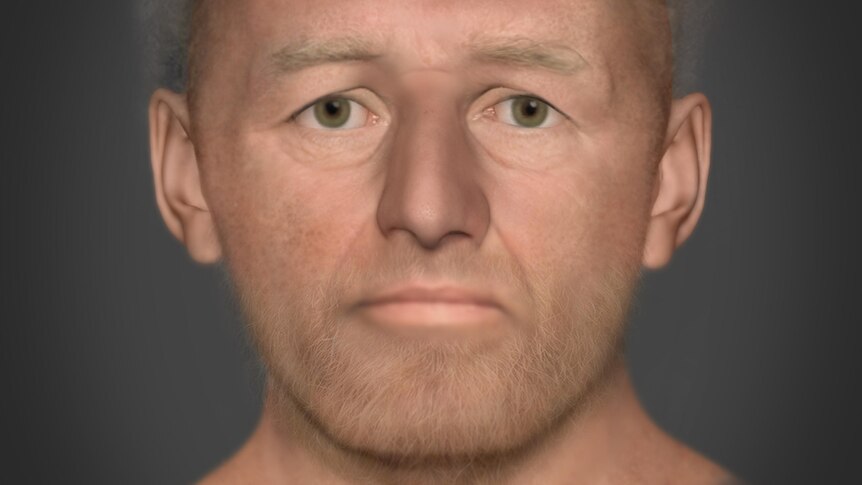
In May the following year, Tasmania Police released a facial reconstruction of the man, hoping that the public could help identify the person who had so far failed to appear on any state or national DNA database.
At the time, police said they believed the remains could be from as recent as five years ago, and up to 50 years old.
The information that could be gleaned from the skull was slim: forensic analysis had determined the remains belonged to a Caucasian male, most likely with blond, brown or black hair, one of the business cards found at the camp belonged to a restaurant on Swanston Street in Melbourne, and there was no indication of violence.
Mr Tait's sister, Helen Tait, would become the vital link in helping confirm his identity.
A 'reclusive and itinerant' existence
According to information Ms Tait provided in Ms Wilson's coronial report, Mr Tait had led a difficult and wandering life.
He was born with a congenital condition which led to one leg to be shorter than the other — a cause of significant pain later on.
Following the separation of his parents, Mr Tait's early life was split between Scotland and Australia.
He would go on to lead a "reclusive and itinerant" existence, Ms Wilson noted in her report.
After becoming estranged from his sister in 1993, he went on to find himself in trouble with police across several states, facing charges relating to trespassing, begging and stealing.
A chance meeting with her brother in Melbourne in 1998 would be the last time Ms Tait would see him.
Shoe orthotics a key clue
By July 2024, the forensic investigation had made a breakthrough in confirming Mr Tait's identity.
Forensic Genetic Genealogy testing through the AFP's National DNA Program had identified a third-degree male relative based off a sample taken from the skull found at Clifton Beach.
Forensic data, genealogical research, "and other relevant sources" had led investigators to identify Mr Tait as the most likely source of the unidentified remains.
In January 2025, investigators contacted Ms Tait to let her know the remains of a person believed to be her brother had been found in southern Tasmania.
Ms Tait would go on to provide a DNA sample to help the investigation.
"Helen Tait was unaware that Edward had been in Tasmania and did not know of any connection between him and the state,"Ms Wilson said.
She said the fact that Mr Tait's parents were Scottish, and the additional fact that he was born with one leg shorter than the other, and that one of the two matching shoes found near skull contained orthotics, "fortified" her belief the remains were him.
Ms Wilson concluded he died at or near the shelter at an unknown date.
In the coroner's report, Senior Constable Lucy Brown from Tasmania Police's Missing Person Unit said investigations had revealed Mr Tait had led "an extremely reclusive and transient lifestyle" in the state, and had never been reported missing.
According to Senior Constable Brown's investigation, Mr Tait had lived in hotels and men's shelters in Hobart throughout August and September 1999, and secured a rental in New Town later that month.
He last contacted Centrelink in person on November 30, 1999 and his rental agreement was terminated in March the following year.
In her report, Ms Wilson said there were no further reported sightings of Mr Tait, and the cause of his death remains unknown.
Edward Harold Tait (PERSON)
Tasmania (LOCATION)
Tasmanian (ORG)
Madeleine Wilson (PERSON)
Ms Wilson (PERSON)
Tait (PERSON)
Scottish (ORG)
Victoria (PERSON)
Clifton Beach (LOCATION)
Gregory Hunter (PERSON)
Hunter (PERSON)
the Australian Federal Police (AFP (ORG)
Caucasian (ORG)
Swanston Street (LOCATION)
Melbourne (LOCATION)