
Politics
‘Constitutional monstrosity’: P Chidambaram attacks One Nation, One Election Bill
Key Points
‘Constitutional monstrosity’: P Chidambaram attacks One Nation, One Election Bill Edited by: Yashasvi Vasistha / TIMESOFINDIA.COM / Aug 25, 2026, 11:09 IST Comments Share AA Text Size Small Medium Large File photo: Congress MP P Chidambaram NEW DELHI: Senior Congress leader and Rajya Sabha member P Chidambaram on Tuesday said simultaneous elections to the Lok Sabha and state assemblies cannot be held in 2029 even if Parliament passes the proposed One Nation, One Election (ONOE) legislation.
‘Constitutional monstrosity’: P Chidambaram attacks One Nation, One Election Bill
Edited by: Yashasvi Vasistha / TIMESOFINDIA.COM / Aug 25, 2026, 11:09 IST
Comments
Share
AA
Text Size
Small
Medium
Large
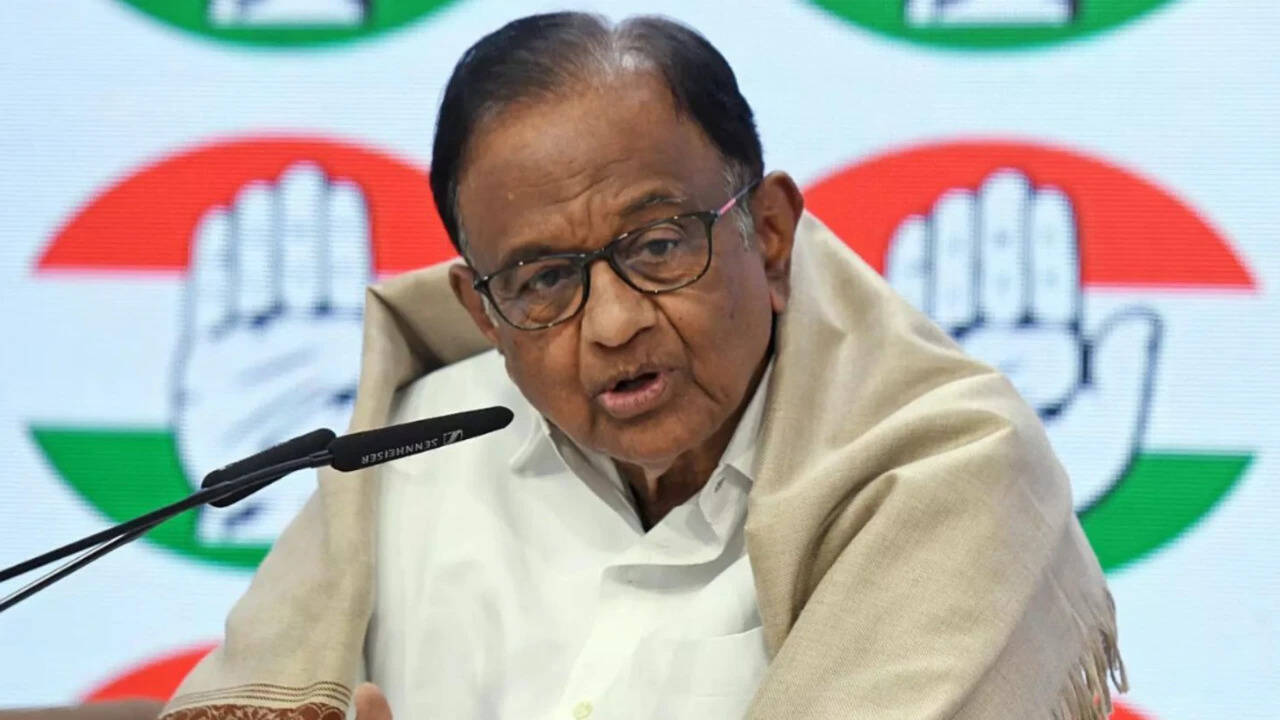
File photo: Congress MP P Chidambaram
NEW DELHI: Senior Congress leader and Rajya Sabha member P Chidambaram on Tuesday said simultaneous elections to the Lok Sabha and state assemblies cannot be held in 2029 even if Parliament passes the proposed One Nation, One Election (ONOE) legislation.Chidambaram, who appeared before the Joint Parliamentary Committee (JPC) examining the ONOE Bills, said his basic submission before the panel was that the proposed legislation violated the basic features of the Constitution, particularly parliamentary democracy in a federal country.In a post on X, Chidambaram said he was not permitted to disclose his evidence before the JPC but outlined the thrust of his argument.“I am grateful for the opportunity to present my views to the JPC on O.N.O.E. I am not at liberty to disclose my evidence to the JPC but the basic thrust of my deposition was that the Bill violated the basic features of the Constitution, especially the tenets of parliamentary democracy in a federal country,” he wrote.
Chidambaram disputes 2029 timeline
Chidambaram also rejected the reported assertion by JPC chairman PP Chaudhary that simultaneous elections could be held in 2029.
“I have read the reported statement of the Chairman, JPC, that simultaneous elections are possible in 2029 I am afraid his view is wrong and goes against the text of the Bill,” he said.According to Chidambaram, the Bill provides that the “appointed date” can only be a date that comes after a general election. Since the next Lok Sabha election is due in 2029, he argued that simultaneous polls cannot be conducted in that year.“Even if the Bill is passed (which is very unlikely), the 'appointed date' under the Bill can only be a date 'after a general election'. The next general election will take place in 2029. Hence, simultaneous elections are not possible in 2029, which is a blessing,” he said.Chidambaram added that the Congress and other Opposition parties would launch a nationwide campaign against the legislation, calling it a “Constitutional monstrosity in parliamentary democracy in a federal country.”
JPC receives suggestions on deferring state polls
Meanwhile, the parliamentary committee examining the ONOE legislation received several suggestions during its deliberations on Monday.According to sources cited by news agency ANI, two public policy institutions proposed replacing subjective discretion in deciding whether to defer state assembly elections with defined and judicially traceable grounds, along with fixed outer limits for such deferrals.The Constitution (One Hundred and Twenty-Ninth Amendment) Bill, 2024, seeks to facilitate the proposed synchronisation of Lok Sabha and state assembly elections. The Union Territories Laws (Amendment) Bill, 2024, forms part of the broader legislative framework for implementing simultaneous polls.Both Bills were introduced in the Lok Sabha on December 17, 2024, and subsequently referred to the JPC for detailed examination.The panel has since held meetings with subject-matter experts and undertaken study visits, with its most recent study visit taking place in Lucknow in July.
Chidambaram had opposed Bills before panel
Chidambaram had appeared before the JPC on Monday and strongly opposed the proposed simultaneous-election framework.He argued that curtailing the five-year tenure of elected legislatures would violate the Constitution's basic structure.He also said he could not support the Bills on grounds of conscience and contended that the government did not have the two-thirds majority required to pass the proposed constitutional amendments, according to sources cited by news agency PTI.JPC chairman PP Chaudhary said Chidambaram had provided “good inputs” but noted that he represented a particular political party. Chaudhary maintained that the proposal to hold simultaneous elections was not against the basic structure of the Constitution.
The ONOE Bills were formulated after a high-level committee headed by former President Ram Nath Kovind recommended holding Lok Sabha, state assembly and local body elections simultaneously in a phased manner.Historically, Lok Sabha and state assembly elections were held together from 1951-52 until the cycle was disrupted by premature dissolutions of some state assemblies in 1968 and 1969, followed by the early dissolution of the Fourth Lok Sabha in 1970.