
Technology
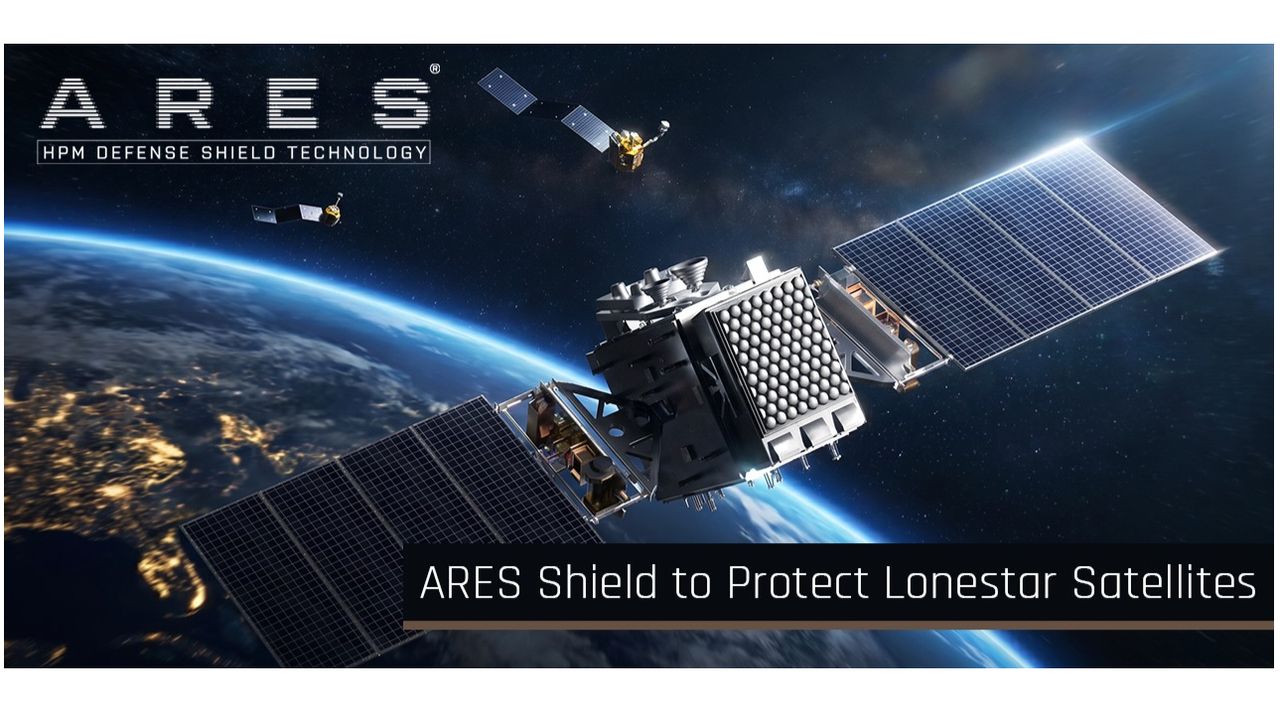
Polish startup Ares Shield hired to protect data center satellites with high-power microwave weapons
Key Points
Polish startup Ares Shield hired to protect data center satellites with high-power microwave weapons The final frontier is getting more and more contested, so satellite companies are investing in some self-defense. At least one of them is, anyway. Florida-based Lonestar Data Holdings announced today (Aug. 25) that it has contracted Polish startup Ares Shield to provide protection for its off-Earth data centers, in a deal worth up to $6 million.
Polish startup Ares Shield hired to protect data center satellites with high-power microwave weapons
The final frontier is getting more and more contested, so satellite companies are investing in some self-defense.
At least one of them is, anyway. Florida-based Lonestar Data Holdings announced today (Aug. 25) that it has contracted Polish startup Ares Shield to provide protection for its off-Earth data centers, in a deal worth up to $6 million.
"Our clients entrust us with mission-critical data, which is why we treat the security of our orbital infrastructure as the foundation of our entire service," Lonestar CEO Stephen Eisele said in a statement today. "Ares Shield technology offers a unique solution that allows us to further protect our satellites without the risk of generating space debris. For a company whose product is data security, it is a compelling option."
Lonestar has already tested its data-storage tech on four space missions, including two that went to the moon.
For example, one of the company's devices hit the gray dirt aboard Intuitive Machines' Athena lander in March 2025. Athena toppled over shortly after touchdown, but Lonestar's mini data center achieved its desired milestones regardless, according to the company.
Such work has helped inform the development of Lonestar's first commercial space-based offering — a platform called StarVault, which will store customer data at a healthy remove from natural disasters and other issues that could crop up here on terra firma.
"StarVault combines Lonestar's advanced cryptographic key escrow capabilities with space-based data storage infrastructure, creating a new class of digital resilience — extending secure data beyond Earth," the company said in a statement in April.
The first StarVault payload is currently scheduled to fly aboard Sidus Space's LizzieSat-4, which is manifested on SpaceX's Transporter 18 rideshare mission. That flight is expected to launch from California's Vandenberg Space Force Base in late October.
Other StarVault missions will follow, as Lonestar builds a data-storage network in low Earth orbit and, perhaps, more far-flung locales.
Multiple satellites in that network will be protected by Ares Shield technology, if all goes according to plan. That tech is a combination of sensors, AI-driven analytics and a high-power microwave (HPM) emitter, which are integrated into a module that attaches to the client satellite.
Ares Shield's system will be able to detect and classify potential threats, such as approaching "inspector" satellites that may have designs on stealing the client's data. And the defense module can neutralize them via electronics-frying HPM emissions, knocking satellites out without creating a cloud of space debris.
But shooting to kill will likely not be the first option, said Ares Shield CEO Grzegorz Zwolinski.
"The defense system can show the opponent that we can create malfunctions in their hardware, jam them, or do like small-energy attacks," Zwolinski, who previously co-founded the Polish aerospace company SatRev, told Space.com. "Then they will realize that it's not worth losing their system on this particular infrastructure, which we are protecting."
Ares Shield plans to deliver its first defense systems for Lonestar in 2028 or 2029, he added. The newly announced agreement calls for three satellites to be protected initially, with Ares providing modules for more spacecraft in the constellation over time.
And there could be other customers in the near future as well.
"We are discussing another delivery for other operators," Zwolinski said. "So, we are seeing more and more interest."
Such interest is not surprising, given the rise of in-space surveillance and the continuing development of satellites capable of rendezvous and proximity operations (RPO) — the ability to meet up, and potentially interfere, with other satellites in orbit.
These threats have increased dramatically in the past few years, according to Zwolinski.
When he co-founded SatRev back in 2016, "there were mostly peaceful actions, but during the the war in Ukraine, more hostile actions started to appear on orbit," Zwolinski said, referring to Russian's ongoing invasion, which began in February 2022.
"The inspector robots and RPO attacks started to be more frequent," he added. "Russia is is trying to exercise those attacks more and more often. China is doing a lot of RPO attacks on NATO satellites. There are more and more actors which are producing the inspector robots.
"So, it appears to me that we should have something to answer for those problems," he continued. "I think in the future, most satellites will need our protection."
That need will only increase as more and more data centers reach orbit. And that's expected to happen relatively soon. For example, Elon Musk has said that SpaceX plans to operate one million of its "Starmind" AI satellites in Earth orbit — and that it aims to launch the first prototype spacecraft early next year.
Ares Shield plans to protect infrastructure here on Earth as well. The company is currently building HPM systems that can take out drones — which have become key weapons on the modern battlefield — at a distance of 330 feet (100 meters), according to Zwolinski.
"The plan is that, in the next five months, we want to increase the distance where we are shooting the drones, and the most wanted is 2 kilometers," he said.
You must confirm your public display name before commenting
Please logout and then login again, you will then be prompted to enter your display name.
Michael Wall is the Spaceflight and Tech Editor for Space.com and joined the team in 2010. He primarily covers human and robotic spaceflight, military space, and exoplanets, but has been known to dabble in the space art beat. His book about the search for alien life, "Out There," was published on Nov. 13, 2018. Before becoming a science writer, Michael worked as a herpetologist and wildlife biologist. He has a Ph.D. in evolutionary biology from the University of Sydney, Australia, a bachelor's degree from the University of Arizona, and a graduate certificate in science writing from the University of California, Santa Cruz. To find out what his latest project is, you can follow Michael on Twitter.
[Image text:] AREn
HPM DEFENSE SHIELD TECHNOLOGY
ARES Shield to Protect Lonestar Satellites
Polish (ORG)
Ares Shield (ORG)
Florida (LOCATION)
Lonestar Data Holdings (ORG)
Lonestar (ORG)
Stephen Eisele (PERSON)
Intuitive Machines' (ORG)
Athena (ORG)
StarVault (ORG)
Earth (LOCATION)
Sidus Space's (ORG)
SpaceX (ORG)
California (LOCATION)
Vandenberg Space Force Base (LOCATION)
Ares Shield's (ORG)