
Science
Commentary: NDR 2026 – if Singapore can plan 50 years ahead for infrastructure, can it do the same for nature?
Key Points
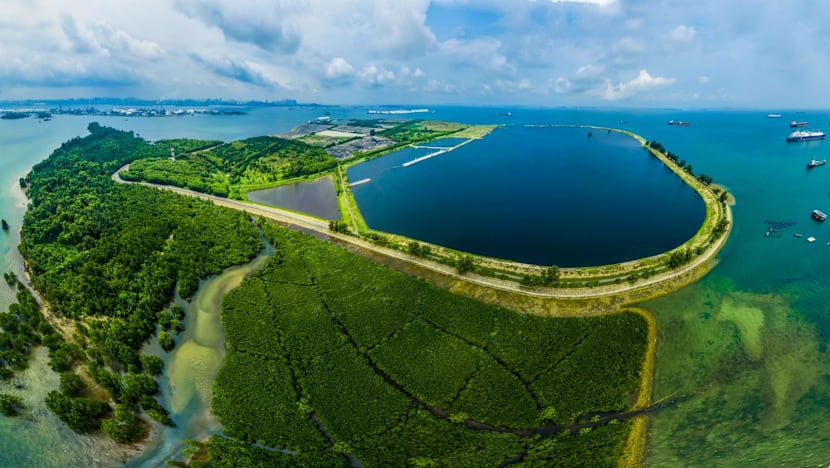
Commentary: NDR 2026 – if Singapore can plan 50 years ahead for infrastructure, can it do the same for nature? Long-term plans for Singapore’s western islands offer something precious: time to get it right, says NUS’ Melissa Low. SINGAPORE: Plans to study the creation of a “western island”, potentially joining Pulau Semakau, Pulau Bukom, Pulau Sudong and several smaller islands, come at an interesting moment for Singapore.
Commentary: NDR 2026 – if Singapore can plan 50 years ahead for infrastructure, can it do the same for nature?
Long-term plans for Singapore’s western islands offer something precious: time to get it right, says NUS’ Melissa Low.
SINGAPORE: Plans to study the creation of a “western island”, potentially joining Pulau Semakau, Pulau Bukom, Pulau Sudong and several smaller islands, come at an interesting moment for Singapore.
Over the past weeks, proposed developments at Maju Forest and Gillman Barracks have generated intense public discussion about the value of nature and how Singapore makes difficult land-use choices.
The debate has been about more than how much nature should be retained. It has raised questions about how environmental considerations and public participation are weighed in the planning process.
The western island raises similar questions, but on a far larger scale and over a much longer timeframe.
Singapore will undoubtedly need to provide for future industrial and energy infrastructure. As a small country with severe land and resource constraints, long-term planning has always been one of our strengths.
But a project that may unfold over 50 years offers something else precious: time to get it right.
We have an opportunity to understand environmental consequences, examine alternatives and engage the public before major spatial choices become difficult, or impossible to reverse.
THE SEA IS NOT EMPTY SPACE
The starting point should be understanding what already exists around the Southern Islands.
On a map, the spaces separating these islands may appear to be stretches of open sea. Ecologically, they are anything but empty.
Singapore's southern waters contain a mosaic of coral reefs, seagrass meadows, intertidal areas, mangrove forests and other marine habitats. These ecosystems support biodiversity and are interconnected in ways that do not correspond neatly with the boundaries we draw around individual islands.
These habitats also matter for the climate. NUS research has identified Pulau Semakau as home to one of Singapore's three largest seagrass meadows, while seagrass has also been documented at Pulau Sudong. Seagrasses and mangroves are increasingly recognised as “blue carbon” ecosystems because of their ability to capture and store carbon dioxide, and hence tackle climate change.
The environmental consequences of creating a much larger island cannot be measured simply by the hectares of new land created.
Reclamation can bury marine habitats. Sediment and increased turbidity can affect corals and seagrasses beyond the development footprint. Altered coastlines can change currents and sediment movement, while joining islands could affect ecological connectivity across a much larger marine landscape.
These effects may not be easy to mitigate. Before another transformation of these islands is contemplated, we should ask what can be avoided in the first place.
There is a cultural dimension too. At this year's National Day Parade, Singapore celebrated its Orang Laut heritage through Aok Diko, performed by Asnida Daud and inspired by her childhood memories of Pulau Sudong. Shortly afterwards, Pulau Sudong was named among the islands being considered for the western island.
This tension is worth reflecting on – celebrating the stories of Singapore's island communities while fundamentally transforming the landscapes from which those stories emerged. Heritage cannot exist only in memory. It should factor into decisions about the future.
LOOK BEYOND INDIVIDUAL PROJECTS
In response to concerns raised by the marine community, a Ministry of Development (MND) spokesperson said that the government “recognises the biodiversity value of the western islands and its surrounding”. The ministry said it will conduct assessments such as feasibility studies, site surveys and environmental studies to inform its development plans.
Environmental impact assessments are important tools for identifying the effects of individual projects and determining how they can be avoided, minimised or mitigated. But nature operates at a larger scale.
A forest patch may be cleared in one part of Singapore. A coastal habitat may be reclaimed elsewhere. Another development may retain a wildlife corridor while reducing the habitat surrounding it. Each decision may appear manageable individually.
Over decades, however, these decisions can add up to an ecological network that is increasingly fragmented and less resilient.
This is one of the deeper concerns underlying the reaction to Maju Forest and Gillman Barracks. The question is not whether Singapore should never develop another forest. It is about the overall trajectory: What are we progressively losing? What are we retaining? And what will Singapore's ecological landscape look like for the next generation?
A project on the scale and timeframe of the western island presents an opportunity to assess environmental impacts strategically and cumulatively from the earliest stages and across different development scenarios and over time, rather than relying only on project-level studies as individual components are developed.
DEVELOPMENT AND NATURE AREN’T ALWAYS IN CONTEST
Singapore's land constraints require difficult choices, but those choices need not amount to a contest between development and nature. Framing the issue that way obscures the range of possibilities planners actually have.
The choice is rarely between developing something and developing nothing. It is between different forms of development, locations, scales, timelines and environmental consequences.
That is particularly important with a 50-year horizon. Technologies will change. Our energy system will evolve. Economic needs may change. Climate risks certainly will.
Long-term planning should therefore preserve options while progressively improving our understanding of their consequences.
Nature itself should also be understood as infrastructure. Coral reefs, seagrasses, mangroves and forests contribute to biodiversity, coastal resilience, recreation and quality of life. In an increasingly dense Singapore, these functions may become more valuable, not less.
ENGAGE BEFORE THE CHOICES NARROW
Finally, the western island gives Singapore an opportunity to rethink when public engagement happens.
The debate on Gillman Barracks and Maju Forest suggests consultation becomes most difficult when people believe the fundamental planning decision has already been made and they are being asked primarily to comment on mitigation or details.
There is little reason for that to happen with a project that is decades in the making.
The timing is also worth reflecting on. The western island proposal comes just as residents, nature groups and members of the public have invested considerable time and effort engaging on Maju Forest and Gillman Barracks. Repeated cycles of public mobilisation around individual development proposals risks generating consultation fatigue, particularly as difficult land-use choices become more frequent.
Moving engagement upstream could allow different possibilities and their consequences to be considered more strategically.
Marine scientists, nature groups, island communities and their descendants, recreational users, industry and the wider public could be engaged while alternatives are still being examined. Baseline environmental information could be made accessible, and Singaporeans could be shown not simply a preferred proposal, but the different options being considered, the needs they are intended to meet, and their respective consequences.
This should include greater clarity about the assumptions underpinning the western island itself. What are Singapore's projected energy, industrial and infrastructure needs over the next 30 to 50 years? How much additional land would different scenarios require, and when?
Which technologies and industries are being planned for, and how certain are those assumptions given the pace of technological change? Could some needs be met through existing industrial land, redevelopment, greater land-use efficiency or different energy pathways? And what would happen if some of the most ecologically sensitive areas were taken off the table from the outset?
MND has said it will “engage stakeholders early to listen to their inputs before studies and work commence”.
Public participation does not mean every preference must be adopted, nor does it remove the government's responsibility to make difficult decisions in the national interest. But participation is most meaningful when there are still real choices to influence.
Singapore has earned an international reputation for planning infrastructure decades ahead. The western island offers an opportunity to apply the same long-term thinking to our natural environment.
If we are planning Singapore's energy and economic infrastructure 50 years into the future, we should plan the future of its ecological infrastructure over the same horizon.
Melissa Low is Head of NUS Sustainability Academy and Research Fellow at the Centre for Nature-based Climate Solutions, National University of Singapore. The opinions expressed are those of the writer and do not represent the views and opinions of NUS.