
Science
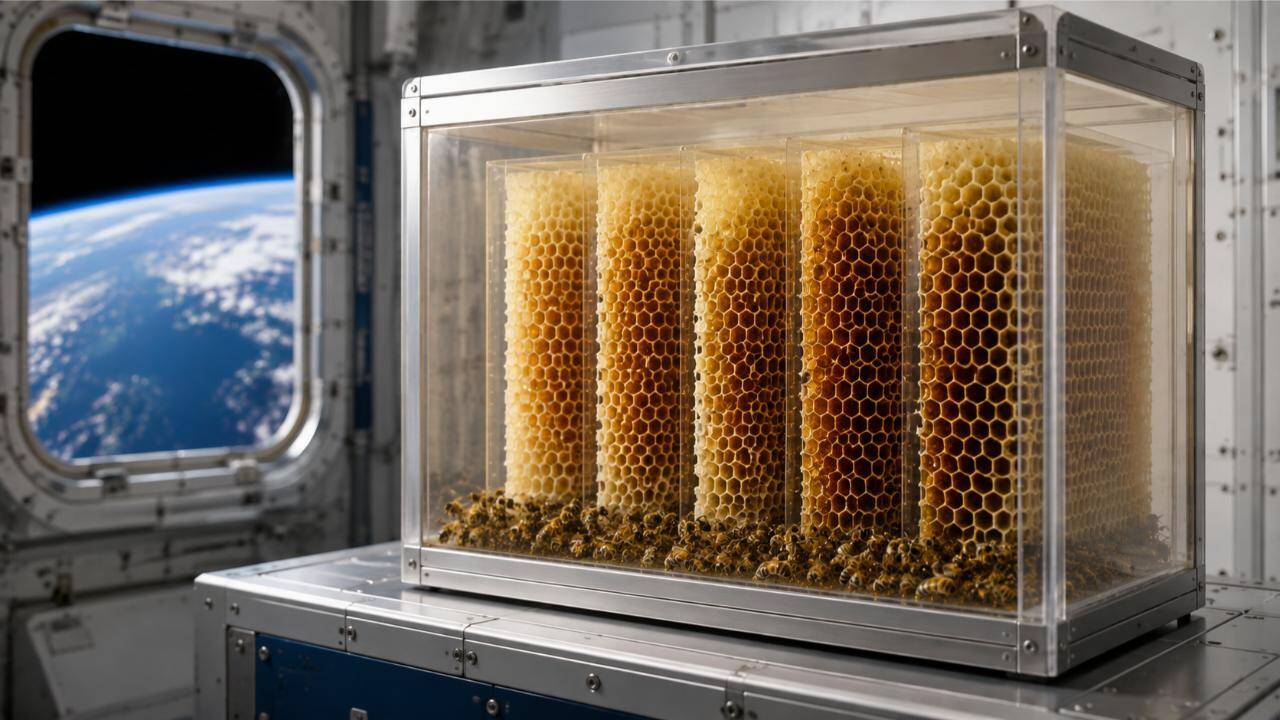
In 1984, NASA sent 3,301 bees to space to see how they built honeycomb
Key Points
Thousands of honeybees travelled into space aboard NASA's Space Shuttle Discovery in 1984 for an experiment that sounds unusual even today. The space agency sent 3,301 bees into microgravity to see whether they could survive and, more importantly, build their famous honeycomb without the pull of gravity. The 7-day mission got off to a difficult start, with some bees crashing into the walls as they tried to fly.
Thousands of honeybees travelled into space aboard
NASA's Space Shuttle Discovery in 1984 for an experiment that sounds unusual even today. The space agency sent 3,301 bees into microgravity to see whether they could survive and, more importantly, build their famous honeycomb without the pull of gravity. The 7-day mission got off to a difficult start, with some bees crashing into the walls as they tried to fly. But within days, they adapted to their new surroundings. By the end of the mission, the bees were flying normally and had built around 200 cm of honeycomb in space.
NASA wanted to find out how bees work without gravity
The experiment was part of the STS-41C mission and had two main goals. Researchers wanted to see how honeybees behaved and survived in microgravity. They also wanted to compare the honeycomb built in space with honeycomb made by bees on Earth.
The bees were kept in specially designed enclosures with a queen bee, food and wooden frames. NASA used a mixture containing sugar, water and agar as food because ordinary liquids can form floating droplets in microgravity.
The bees initially kept hitting the walls
The bees survived the launch, but flying in space was clearly a new experience for them. During one of the early observations, some bees tried to fly but collided with the walls of their enclosure.
However, their behaviour changed as the mission continued. By the seventh day, the crew reported that the bees had adapted to zero gravity and were flying confidently.
The crew wrote: “...by Day 7, comb well developed, bees seemed to adapt to 0-g pretty well. No longer trying to fly against top of box. Many actually fly from place to place.”
Bees built 200 cm of honeycomb in space
The bees did not just survive their time in space. They also got to work. The bees in the space enclosure built about 200 cm of honeycomb during the mission. Researchers found that the honeycomb made in microgravity had some differences. The cells had smaller average diameters and thicker walls than those studied on Earth. However, the bees were still able to build cells of normal depth and use some of them to store sugar syrup.
Most of the bees survived the mission. The queen also laid around 35 eggs, although the eggs did not hatch after returning to Earth. The reason for this was not known.