
Science
In 1962, NASA blew up a water tank 65 miles above Earth to study the atmosphere
Key Points
For humans to travel deeper into space and remain there for months or even years, they will need much more than powerful rockets. Astronauts must have a continuous supply of oxygen, water and food, while waste and carbon dioxide must be carefully managed. On short missions, these needs can largely be met by carrying supplies from Earth.
For humans to travel deeper into space and remain there for months or even years, they will need much more than powerful rockets. Astronauts must have a continuous supply of oxygen, water and food, while waste and carbon dioxide must be carefully managed. On short missions, these needs can largely be met by carrying supplies from Earth. But as missions become longer and destinations move farther away, constant resupply becomes increasingly difficult.
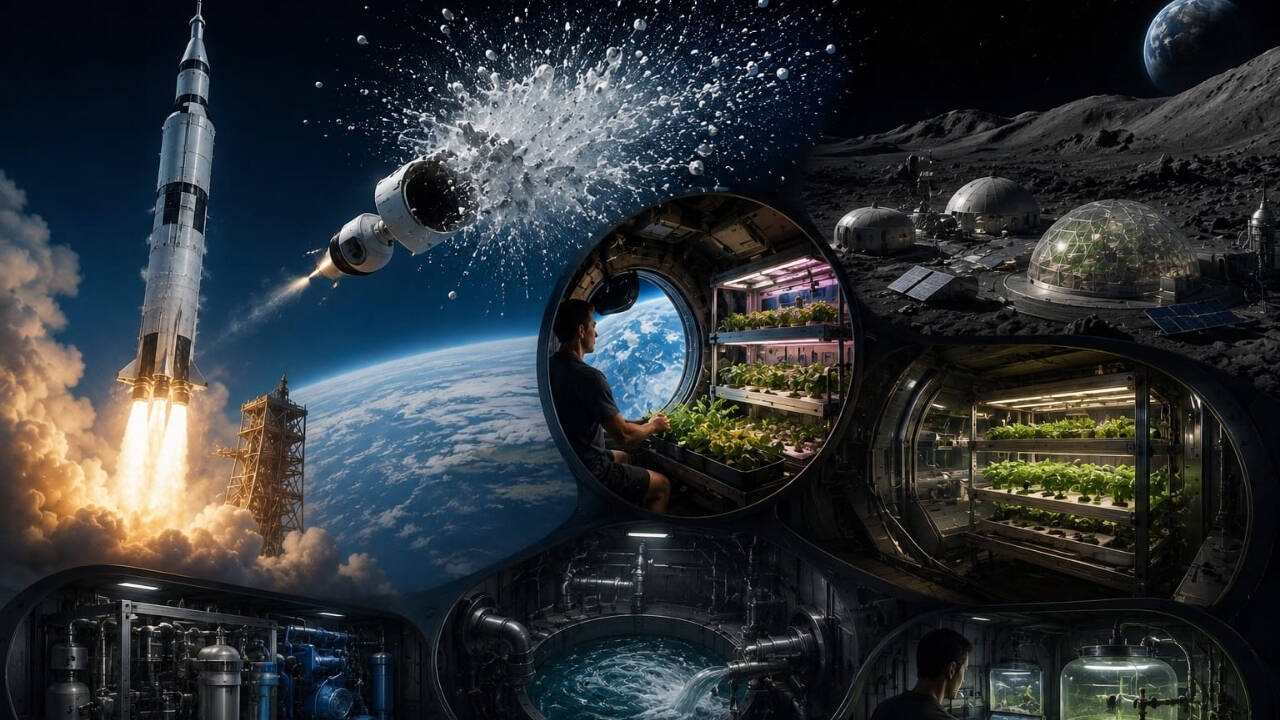
NASA (National Aeronautics and Space Administration) explored many unusual questions during the early decades of the space age, including how materials behaved in the unfamiliar environment beyond Earth and what it would take to keep humans alive during long-duration missions. In 1962, for example, the agency launched 22,900 gallons of water aboard a Saturn I test rocket and deliberately detonated the water-filled upper stage at an altitude of about 65 miles. The experiment, known as Project Highwater, allowed scientists to study how the sudden release of such a large volume of water behaved and affected the upper atmosphere.
Decades before today's renewed interest in lunar bases and human missions to Mars, NASA researchers were also studying whether closed environments and biological systems could help support humans during long-duration missions beyond Earth.
According to historical reports published through NASA's Technical Reports Server, researchers examined the challenges of creating controlled environments for humans living in space and explored ideas related to biological life-support systems, resource recycling and the role living organisms could play in supporting long-duration space missions.
Living in a closed environment
Life on Earth depends on interconnected natural cycles. Plants absorb carbon dioxide and release oxygen, water is continually recycled through the environment, and microorganisms help break down organic matter. Humans living inside a spacecraft or a future planetary habitat, however, would exist in a far more limited environment.
Every resource would have to be carefully controlled. Oxygen would need to be replenished, water recovered and purified, and waste processed. The farther astronauts travel from Earth, the more difficult it becomes to rely entirely on replacement supplies. This led researchers to explore the idea of controlled systems that could recycle some of the materials needed to support human life. Rather than treating every used resource as waste, the goal was to recover and reuse as much as possible.
Could biology help astronauts?
One of the key ideas behind this research was the possible use of living organisms as part of a life-support system. Plants, in particular, attracted attention because they could potentially serve more than one purpose. Through photosynthesis, plants use carbon dioxide and produce oxygen. They could also provide food, making them a potentially valuable part of a long-duration mission. In theory, a carefully managed system could connect human needs with plant growth and other biological processes.
Humans would produce carbon dioxide and organic waste, while plants and microorganisms could potentially help process some of these materials. Water and nutrients could also be recovered and reused within the habitat. The idea was not simply to recreate an entire Earth ecosystem inside a spacecraft. Instead, researchers were interested in identifying specific biological processes that could work alongside mechanical and chemical life-support technologies.
The challenge of maintaining balance
Creating such a system, however, would be far more complicated than simply growing plants in space. A biological system constantly changes. Plants require the right levels of light, water, nutrients and temperature. Their growth can also be affected by disease, changes in atmospheric conditions or equipment failures. Microorganisms may be useful for processing waste, but they would also need to be carefully controlled.
A space habitat would therefore need to maintain a delicate balance between its human occupants, plants, microorganisms and technology. If one part of the system failed, it could affect everything connected to it.
Reliability would be especially important because astronauts travelling far from Earth might not have immediate access to replacement equipment or emergency supplies. For this reason, biological systems were not viewed as a simple substitute for conventional technology. Instead, they could potentially become one part of a larger and more reliable life-support network.
Reducing dependence on Earth
The potential benefits of recycling resources in space were significant. Carrying large quantities of food, water and oxygen adds weight to a mission, and launching that material from Earth is expensive. A system capable of regenerating even part of these resources could reduce the amount of supplies astronauts need to take with them.
This would become increasingly important for missions lasting several years, including possible journeys to Mars. A future settlement on another world would also need ways to produce food and manage resources locally rather than depending completely on deliveries from Earth.
NASA's historical reports helped explore these fundamental questions long before modern space agencies began actively discussing permanent lunar infrastructure and future human missions to Mars.
An idea that remains relevant
Technology has changed dramatically since these reports were produced, but the basic problem remains the same: how can humans live safely in an isolated environment with limited resources?
Modern spacecraft already use sophisticated systems to recycle water and control air quality, while experiments continue to investigate growing food in space and using biological processes as part of future life-support systems. However, creating a completely self-sustaining habitat remains an enormous scientific and engineering challenge.
NASA's early research shows that the concept of sustainable living beyond Earth has been studied for decades. The agency's scientists were not simply thinking about how to send humans into space, but also about what would be required to keep them alive once they arrived.
As humanity looks again towards the Moon and eventually Mars, those questions remain just as important. The future of long-duration space exploration may depend not only on rockets and spacecraft, but on how effectively humans learn to recycle, regenerate and manage the small worlds they create far away from Earth.