
Weather
Commentary: Nepal’s ‘tsunami of dirt’ highlights rising risk of glacial floods
Key Points
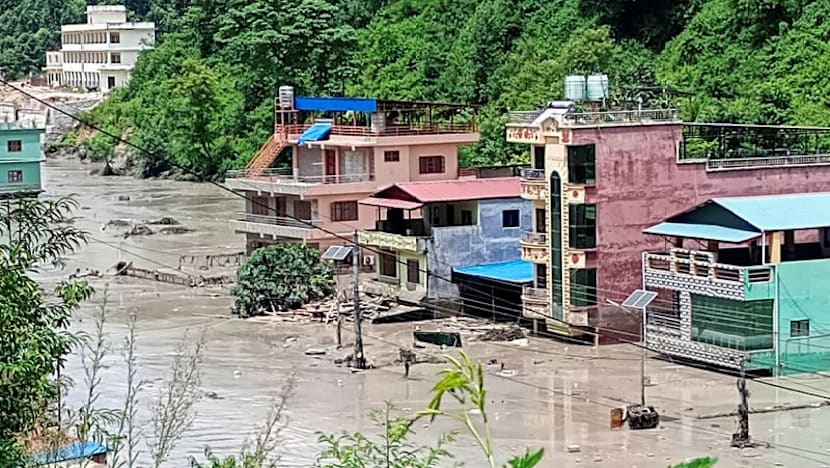
Commentary: Nepal’s ‘tsunami of dirt’ highlights rising risk of glacial floods Glaciers worldwide are in retreat, which can lead to more floods and debris flow disasters, says this researcher. MELBOURNE: More than 270 people are dead and hundreds more missing (as of Thursday, Aug 27) after an enormous wave of water, ice, mud and rock cascaded more than 170km down the Bhote Koshi River valley in Nepal. The valley is the main link between Kathmandu in Nepal and Lhasa in Tibet.
Commentary: Nepal’s ‘tsunami of dirt’ highlights rising risk of glacial floods
Glaciers worldwide are in retreat, which can lead to more floods and debris flow disasters, says this researcher.
MELBOURNE: More than 270 people are dead and hundreds more missing (as of Thursday, Aug 27) after an enormous wave of water, ice, mud and rock cascaded more than 170km down the Bhote Koshi River valley in Nepal.
The valley is the main link between Kathmandu in Nepal and Lhasa in Tibet. There was little warning.
Footage of the debris-laden flash flood is shocking. It is, unfortunately, not surprising.
As an expert in glaciers, I have tracked their accelerating retreat around the world as they melt – and the disasters that can follow. Early analysis suggests the abrupt collapse of a glacier triggered the disaster.
As climate change intensifies, glaciers worldwide are melting, even in high regions such as the Himalayas. The Himalayas are especially vulnerable, because the steep slopes of many of these very tall mountains are made of permafrost – rock and soil frozen for centuries.
As temperatures rise, these slopes are beginning to melt or destabilise. If an earthquake or slope failure occurs, it can trigger a sudden and devastating debris flow.
It’s too early to say this was the exact cause. But we know that the great ice stores of the Himalayas, known as the world’s “third pole” because it contains the largest amount of snow and ice after the Arctic and Antarctic, are no longer safe.
TSUNAMI OF DIRT
What happened in Nepal is likely due to an enormous ice-and-rock landslide sweeping down a mountain pass and gathering up ice, water, rock, trees and dirt.
The landslide was so large it was originally thought to be an earthquake, as the seismic energy registered as a 4.4 magnitude quake on seismographs.
By the time it reached Gyirong Port, a China-Nepal border crossing, the wall of debris resembled a tsunami of dirt. Early estimates suggest the wave may have been 30m high.
Sometimes, disasters like these can be caused when glacial meltwater trapped in a lake by a landslide breaks free. One of these events, known as a glacial lake outburst flood, hit Nepal in 2024.
But early analysis suggests this isn’t the case here. Satellite imagery suggests the landslide may have carved away large parts of a glacier, triggering its collapse.
GLACIERS IN RETREAT
We don’t know yet what caused the glacier to collapse. But glaciers worldwide are broadly in retreat, and flood and debris flow disasters can follow.
A smaller flood hit the same district in Nepal last year, killing nine people. Also last year, a melting glacier in Switzerland triggered a huge debris flow that destroyed the village of Blatten. In 2023, a landslide and subsequent flood in my home country of Georgia killed 33 people at a mountain resort.
But this disaster is one of the largest so far.
The high-elevation glaciers of the Himalayas can respond differently to climate change than glaciers at lower elevations or in relatively warmer regions. Thawing and degrading permafrost can also contribute by making steep Himalayan slopes less stable.
Permafrost is ground containing rock, soil and ice that has remained at or below 0°C for many years. As the climate warms, the ground can thaw, weakening the ice that helps bind rock and soil together.
On steep mountain slopes, this loss of frozen ground can make slopes less stable and make rockfalls, landslides and other forms of ground movement more likely. An earthquake, rockfall or other disturbance can then trigger a rapid downslope movement of rock, soil and debris.
CAN THESE DISASTERS BE PREVENTED?
No one died when the Swiss glacier collapsed. That’s because early warning systems were in place. Authorities evacuated residents before it fell.
As temperatures rise and climate-related disasters become more frequent or severe in some regions, early warning systems will become increasingly important for villages and towns located near glaciers or thawing permafrost.
These systems can monitor rapidly rising river levels, intense rainfall and seismic waves to alert authorities before disaster strikes.
However, installing and maintaining effective early warning systems can require significant investment. That’s a challenge for lower-income and developing countries. In good news, the Green Climate Fund last year announced funding for better monitoring systems in Nepal.
There’s another problem, too. Meltwater from Himalayan glaciers feeds rivers that are vital to billions of people across Nepal, Pakistan, India and China.
As the climate warms, increased glacier melt can temporarily increase river flows and, in some places, contribute to flood risk. But as glaciers continue to shrink, their contribution may eventually decline and lead to less water availability – particularly during the dry season.
Rapidly reducing greenhouse gas emissions, investment in early warning systems and better monitoring of vulnerable mountain regions can help communities prepare. These measures cannot prevent every disaster, but they can save lives and give people a better chance to adapt to a changing climate.
Levan Tielidze is Research Fellow in Glacial Geomorphology at Monash University. This commentary first appeared on The Conversation.