
Science
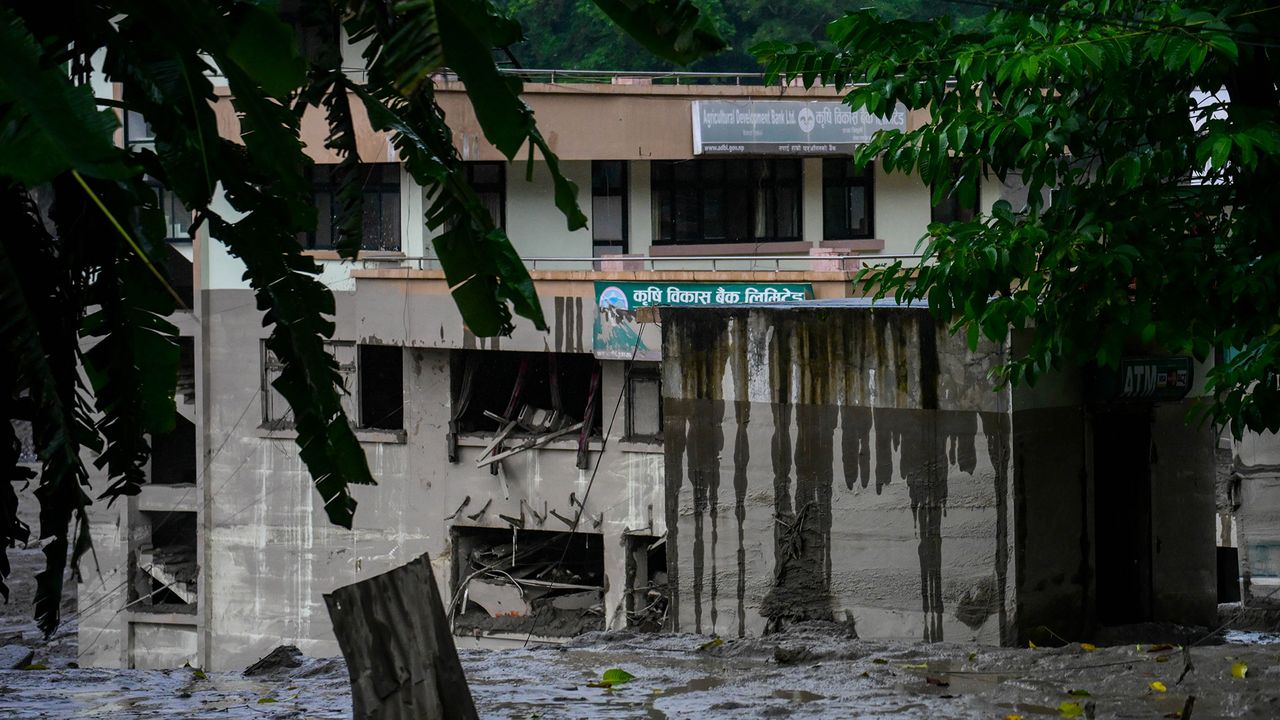
Devastating Nepal floods were triggered by glacier collapse, experts say — and there's a risk of more landslides to come
Key Points
Devastating Nepal floods were triggered by glacier collapse, experts say — and there's a risk of more landslides to come Catastrophic floods in Nepal may have resulted from a "hazard cascade" that may have been amplified by climate change, one scientist has warned. Devastating flash floods near the Nepal-Tibet border have left more than 330 people dead and more than 1,500 missing — including 65 from the U.S. — following a glacier collapse early Wednesday morning (Aug. 26), according to...
Devastating Nepal floods were triggered by glacier collapse, experts say — and there's a risk of more landslides to come
Catastrophic floods in Nepal may have resulted from a "hazard cascade" that may have been amplified by climate change, one scientist has warned.
Devastating flash floods near the Nepal-Tibet border have left more than 330 people dead and more than 1,500 missing — including 65 from the U.S. — following a glacier collapse early Wednesday morning (Aug. 26), according to Nepalese authorities and Chinese state media.
Data from a surviving water level gauge shows that the Trishuli River water level surged by 30 feet (9 meters) in just 30 minutes on Wednesday in the municipality of Galchhi, some 20 miles (33 kilometers) west of the Nepalese capital, Kathmandu, the International Centre for Integrated Mountain Development reported.
Videos posted to social media show people fleeing the oncoming wall of mud and water that has destroyed buildings and uprooted bridges. Meanwhile, authorities have warned the public to stay away from the banks of the Bhotekoshi, Narayani (also called the Gandaki or Gandak) and Trishuli rivers amid concerns of further flooding.
"Although this occurred at the height of the monsoon season, significant rainfall does not appear to have been the trigger," Jon Tunnicliffe, a river science researcher at the University of Auckland in New Zealand, said in a statement to the Science Media Centre. "Preliminary investigations instead point to a large collapse of glacier ice and rock high above the Lhende Kola [river]."
The impact of this glacial material was so powerful that the U.S. Geological Survey (USGS) initially confused it for an earthquake. The seismic shock reached magnitude 5.2 — equivalent to a moderate earthquake. The USGS's subsequent analysis of the seismic waves produced also indicate that the signal was produced by a glacial collapse and debris flow.
Based on satellite images, researchers suspect the ice and rock shed by the glacier entered the Lhende Kola river valley at an elevation of around 17,060 feet (5,200 m), according to Tunnicliffe. He added that scientists are investigating the possibility that the debris may have temporarily blocked the river before releasing a larger surge downstream.
"That sequence is what geomorphologists call a hazard cascade — instability high on a glacierised slope becomes an ice-rock avalanche; that can block a river, entrain water and sediment, and transform into a debris-laden flood travelling tens of kilometers downstream," Tunnicliffe explained.
Get the world’s most fascinating discoveries delivered straight to your inbox.
These processes are familiar, he said, but the danger comes from the connections between them, turning what may have started as a localized failure upslope turned into a catastrophe for the people far below in the valley.
However, Tunnicliffe cautioned against attributing this specific event entirely to climate change.
"There is an important climate change context here, but we need to be careful about attribution," he said. "We do not yet know why this particular glacier failed.
"What we do know is that conditions across the Hindu Kush Himalaya are changing rapidly," he added. "Glaciers are retreating, permafrost is degrading, new lakes are forming and steep slopes are being exposed and destabilised. Climate change can amplify hazards that already exist by altering the thresholds at which one process triggers another."
Tunnicliffe warned that in such events, the danger does not necessarily end after the initial surge passes. Instead, material deposited in the flood's wake can raise riverbeds, divert channels and create temporary new dams, all of which can set off further hazards in the following days, weeks or even years.
Basanta Raj Adhikari, director of the Centre for Disaster Studies at Nepal's Tribhuvan University, agreed that there is a risk of "second and third waves" over the next couple of days, he told BBC Newsday.
"We don't know yet," he cautioned. "There isn't high rainfall, but [a] landslide might happen." Adhikari said he is continuing to discuss the risk with colleagues in China who are monitoring the situation.
Related stories
- 'They are trying to tame nature': China is building the world's biggest dam in an earthquake-prone region of Tibet
- 'It affects your daily life suddenly': Sea level researcher explains why once-in-a-century floods could become the new normal
- The 'Doomsday Glacier' is poised to lose its ice shelf this year. An Antarctic researcher explains what that means for global sea levels
With an eye to the future, "the broader lesson is that we increasingly need to manage hazard chains, rather than individual hazards," Tunnicliffe said.
Satellite monitoring of glaciers, lakes and slopes must be combined with seismic monitoring, river gauges and warning systems capable of detecting cascades once they begin, he said, and we need to plan infrastructure, evacuation plans and land-use controls with the risk of future disasters in mind.
But for now, "Our thoughts are with the families of those killed and still missing, and with the Nepali and Chinese agencies and communities carrying out the search," Tunnicliffe said.
Ian Randall is a freelance science writer. He previously worked as the deputy science editor at Newsweek and has written for various specialist publications including Science, Physics World and Chemistry World. Ian holds a BA in geology from the University of Oxford and an MA in science journalism from City University London.
You must confirm your public display name before commenting
Please logout and then login again, you will then be prompted to enter your display name.
Nepal (LOCATION)
Tibet (LOCATION)
U.S. (LOCATION)
Nepalese (ORG)
Chinese (ORG)
the Trishuli River (LOCATION)
Galchhi (LOCATION)
Kathmandu (LOCATION)
the International Centre for Integrated Mountain Development (ORG)
Videos (ORG)
Bhotekoshi (PERSON)
Narayani (PERSON)
Gandaki (PERSON)
Gandak (LOCATION)
Trishuli (LOCATION)