
Health
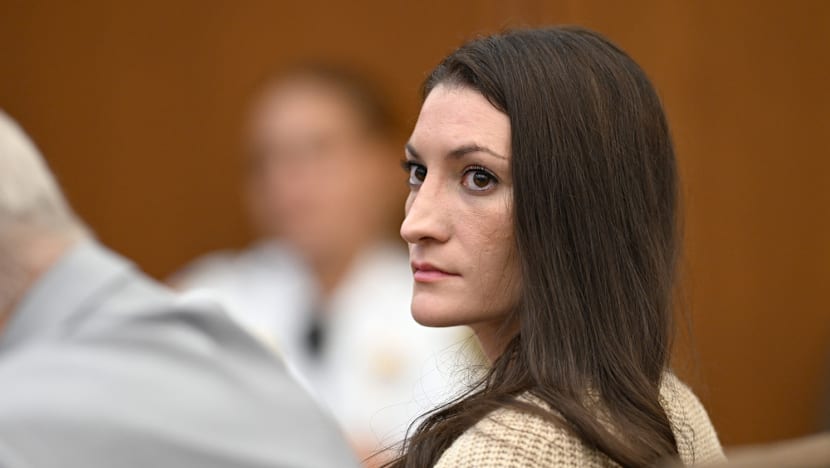
Lindsay Clancy's 'mind was gone' when she killed her children, her lawyer says at trial's end
Key Points
Lindsay Clancy's 'mind was gone' when she killed her children, her lawyer says at trial's end The US mother’s lawyer urged jurors to find her not guilty by reason of insanity, arguing that she was suffering from postpartum psychosis when she killed her three young children. BOSTON: Lindsay Clancy's lawyer urged jurors at the end of her murder trial on Thursday (Aug 27) to conclude that she was in the throes of postpartum psychosis when the Massachusetts woman killed her three young children...
Lindsay Clancy's 'mind was gone' when she killed her children, her lawyer says at trial's end
The US mother’s lawyer urged jurors to find her not guilty by reason of insanity, arguing that she was suffering from postpartum psychosis when she killed her three young children.
BOSTON: Lindsay Clancy's lawyer urged jurors at the end of her murder trial on Thursday (Aug 27) to conclude that she was in the throes of postpartum psychosis when the Massachusetts woman killed her three young children in 2023, an act a prosecutor said she intentionally carried out after sending her husband out on an errand.
Clancy, 36, admits that she killed her three children by strangling them with exercise bands in the basement of her home in the Boston suburb of Duxbury in January 2023. She then cut herself with a knife and jumped from a second-story window in a failed attempt to end her own life that left her paralyzed.
But defence attorney Kevin Reddington during his closing argument in Plymouth County Superior Court urged jurors to find her not guilty by reason of insanity on the three counts of first-degree murder she faces, presenting a defence that throughout the trial has revived a nationwide debate over how postpartum mental health in women is treated in the US.
"Her mind was gone," he said.
He said testimony and evidence throughout the trial showed that for months leading up to the "horrific" killings, Clancy had been seeking treatment as she struggled with her mental health and suicidal thoughts following the birth of her third child.
Reddington argued that prosecutors had manipulated evidence to "assassinate" the character of a "young, vibrant hardworking" mother who killed her children and tried to commit suicide, acts he said occurred after she heard a voice he blamed on "the damn medicine and the lousy medical care that she got."
"This young lady is not guilty of the killing of her children because she was suffering from a disease and defect, as his honour instructed you," he told jurors. "And they're not going to be able to prove otherwise."
Assistant District Attorney Jennifer Sprague did not dispute that Clancy had struggled with her mental health. But she said that was not the question - but instead whether on Jan 24, 2023, she could appreciate that it was wrong to kill her children but did it anyway before attempting to commit suicide.
"This case is not about our mental health system or how it treats women," she told jurors. "That's a distraction to get you angry and passionate about an important issue, but an issue that's not on trial here."
Following closing arguments, Judge William Sullivan finished instructing jurors on the law, picked a foreperson and sent the 12 jurors who will decide the case out to begin their deliberations.
"It's not going to be an easy task," Sullivan said.
POTENTIAL LIFE SENTENCE
Clancy, a former labor and delivery nurse at Massachusetts General Hospital, faces life in prison without parole if convicted of first-degree murder for killing Cora, 5; Dawson, 3; and 8-month-old Callan on January 24, 2023.
If found not guilty due to lack of criminal responsibility or by reason of insanity, she would be committed to a state psychiatric hospital for evaluation. Jurors also have the option to find her guilty of murder in the second degree or manslaughter.
The five-week trial drew comparisons to the case of Andrea Yates, a Texas woman who drowned her five children in a bathtub in 2001. After an appeals court overturned her initial murder conviction, she was found not guilty by reason of insanity in 2006. Her lawyers had said that she suffered from severe postpartum psychosis.
In her closing argument, Sprague focused on evidence showing how shortly before the killings, Clancy sent her then-husband, Patrick, out to pick up a food order and to a pharmacy after mapping on her phone the time it would take for him to return.
He spoke on the phone briefly with his wife while at the pharmacy. Upon his return, he discovered her lying on the ground in the backyard with cuts on her wrists and neck. She told him she had tried to kill herself.
He said he asked where the children were, and she said they were in the basement. After he called 911 and first responders arrived, Patrick Clancy said he ran to the basement and discovered them with exercise bands tied around their necks.
Witnesses during the trial including Patrick, other family members and a hospital chaplain testified that Clancy later told them that she had heard a man's voice tell her that if she did not act, she would lose her chance.
But Sprague argued that Clancy was "making up the voice," claiming that experts say it would make no sense for her to have heard it only once and that Clancy only began speaking about having heard it after she was in the hospital following her failed suicide.
She argued that Clancy clearly knew that what she was doing was wrong and had sent her husband out on the errand to provide her enough time to execute her plan to take the children to the basement one by one to strangle them before then trying to kill herself. She made no mention of a voice when she spoke to Patrick Clancy on the phone when he was at the pharmacy, Sprague said.
"It was a choice to take them with her," Sprague said. "It was a horrific choice. And it's a choice that we don't want to think about that a mother made because that doesn't make us feel safe or comfortable in this world. But it's a choice she made."
Lindsay Clancy's (PERSON)
US (LOCATION)
BOSTON (LOCATION)
Massachusetts (LOCATION)
Clancy (PERSON)
Duxbury (LOCATION)
Kevin Reddington (PERSON)
Plymouth County Superior Court (ORG)
Reddington (PERSON)
Jennifer Sprague (PERSON)
William Sullivan (PERSON)
Sullivan (PERSON)
Massachusetts General Hospital (ORG)