
Technology
Excuse me, are you a pole dancer? Singaporeans defy stereotypes about who can take part
Key Points
Excuse me, are you a pole dancer? Singaporeans defy stereotypes about who can take part From building strength to finding confidence and friendships, pole dancers say there is much more to the activity than what outsiders might expect. When Ms Jaslyn Tan started pole dancing in 2019, her colleagues at her new workplace invited her to try a class they planned to join.
Excuse me, are you a pole dancer? Singaporeans defy stereotypes about who can take part
From building strength to finding confidence and friendships, pole dancers say there is much more to the activity than what outsiders might expect.
When Ms Jaslyn Tan started pole dancing in 2019, her colleagues at her new workplace invited her to try a class they planned to join.
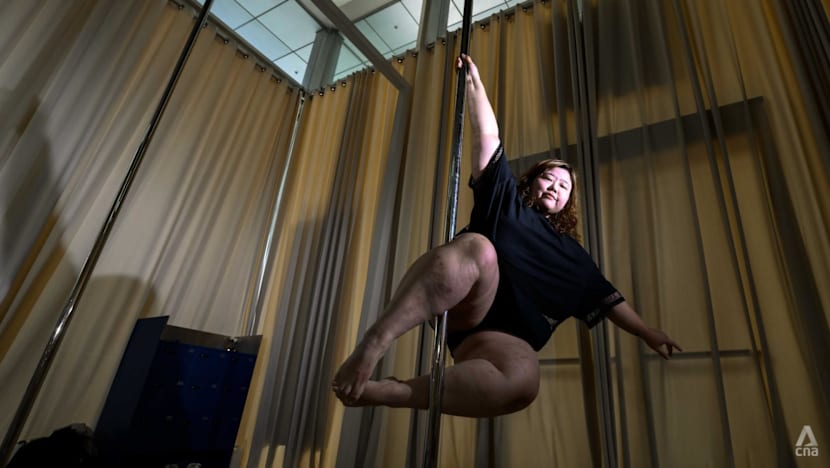
The 32-year-old plus-sized preschool teacher, who had no dance or gymnastics background, associated the activity with stripping and sexy dancing at first.
However, a small success in her first class was enough to make her return. She briefly managed to hold herself up in a fireman spin, which involves wrapping her legs around the pole while spinning down.
Seven years on, she now does other physically demanding activities such as aerial hammock, which uses suspended fabric, and aerial hoop, which involves performing on a suspended metal ring.
She also works part-time as a studio manager at Fable Dance Co, which conducts pole dancing classes.
Although she is proud of how far she has come in pole dancing, reactions to the progress she shares with more than 40,000 followers on her social media account have been mixed.
Some online users have told her to "go and lose weight first", joked that the pole was bending or the floor was breaking, and mocked her for "creating an earthquake".
"They think that dancers need to be sleek and tall to look graceful and nice," she said.
Yet, alongside the detractors, there has also been plenty of encouragement, including from plus-sized women who messaged Ms Tan to say that seeing her dance has given them the courage to try it themselves.
After seeing plus-sized pole dancers and aerialists from other countries on TikTok, Ms Tan realised that larger bodies were not unusual in these spaces overseas.
In Singapore, pole dancing was seen as something of a novelty when it first emerged as a form of exercise in the early 2000s, with people wondering if it was yet another fitness trend that would eventually fizzle out.
Now, more than 20 years on, that "trend" has remained. Dancers and instructors told CNA TODAY that the community is more diverse than ever, bringing together people of different ages, body types, genders and backgrounds.
Pole dancing, they said, was less about performing sexy dance moves to an audience and more about keeping their bodies nimble and strong.
It is also about gaining body confidence as well, regardless of a learner's size or age.
They think that dancers need to be sleek and tall to look graceful and nice.
In 2019, when Ms Kellie Koh first took up pole dancing at the age of 47, she entered a form of exercise unlike anything she had done before.
Running had been her main workout, but strength training was largely unfamiliar territory. When she was younger, she had also led a relatively sedentary lifestyle.
In her 40s, Ms Koh was diagnosed with cerebral vasculitis, an inflammation of the blood vessels in the brain and spinal cord. She also entered menopause during this period and began looking for a way to stay active to support her health better.
She came across pole dancing and signed up, but recalls her first class as intimidating.
Most of the other students were "a lot younger", and she felt like she was struggling to keep up with the rest.
"Everybody in class seemed to be able to do something."
Despite this, she enjoyed the class enough to keep going and soon became stronger, noticing changes in her body such as increased muscle definition.
Seven years on, she is still going and has become skilled enough to take on a teaching role.
Since 2024, Ms Koh has been working part-time as an instructor for MAD Dance Studio, located in the central business district.
"Today, at 54, I can do a split while inverted and holding onto the top bar of an aerial hoop," she said.
"My younger self would have never thought I'd be able to do this. I'm damn proud of myself."
For 33-year-old Louis Sue, who has been pole dancing for more than a decade, what drew him in were online videos of dancers pulling off gravity-defying tricks.
Although he was one of just two male students in his first class, he found the environment welcoming, with fellow students encouraging and hyping up one another.
His friends and family were supportive from the start, too. After learning how interested he was, his father even bought him a S$500 dance pole for home practice.
However, he soon realised that not everyone felt as comfortable pursuing the activity openly. Fellow students told him they kept pole dancing a secret from their parents or friends.
"I think I'm among the lucky ones," Mr Sue said.
Having fallen in love with pole dancing, he opened his first studio in 2019, five years after taking his first class.
Today, he is the only male pole dance studio owner in Singapore and has amassed more than 125,000 followers on Instagram.
Being a male pole dancer never made Mr Sue feel out of place. Instead, he had to overcome his own shyness and self-consciousness about his body.
He felt uncomfortable showing too much skin, even though direct skin contact with the pole is sometimes needed for grip when performing certain manoeuvres.
His default outfit was shorts and a tank top, which he would roll up only occasionally.
During an outdoor performance one day, however, he slipped because his tank top prevented his waist from getting enough grip on the pole.
"In my head, I thought that if I went topless, I'd be embarrassing myself," he recalled.
"But after that incident, my brain just went, 'You know what? I would prefer not to wear a shirt than to repeat that (slip-up)'."
MORE THAN A PASSING FAD
When Mr Sue first started pole dancing more than a decade ago, he encountered people who didn't expect the activity to have a following in Singapore, or that men were also taking part.
He soon became accustomed to hearing comments such as: "Huh? Got such thing?" or "Got guys who pole dance, meh?"
At the time, he estimated that there were about three pole studios in Singapore.
Now, there is a mix of larger studios and smaller practice spaces, and he has "lost count" of how many there are.
Pole dancing has also become more recognised as a recreational activity, Mr Sue said, with people coming across it on social media or knowing friends who have tried it.
More people have also come to appreciate the strength, technique and practice that it demands.
Dr Janice Tan, head of the psychology undergraduate programme at the Singapore University of Social Sciences (SUSS), said that a mix of challenge, progression and community may help explain why pole dancing has endured over time.
Dancers can keep working towards new tricks and levels, while also finding avenues for self-expression and social connection.
Some leisure activities such as pole dancing allow individuals to explore another side of themselves, she added.
She also said that people may be drawn to pole dancing for different reasons and may view it as athletic, artistic, sensual or performative.
"People may initially join because they were curious about the activity or because they wanted some exercise, but remain because of the friendships and social connections they develop over time."
That was the case for Ms Shahrazad Logan, 26, who enjoyed watching circus performers, which piqued her interest in pole dancing.
The plus-sized senior animator, who has been pole dancing for four years, had previously learnt contemporary dance, ballet and jazz, for instance.
Pole dancing offered something quite different.
Although Ms Shahrazad was also drawn to aerial activities such as trapeze and acrobatics, the height involved felt too intimidating, so pole dancing seemed like a good middle ground.
Still, she hesitated to try it because she had seen online remarks suggesting that larger-sized pole dancers were not the "right shape" for the activity or that dancers were simply "looking for attention".
She was relieved to find a welcoming community from the get-go, where dancers monitored one another for safety and readily helped newbies trying to master a trick.
"I've never felt like I wasn't accepted," she said.
Ms Shahrazad now regularly introduces her friends and colleagues to pole dancing and has even taken her mother along to a Mother's Day class.
"There's the initial draw of how unique it is, and then the community is what makes you stay."
WHERE THE STIGMA STILL LINGERS
In 2017, the now-defunct Global Association of International Sports Federations recognised pole dancing as a sport.
The International Pole Sports Federation has also long campaigned to include pole dancing in the Olympics.
Despite growing acceptance outside the pole dancing community, dancers and studio owners told CNA TODAY that some stereotypes remain – chief among them the perception that pole dancing is synonymous with stripping.
Ms Koh said that while stripping culture played an important role in the origins and development of modern pole dancing, the activity has since evolved and become a mainstream form of fitness, much like weight training or yoga.
When she first told friends that she was taking it up, some asked if she meant "that kind of stripper activity", though they have since come to understand that pole dancing encompasses far more than stripping.
This perception has led Ms Hani, a pole dancer in her 30s, to keep her love of pole dancing a secret from her family and older relatives.
Not wanting to be identified by her full name, she said that while her friends have been generally supportive, some of them imagined that she spent her time "just dancing around in my underwear" – a misconception she finds more amusing than offensive.
Dancers typically wear minimal clothing such as shorts and sports bras because direct skin contact provides the grip needed on the pole, she explained.
Being a special-education teacher who enjoys pole dancing, Ms Hanie has also raised some eyebrows.
Some people tend to expect teachers, particularly those working with children, to be more "prim and proper" or "demure", she added.
With the pole dancing community, however, she has always felt accepted and never judged since taking up the activity four years ago.
"I can express a different side of myself that people in my personal life don't normally see," she said.
Another stereotype keeping some away is that such an activity is only for the young.
Ms Koh from MAD Dance Studio emphasised that pole dancing is not beyond the capabilities of older adults. The oldest student under her tutelage is 82.
What often stops people from trying is not whether they are physically capable but the fear of feeling out of place, Ms Koh said.
Trying something unfamiliar can already be intimidating, especially when the activity still carries stigma.
"You don't need to be young, strong, flexible or have dance experience. You just need to be willing to try something new," she added.