
World News
Ukraine-Russia war latest: Moscow vows ‘massive strikes’ as missile attack on Belgorod kills two
Key Points
Ukraine-Russia war latest: Moscow vows ‘massive strikes’ as missile attack on Belgorod kills two Kremlin says strikes would be an ‘appropriate response’ to Ukraine’s ‘path of escalation’ - Bookmark - CommentsGo to comments Russia’s defence ministry has announced it is preparing “massive strikes” on Ukraine’s energy infrastructure in retaliation for a drone campaign by Kyiv attacking warehouses and oil and gas facilities. Kremlin spokesperson Dmitry Peskov said the move would be an...
Ukraine-Russia war latest: Moscow vows ‘massive strikes’ as missile attack on Belgorod kills two
Kremlin says strikes would be an ‘appropriate response’ to Ukraine’s ‘path of escalation’
- Bookmark
- CommentsGo to comments
Russia’s defence ministry has announced it is preparing “massive strikes” on Ukraine’s energy infrastructure in retaliation for a drone campaign by Kyiv attacking warehouses and oil and gas facilities.
Kremlin spokesperson Dmitry Peskov said the move would be an “appropriate response” to Ukraine’s “path of escalation” and said that Moscow had been “fairly systematic” in attacking Kyiv’s military infrastructure.
Ukraine has targeted online retailers Wildberries - often referred to as Russia’s Amazon - and Ozon, accusing the companies of selling goods that have aided the military, claims that they deny.
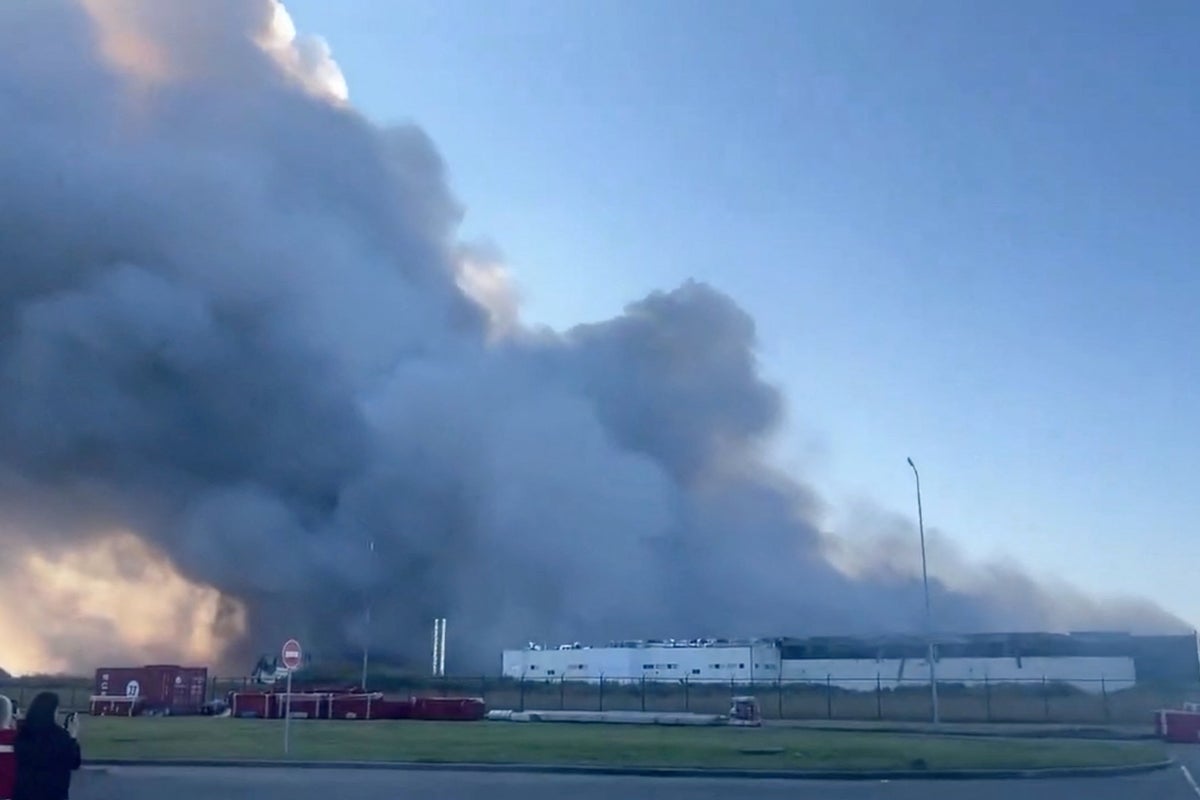
This comes as a missile attack killed two people and injured 16 in the city of Belgorod close to the Russian border with Ukraine, acting governor Alexander Shuvayev said.
Sunday's deaths followed Ukraine's hit on a commercial facility, which also set ablaze seven warehouses in the city, he added.
Meanwhile, CIA director John Ratcliffe is reported to have floated a trilateral meeting between Vladimir Putin, Volodymyr Zelensky, and Donald Trump during his mysterious visit to Moscow, according to two sources briefed on the matter cited by Axios.
Talks between Ukraine and Russia were paused in February when the US invaded Iran, and little progress has been made since.
Navy tracks Russian warships in English Channel during ‘intense’ operation
Russian warships have been tracked by the Navy through UK waters in an “intense” 72-hour operation.
A task group was shadowed by Type 45 destroyer HMS Duncan, Type 23 frigate HMS St Albans and patrol vessel HMS Severn as it made its way from the North Sea through the English Channel.
Russian destroyer Admiral Levchenko was watched escorting sanctioned cargo vessels General Skobelev and Sparta, with a Merlin helicopter extending the UK’s surveillance as the ships approached the Strait of Dover.
In response to the tracking, Russia deployed other military resources including the Neustrashimy frigate to guard the illegal shipment, UK officials said.
First Sea Lord General Sir Gwyn Jenkins said there was “no room for complacency” as shadow fleet vessels continue to pose “an unacceptable risk” to maritime security and the environment.
“Alongside our allies, this approach is forcing Moscow to divert Russian warships away from their core purpose. That is because Russia knows we stand ready to act again, should it be required,” he said.
Navy tracks Russian warships in UK waters for three days during ‘intense’ operation
CIA director proposed summit between Trump, Putin and Zelensky
The director of the CIA had proposed a meeting between the leaders of Russia, Ukraine, and the US when he visited Moscow, sources say.
During his secret meeting with Russian officials, CIA director John Ratcliffe had floated a summit with Vladimir Putin, Volodymyr Zelensky, and Donald Trump, Axios reported.
It comes after talks between Ukraine and Russia were paused in February, when the US invaded Iran.
The US has held talks with negotiators from both sides in recent months, but little progress has been made.
Kyrylo Budanov, Ukraine’s head of office, said this week that talks with Russia could resume in September.
Ratcliffe’s visit to Moscow on Tuesday, which was not announced in advance, has sparked much speculation.
President Trump played down the visit, saying it was “semi-routine”.
Nato sees no imminent threat of attack, official says
A Nato official has said that Russia is stepping up hybrid acts in Europe, but that at this time the alliance sees no imminent threat of attack.
"Even as the Russians are facing very substantial resistance from Ukraine, they are stepping up attacks on Ukraine as well as hybrid acts in Europe," the official said on Sunday.
"As always, Nato remains vigilant and alert to the variety of threats we face. At this time, we see no imminent threat of attack," the official said, adding: "We continue to stand with Ukraine. And Nato continues to work around the clock to keep our one billion people safe".
CIA Director John Ratcliffe flew to Russia on Tuesday to meet briefly with intelligence counterparts.
Two sources familiar with the matter told Reuters that Ratcliffe brought up the possibility of a Russian operation against a Nato member during that meeting, though it was unclear if that was the sole purpose of the trip.
On Saturday Poland’s prime minister Donald Tusk said that Nato must be prepared for various scenarios and that a provocation against an alliance member could not be ruled out.
The Kremlin had called the reports “scare-stories” earlier in the week.
Two killed in missile attack on Russia's Belgorod
A missile attack killed two people and injured 16 in the city of Belgorod close to the Russian border with Ukraine, acting governor Alexander Shuvayev said.
Sunday's deaths followed Ukraine's hit on a commercial facility, which also set ablaze seven warehouses in the city, he added.
Russian online retailer Ozon said on Telegram that a logistics hub and a sorting facility in Belgorod also came under attack, triggering a fire and injuring people.
It was not immediately clear whether Shuvayev and Ozon were referring to the same facilities.
Russia vows ‘massive strikes’ against Ukraine's energy sector
Russia’s defence ministry in Moscow said yesterday it is preparing "massive strikes” on Ukraine’s energy infrastructure.
It described the planned strikes as retaliation for Kyiv's drone campaign against Russian online retailers Wildberries and Ozon, as well as the country's oil and gas sector.
Kremlin spokesperson Dmitry Peskov said large-scale strikes against Ukraine's energy sector would be “an appropriate response” to what he called Ukraine’s “path of escalation” and targeting of Russia’s civilian economy.
Peskov told Russian state TV that Moscow has been launching “fairly systematic” strikes on what he called Kyiv's military and war-related infrastructure.
During the war’s previous winters, Russia systematically battered Ukraine’s power grid, depriving thousands of heat and light.
Ukrainian officials have repeatedly warned that the coming winter may prove to be the most challenging since the full-scale invasion began in February 2022.
Russia's deadliest attack on Ukraine this year killed 38, says Zelensky
The death toll from a Russian strike on a warehouse west of Kyiv, the war's deadliest attack this year, rose to 38 with four people still missing, Ukrainian president Volodymyr Zelensky said.
The Friday night strike on the warehouse, which Ukrainian officials said was storing ammunition, sparked massive explosions and fires that swept through dozens of nearby homes and buildings in the village of Myla.
Zelensky called the Myla attack “a terrible situation” and a consequence of “terrible negligence on the part of those who stored explosives right next to people.”
He said an investigation was underway into why the ammunition came to be kept there.
Nato's Arctic moves pose 'direct threat' to Russia, says foreign minister Lavrov
Russia sees Nato activity in the Arctic as a direct security threat, foreign minister Sergei Lavrov said in an article published this morning, as the alliance members boost their presence in the region in the wake of Russia's war on Ukraine.
In February, Nato launched a mission called Arctic Sentry to bolster its presence in the far north, underscoring the alliance's increased focus on the Arctic amid tensions with Russia and US.
But Russia has the largest military presence and the most extensive military infrastructure in the Arctic and in recent years China has started to increase its activity in the mineral-rich area, mostly in partnership with Moscow.
Moscow has earlier protested the Arctic Sentry mission and in the article, Lavrov, president Vladimir Putin's long standing foreign minister, said Russia sees Nato military exercises in the region as 'aggressive'.
“Such military activity in the Far North poses direct threats to Russia's security. The risks of incidents that could trigger an armed confrontation, with potentially catastrophic consequences, are increasing," he said in the article published by the Russian foreign ministry.
Russia, which has a naval fleet including nuclear-armed submarines in the Arctic, sees the region as its sphere of interest where it also develops a shipping route to connect with the Asian nations.
Ukraine defence chief calls for bringing forward part of EU loan to cover deficit
Ukraine wants to bring forward part of a European Union loan earmarked for next year to help cover a $27 billion budget deficit this year, defence minister Yevhenii Khmara said.
Speaking to reporters, he added that Kyiv's war plan must be clear to Ukraine's partners as well as across the military chain of command.
Khmara also said Ukraine has tested four potential interceptors to shoot down the jet-powered drones Russia is increasingly firing at Ukraine.
What is the real reason the CIA boss John Ratcliffe made a secret trip to Moscow?
Earlier this week, a C17A Globemaster III descended into Moscow’s Vnukovo airport. Although it was hopping in from Riga, Latvia, the plane had originated at Andrews Air Force Base, close to Washington DC. On board was John Ratcliffe, the director of the CIA. After being whisked into the Russian capital in a motorcade, a few hours later, Ratcliffe was up in the air again and on his way home.
Who Ratcliffe met was not clear. The visit had not been announced in advance in the US, while Kremlin spokesperson Dmitry Peskov claimed to have no knowledge or information about the arrival of a US Air Force plane.
Not surprisingly, there has been much speculation as to why the most senior figure in US intelligence had gone to Moscow in person. After all, if Ratcliffe had an important message to share or communicate, there were other, easier and safer ways to do so than spending hours in a plane travelling to Russia.
What is the real reason the CIA boss John Ratcliffe made a secret trip to Moscow?
Join our commenting forum
Join thought-provoking conversations, follow other Independent readers and see their replies
Comments