
Technology
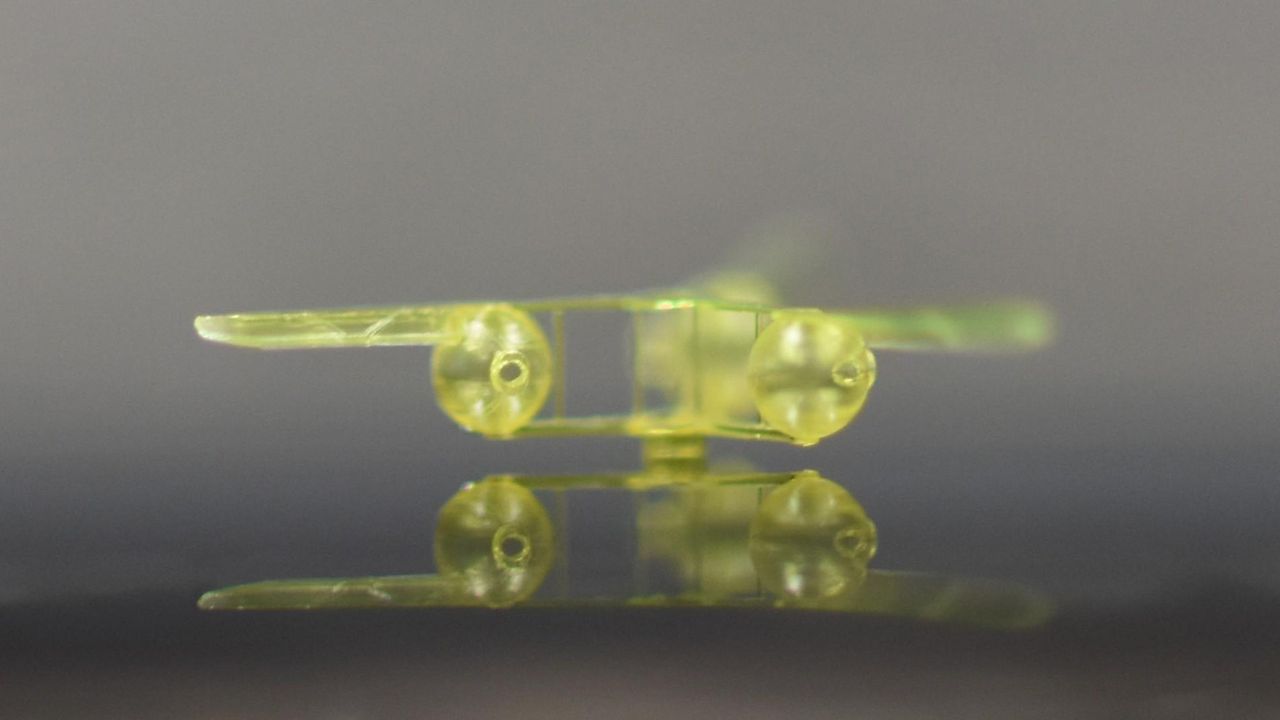
Scientists build tiny robots without motors that can fly using sound waves alone
Key Points
Scientists build tiny robots without motors that can fly using sound waves alone A century-old trick for tuning musical instruments has been repurposed to power robots that fly, float and steer themselves using nothing but sound waves. If you blow across the top of an empty bottle you'll hear a clear, steady note. Now, engineers have used that same concept to power tiny robots that move without a single motor on board.
Scientists build tiny robots without motors that can fly using sound waves alone
A century-old trick for tuning musical instruments has been repurposed to power robots that fly, float and steer themselves using nothing but sound waves.
If you blow across the top of an empty bottle you'll hear a clear, steady note. Now, engineers have used that same concept to power tiny robots that move without a single motor on board.
These new devices are powered entirely by sound. When the right frequency is aimed at them, hollow chambers built into their structure resonate and push out a jet of air, generating enough thrust to steer a small boat or lift a tiny flying robot off the ground.
The scientists described their innovation in a study published Aug. 12 in the journal Science Advances.
A 19th-century tuning trick, miniaturized
The effect behind it, known as Helmholtz resonance, was first studied in 1856 by the German physicist Hermann von Helmholtz, who was trying to invent a tool for tuning musical instruments. He noticed that when air trapped inside a cavity resonates, it also pushes out a faint jet of air.
"It isn’t very powerful when you do it with a musical instrument, because pressure is low," said study co-author Selman Sakar, an associate professor of mechanical engineering at the Swiss Federal Technology Institute of Lausanne (EPFL) in Switzerland. "But if you could crank up the pressure, all of a sudden that jet could become significant... in a way that the force can be harnessed for machinery," he told Live Science.
The team realized that shrinking Helmholtz's resonators down would push the frequency needed to activate them into the ultrasonic range — meaning it's too high-pitched for humans to hear and, crucially, easier to focus with precision. Larger versions generating the same force would need audible sound loud enough to be both annoying and potentially harmful, Sakar said.
Using a specialized 3D-printing technique called two-photon printing, the researchers built hollow structures based on Helmholtz's original equations and confirmed with lab tests and computer simulations that they generated thrust as predicted.
Get the world’s most fascinating discoveries delivered straight to your inbox.
Boats, rockets and tiny helicopters
The team built small boats measuring roughly 2 inches (5 centimeters) fitted with multiple resonators, each tuned to a different frequency and pointed in a different direction. By changing the pitch of a nearby speaker, the researchers could steer the boats left, right or straight ahead.
At a far smaller scale — some just 0.04 inches (1 millimeter) across — the team also built "microfliers" that generated lift two different ways: some pushed thrust downward like a rocket — but using air for the thrust — while others span tiny attached blades to fly like a helicopter, using sound waves to rotate the blades.
Related stories
- Meet Phantom Twist, a stealthy new drone that hides in plain sight by tricking your eyes
- Drones could achieve 'infinite flight' after engineers create laser-based wireless power system that charges them from the ground
- New 'microcomb' chip brings us closer to super accurate, fingertip-sized atomic clocks
The technology has an advantage over conventional means of power generation because it can be built at extremely small scales, Sakar said. Conventional motors have "a fundamental limit" on miniaturization because of the physical components like magnets, coils and shafts that a motor needs to work, he said. Because these resonators are just precisely shaped hollow cavities, there's no comparable limit on how small they could eventually build.
The researchers said in the study that the same principle could eventually be used to precisely rotate and manipulate small objects in midair without touching them, or to build soft, flexible surfaces that bend and change shape on command when they "hear" a particular frequency which can be used for biomedical applications like heart stents.
For now, the study is a foundation for the researchers to build on, Sakar said. "This paper, I think, is important in the sense that we put the design principles out," he said, adding that follow-up work could focus on more applied designs, control systems or navigation.
Hwang, J., Angéloz, Q., Murugan, A. S., Lissek, H., & Sakar, M. S. (2026). Acoustic resonators as wireless actuators in air for small-scale robots. Science Advances, 12(33), eaef5620. https://doi.org/10.1126/sciadv.aef5620
Olivia Maule is a science journalist whose beats include space, biotechnology and the environment. She holds a B.A. in biology and a B.S. in anthropology from the University of Florida and completed a master's degree in science communication at U.C. Santa Cruz. A 2025 AAAS Mass Media Fellow, she wrote stories and produced videos during a summer at El Nuevo Día, Puerto Rico's largest newspaper, and has written for Eos, Mongabay, Science magazine and Stanford Report. Olivia is a native Spanish and English speaker.
You must confirm your public display name before commenting
Please logout and then login again, you will then be prompted to enter your display name.