
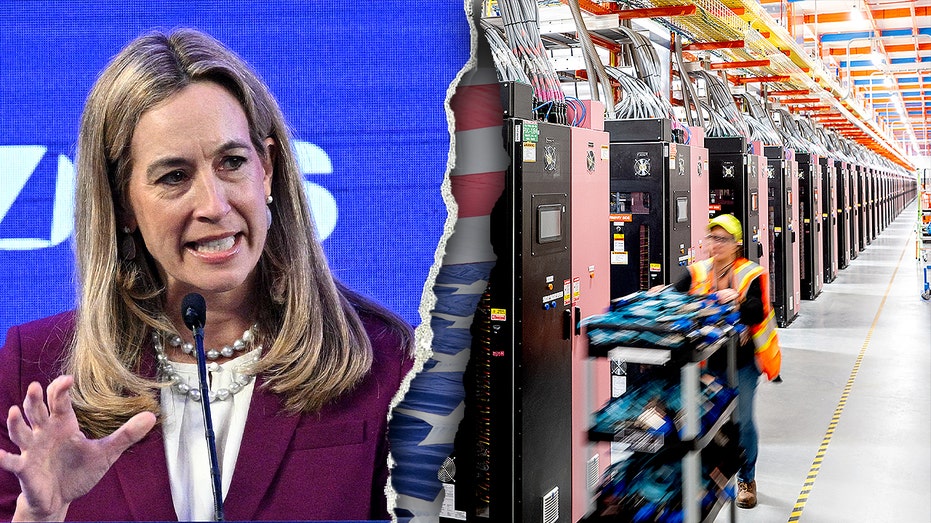
As the AI boom drives an unprecedented hunt for electricity, two states are taking sharply different approaches to assuage fears that Big Tech’s massive energy needs will raise Americans’ utility bills.
New Jersey Gov. Mikie Sherrill’s approach is to set statewide ground rules before large data centers connect to the grid. Under legislation she signed in July, the New Jersey Board of Public Utilities must create a separate rate structure for large data centers and ensure that the costs of new substations, transmission lines or other grid upgrades built mainly for the data center, are not added to other customers’ bills.
The law also requires large data centers to commit to paying for at least 85% of the electricity capacity they request for a 10-year period, in case they scale back their power use or close, and it directs regulators to encourage data centers to bring clean generation or energy storage online, use power more efficiently and reduce their electricity demand during emergencies.
CHINESE BOT FARM CAUGHT RED-HANDED TRYING TO INFLUENCE HEATED AI DATA CENTER DEBATE
Sherrill has paired those ratepayer protections with new disclosure and local-planning measures. A separate law she signed this week requires operators to report their energy and water use to the state twice a year. Sherrill’s administration says the reporting and new municipal guidance will give officials a clearer picture of data centers’ demands and help communities assess local impacts and negotiate with developers.
Meanwhile, Indiana is taking a different approach. Rather than impose statewide rules for every large data center, state regulators approved a deal negotiated by Indiana Michigan Power (I&M), the Fort Wayne-based utility serving customers in Indiana and Michigan, along with consumer advocates and major technology companies.
The deal grew out of a wave of huge planned projects in I&M’s service area. Amazon Web Services (AWS) announced an $11 billion data-center campus near New Carlisle, Indiana, in 2024, while Google announced a $2 billion project in Fort Wayne. I&M and state officials then had to determine who would cover the cost of the additional power and grid infrastructure needed to serve those projects.
FROM NETFLIX TO GPS: 10 WAYS THIS HIDDEN TECH INFRASTRUCTURE QUIETLY POWERS MODERN LIFE
According to I&M, the 2025 agreement requires new large customers, including data centers, to make long-term financial commitments to pay for the electric service they request, even if their future demand falls short of expectations. With those commitments in place, I&M says it can turn the new demand into a benefit for existing customers. The utility is now asking regulators to cut base rates by $59 million in 2027, saying revenue from large customers, including data centers, makes the reduction possible.
If the Indiana Utility Regulatory Commission approves the plan, I&M says an Indiana household using 1,000 kilowatt-hours of electricity a month would save about $100 a year. The utility is also proposing to freeze all rates on customers’ monthly bills for three years, with a decision expected in June 2027 and any savings beginning that summer.
Daniel Turner, executive director of the energy advocacy group Power The Future, said Indiana’s approach was better than New Jersey’s more prescriptive framework, but argued neither state had gone far enough to ensure the AI buildout adds power to the grid rather than simply consuming it.
DSA CANDIDATE PUSHES FEDERAL AI DATA CENTER MORATORIUM WITH MICHIGAN EARLY VOTING UNDERWAY
"Indiana’s approach is definitely the better of the two," Turner told Fox News Digital. "At least Indiana is saying, ‘Hey, we don’t know where this is going, but we’re not going to put in all of the guardrails yet to stop progress from happening. Let’s work together and figure out what the solution is.’"
Turner said he would make new power generation part of the deal from the start. New Jersey’s law encourages data centers to bring clean generation or energy storage online, but Turner said facilities should be built alongside the generation needed to run them and add capacity to the broader grid.
"Every data center should be built in conjunction with the necessary power-generating facility to power it and give back to the grid," he said.
Turner posited that data centers have become a political football, with officials too often choosing sweeping restrictions or open-ended delays instead of working with utilities, developers and local communities on plans that protect ratepayers while adding needed power.
KEVIN O'LEARY DETAILS MASSIVE UTAH AI DATA CENTER TO RIVAL CHINA'S TECH DOMINANCE
"The solutions to data centers are not complicated issues to solve," he said. "They just require political will."
The Trump administration has already sought to turn that argument into a national model. In March, the White House announced a Ratepayer Protection Pledge signed by major technology companies, including Amazon, Google, Meta, Microsoft, OpenAI, Oracle and xAI, which the administration says commits the companies to cover the cost of additional electricity generation needed for AI data centers rather than pass it along to families.
Turner noted the stakes of the data-center debate extend well beyond local utility bills, arguing that the United States cannot afford to fall behind China in the race to build and control artificial intelligence.
"When you tell Americans why we have to win the AI race, look at what China did with the Wuhan flu and how they tried to lie about that," Turner said. "Now imagine they can do that with every single piece of intellectual property on every platform in real time. That alone should scare the crap out of Americans."